A Court of Wings and Ruin Review

The Weight of Crowns and Consequence: A Critical Look at A Court of Wings and Ruin

The landscape of modern fantasy is replete with sagas of power and peril, yet few authors manage to capture the zeitgeist quite like Sarah J. Maas. With A Court of Wings and Ruin, the third installment in her much-lauded A Court of Thorns and Roses series, Maas plunges her readers deeper into a world teetering on the brink, demanding not just emotional investment, but a considered reflection on the nature of leadership and the price of peace.

The Unveiling of a War-Torn Tapestry

From its very genesis, A Court of Wings and Ruin announces itself with an undeniable gravitas. We are no longer observing a personal quest for survival or a budding romance confined to courtly intrigue; instead, Maas meticulously expands her narrative canvas to encompass an entire realm poised for cataclysm. The publisher’s summary accurately teases the overarching conflict: a looming war that threatens to consume Prythian. However, to merely focus on the impending battle is to miss the intricate groundwork laid by Maas, a testament to her evolving command of epic storytelling.

Feyre, having returned to the treacherous Spring Court, navigates a labyrinth of deceit. This isn’t the wide-eyed human girl we first met, nor even the burgeoning High Lady finding her feet. Here, we witness her transformation into a strategist, a spy, a player in a game where the stakes are existential. Her internal conflict — balancing loyalty, love, and the imperative to protect her people — forms the pulsating heart of the narrative. Maas challenges the traditional hero’s journey, positing that true leadership often demands a descent into moral ambiguities, a willingness to wield shadows for the sake of light. We are compelled to question the boundaries of heroism when survival itself demands acts of calculated betrayal.

Forging Alliances in the Crucible of Conflict

One of the novel’s most compelling strengths lies in its masterful depiction of geopolitical maneuvering. As the war approaches, Feyre and her allies must seek out unexpected partnerships, compelling a grand assembly of High Lords and their respective courts. This expansion of the world, beyond the intimate confines of Velaris or the imposing walls of the Night Court, is where Maas truly flexes her world-building muscles. Each new court introduced, each ancient grievance resurrected, contributes to a rich, layered tapestry that feels both fantastical and disturbingly real in its echoes of historical conflicts.

We observe the delicate dance of diplomacy, the clash of powerful personalities, and the painful sacrifices required to unite disparate factions against a common, existential threat. Maas excels at illustrating the human—or rather, the Fae—cost of war, not just in terms of physical casualties but in the emotional toll exacted upon its leaders and participants. The weight of command, the burden of decision-making under duress, and the inevitable compromises required for collective survival are explored with a nuance that elevates the narrative beyond mere genre tropes. It becomes a study in leadership, courage, and the fragile nature of unity in the face of overwhelming odds.

A Symphony of Swords and Souls

Ultimately, A Court of Wings and Ruin culminates in a sweeping, visceral confrontation that justifies the extensive build-up. The scale of the conflict is immense, yet Maas never loses sight of the individual stories, the personal stakes that anchor the grand spectacle. The prose, while maintaining its characteristic accessibility, rises to the occasion with vivid descriptions of battle, moments of breathtaking heroism, and heartbreaking loss. The emotional impact is profound, ensuring that the reader is not merely an observer but an emotionally invested participant in the fate of Prythian.

While some might argue for occasional indulgences in narrative pacing or a reliance on certain romantic tropes, we find that these are largely overshadowed by the sheer ambition and emotional resonance of the story. Maas has crafted a novel that, despite its fantastical setting, speaks to universal truths about love, loyalty, and the enduring human—or Fae—spirit in the face of existential threats.

A Concluding Affirmation of Resilience

A Court of Wings and Ruin stands as a formidable entry in a beloved series, a testament to Sarah J. Maas‘s ability to weave intricate plots with deeply felt character arcs. It is a work for those who crave sweeping, high-stakes fantasy, replete with political intrigue, complex relationships, and the raw, unvarnished realities of war.

This is a quintessential read for devotees of epic fantasy, particularly those who appreciate a narrative where character development is inextricably linked to grand, world-altering events. It invites us to ponder: what depths must we plumb, what facades must we adopt, when the very survival of our world hangs by a thread? Maas leaves us not with easy answers, but with a vivid, compelling journey into the heart of conflict and the unwavering resilience required to forge a new dawn.
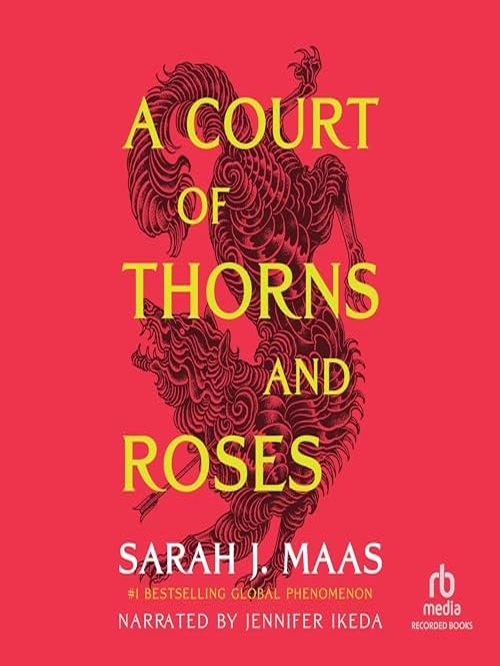
A Court of Thorns and Roses Review

When the Hunter Becomes the Hunted: Sarah J. Maas and the Alchemy of Desire

There is a moment in every great fairy tale retelling when the familiar architecture of the story you thought you knew collapses — and something wilder, more dangerous, more honest rises from the wreckage. A Court of Thorns and Roses is that collapse. It is Sarah J. Maas detonating the polite foundations of “Beauty and the Beast” and rebuilding them with blood, thorns, and a heroine whose hunger — for survival, for agency, for love — feels less like fantasy and more like a mirror held uncomfortably close.

I’ll confess: I approached this book with the skepticism one reserves for any novel that carries the weight of a global phenomenon. Bestseller lists are not, after all, arbiters of literary merit. And yet, by the final act, I found myself confronting something I hadn’t expected — not just a romance wrapped in faerie glamour, but a surprisingly muscular meditation on captivity, transformation, and the terrible cost of selflessness.


A Huntress Stripped of Her Arrows

Feyre — nineteen, starving, holding her fractured family together with nothing but a bow and sheer, grinding will — is one of the more compelling entry points into a fantasy series I’ve encountered in recent years. Maas does something shrewd here: she doesn’t introduce us to a Chosen One bathed in prophecy. She gives us a girl who kills a wolf because her sisters need to eat. The moral calculus is immediate, unglamorous, and deeply human.

When a faerie lord named Tamlin drags her across the border into the immortal lands of Prythian as retribution, the novel’s central tension snaps into place — not as a kidnapping romance (though it flirts dangerously with that territory), but as a study in displacement. Feyre is a creature of pragmatism thrust into a world that operates on ancient rules she cannot read. Her illiteracy, both literal and cultural, becomes a quiet but devastating motif. She is powerful precisely because she is unfinished.

The Architecture of Seduction — and Its Limits

Let’s address the romance directly, because it is both the engine and the Achilles’ heel of this novel. The slow-burn tension between Feyre and Tamlin is, in its early stages, genuinely well-constructed. Maas understands pacing — the lingering glance, the accidental touch, the conversation that reveals one layer while concealing three others. There is a physicality to their attraction that feels earned rather than imposed.

And yet, I found myself more intellectually engaged by what surrounds the romance than by the romance itself. Tamlin, for all his brooding magnetism, remains somewhat opaque — a figure defined more by his curse than by his interiority. He is, in this first volume, more symbol than person: the beast who is not always a beast, the protector who cannot protect himself. Maas would go on to interrogate this archetype with devastating precision in later installments, but here, Tamlin functions largely as a catalyst for Feyre’s awakening rather than as a fully autonomous consciousness.

Where Maas truly excels is in the visceral texture of desire itself — not merely romantic desire, but Feyre’s desire for beauty, for paint and color, for a life that extends beyond survival. The scenes in which she begins to create art in Tamlin’s manor carry a quiet, aching power that surpasses many of the more overtly dramatic set pieces. This is the real love story: a woman discovering that she is allowed to want things that are not strictly necessary.

The Shadow Beneath the Glamour

The novel’s final act pivots sharply from romance into something closer to psychological horror, and it is here that Maas reveals the full scope of her ambition. The ancient evil lurking beneath Prythian — embodied by the cruel and calculating Amarantha — transforms the narrative from a love story into a trial of endurance. Feyre is stripped of every advantage, every ally, every comfort. What remains is will.

The three trials Under the Mountain are brutal, deliberately so. They force both Feyre and the reader to confront an uncomfortable question that pulses beneath the entire novel: What are you willing to destroy — including parts of yourself — to save someone you love? Maas does not offer a clean answer. The victory, when it comes, is stained. It costs something irreversible. And that refusal to sanitize the consequences elevates the book beyond the conventions of its genre.

I would argue that Amarantha, despite her relatively limited page time, represents one of Maas’s sharpest creations — a villain whose cruelty is not arbitrary but rooted in a twisted mirror-logic of the same possessive love the novel ostensibly celebrates. She is what desire looks like when it curdles into domination. The parallels between her obsession with Tamlin and Feyre’s devotion to him are, I suspect, entirely intentional and deeply unsettling.

The Prose Question

A word on craft. Maas’s prose is not what one would call restrained. It is lush, sometimes excessively so — adjectives bloom like the roses of the title, and there are passages where the emotional register tips from intensity into melodrama. For readers calibrated to the austere minimalism of literary fiction, this will grate.

But I think that criticism, while valid on a sentence level, misses the larger point. Maas writes in the tradition of Gothic romance — Brontë, du Maurier, Rice — where excess is the aesthetic, where the emotional landscape is meant to overwhelm. The prose mirrors Feyre’s own sensory overload as she moves from a grey, starving world into one saturated with color, magic, and danger. It is maximalist by design, and within that design, it largely succeeds.

Who Should Walk Through This Door

A Court of Thorns and Roses is not a perfect novel. Its pacing sags slightly in the middle act, Tamlin’s characterization demands patience that only subsequent books will reward, and there are moments where the worldbuilding prioritizes atmosphere over internal logic.

But it is a potent one. It is a book that understands, on a structural and emotional level, that the most interesting fairy tales are the ones that refuse to let their heroines remain passive. Feyre does not wait to be rescued. She paints, she hunts, she bleeds, she solves riddles in the dark, and she makes choices that leave permanent marks on her soul.

This is a book for readers who crave fantasy that takes female desire seriously — not as a subplot, but as the gravitational center of the narrative. It is for those who loved the dark enchantment of Uprooted by Naomi Novik or the fierce romanticism of The Cruel Prince by Holly Black, but who want something rawer, more urgent, less interested in politeness. It is the opening movement of a series that will grow considerably more complex, more morally ambiguous, and more rewarding.

And perhaps the question it leaves us with is this: When we strip away the faerie glamour, the immortal courts, the curses and the roses — what remains is a nineteen-year-old girl who was never taught to read, standing in a room full of paint, realizing for the first time that survival and living are not the same thing.

That distinction, I think, is worth every page.

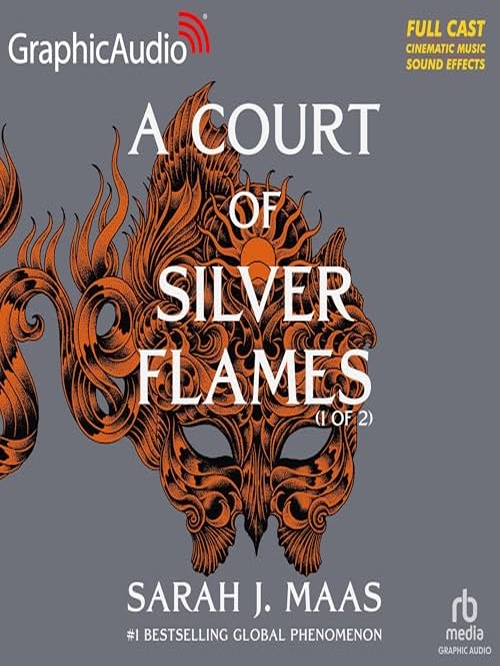
A Court of Silver Flames (Part 1 of 2) (Dramatized Adaptation) Review

Echoes of Resilience: Dissecting the Silver Flames of Nesta’s Odyssey

The sprawling tapestries of Sarah J. Maas‘s A Court of Thorns and Roses series have long captivated a global readership, drawing us into a realm where magic intertwines with raw emotion. Yet, it is with A Court of Silver Flames (Part 1 of 2) (Dramatized Adaptation) that we are invited to linger on a character often relegated to the periphery of our empathy: Nesta Archeron. This Graphic Audio LLC production, an immersive dramatized adaptation, casts a compelling spotlight on the ‘prickly’ sister, inviting us to delve into the complex, often uncomfortable, terrain of her psyche.

The Unburdening of a Broken Spirit

From the outset, Nesta has been an enigma – a proud, tempestuous figure whose sharp edges have kept both allies and adversaries at bay. Here, however, we witness a deliberate, painstaking excavation of her character. The narrative bravely confronts the aftermath of trauma, specifically the indelible scars left by the war with Hybern and her unwilling transformation into High Fae. We observe a woman grappling with identity, haunted by loss, and fiercely resistant to the healing hand of those who surround her. This is not a journey of instant catharsis, but a laborious ascent from the depths of despair, characterized by an almost visceral struggle against self-destruction. Maas‘s writing, brought to life by an expansive ensemble of narrators, paints a portrait of resilience born from profound brokenness, challenging our preconceived notions of strength.

The Crucible of Passion: Cassian’s Enduring Light

Central to Nesta’s arduous path to acceptance is her tumultuous relationship with Cassian, the battle-scarred warrior whose steadfast presence paradoxically both infuriates and ignites her. Their dynamic is the very heart of this installment, a tempestuous dance between raw vulnerability and scorching passion. What is particularly striking is how Cassian, despite his own burdens, serves as an unwavering anchor, his unwavering patience a stark contrast to Nesta’s volatility. The dramatized adaptation truly shines in these exchanges; the nuanced delivery from Colleen Delany (as Nesta) and Anthony Palmini (as Cassian), alongside the broader cast including Natalie Van Sistine and Jon Vertullo, elevates their exchanges beyond mere dialogue. We are not just told of their undeniable fire; we feel it, a palpable force that pushes both characters towards self-reckoning. It is a testament to the power of shared struggle, suggesting that true healing often begins when one finds a mirror, however challenging, in another’s gaze.

Whispers of War and the Echoes of a Larger World

While the emotional core of A Court of Silver Flames resides within Nesta’s personal evolution, the overarching geopolitical landscape of the Fantasy realm is not forgotten. The ominous alliance forged by the treacherous human queens serves as a persistent undercurrent of external peril, threatening the fragile peace established after the previous conflicts. This external threat subtly yet effectively underscores the internal battles waged by Nesta and Cassian. Their individual journeys are not isolated; rather, they are intrinsically linked to the fate of their world. The stakes, therefore, are dual: personal redemption and collective survival, a thematic resonance that enriches the narrative beyond mere character study.

The Theatricality of Sound: A Masterclass in Auditory Immersion

To engage with A Court of Silver Flames in this dramatized adaptation format is to experience storytelling elevated. Graphic Audio LLC has truly crafted a theatrical event for the ears. The collective efforts of over two dozen narrators, including Amanda Forstrom, Nora Achrati, Matthew Bassett, and Renee Dorian, create a tapestry of voices that lends distinct personality to every character, however minor. Beyond the vocal performances, the judicious application of sound effects and musical scoring immerses the listener completely, transforming mundane descriptions into vivid sensory experiences. This is not simply an audiobook; it is a full-scale audio play, allowing the listener to inhabit the vibrant, perilous world of Prythian in a uniquely intimate way.

A Journey of Fire and Forgiveness

Ultimately, A Court of Silver Flames (Part 1 of 2) is a bold exploration of self-acceptance and the arduous road to recovery. It asks us to look beyond superficial judgments and consider the profound complexities that shape even the most challenging personalities. I find myself thoroughly impressed by Maas‘s decision to dedicate such extensive narrative real estate to Nesta’s journey, validating the often-unseen struggles of those who appear ‘difficult.’ This is a testament to the idea that healing is rarely linear, and sometimes, the most profound transformations emerge from the fiercest fires.

This adaptation is an indispensable experience for devotees of the A Court of Thorns and Roses series, particularly those who have yearned for a deeper understanding of Nesta. It is also highly recommended for listeners who appreciate character-driven Fantasy narratives steeped in emotional complexity and enjoy the rich, immersive quality of full-cast audio dramas. As we await the concluding part, one cannot help but reflect on the courage it takes to face one’s own shadows, and the quiet power of finding solace in unexpected embraces.

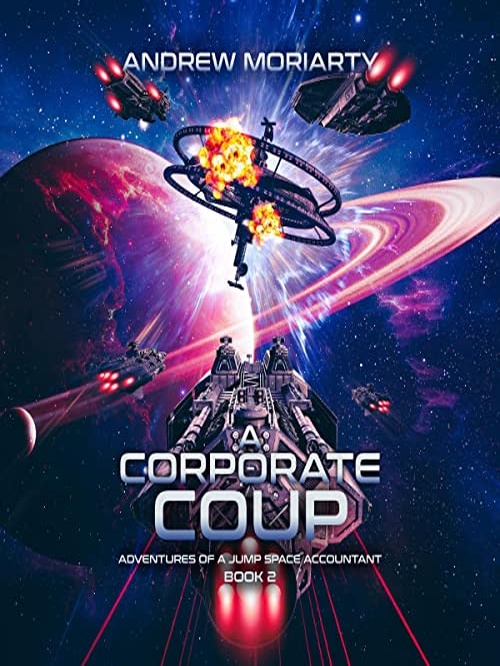
A Corporate Coup Review

When the Spreadsheets Hit the Fan: Strategy as Spectacle in A Corporate Coup

What happens when you hand the fate of a collapsing interstellar order not to a soldier, not to a diplomat, but to an accountant? Andrew Moriarty has been exploring this delicious premise across his Adventures of a Jump Space Accountant series, and by book four, he’s refined the answer into something genuinely compelling: you get a protagonist who survives not by pulling triggers faster, but by reading the room—and the balance sheet—better than anyone else in it.

A Corporate Coup opens in the thick of chaos. Shootings in the vacuum of space, violence spilling through streets, alliances fracturing like cheap hull plating under pressure. And at the center of it all stands Jake, a man whose primary instinct is not to fight or flee, but to calculate. It’s a narrative posture that shouldn’t work in a genre so often drunk on spectacle. And yet it does—precisely because Moriarty understands something most space opera authors overlook: revolutions are won in logistics.

The Geometry of Loyalty

The thematic engine driving this installment is deceptively simple: whose side are you on? But Moriarty refuses to let that question resolve into comfortable binaries. Jake is surrounded by figures whose motivations resist easy categorization. Dashi, the enigmatic strategist who “always knows what he’s doing,” sends Jake on what appears to be a fool’s errand—hunting a lost ship while civilization burns. Jose is inexplicably purchasing welding equipment in the middle of an insurrection. And Nadine, whose sudden friendliness registers as more alarming than any firefight, volunteers to help with an eagerness that sets off every internal alarm Jake possesses.

What Moriarty constructs here is a kind of chess game narrated from the perspective of a pawn who suspects—correctly—that he’s being played, but can’t quite see the board. The pleasure lies not in dramatic revelations but in the slow, grinding process of figuring it out. Each character operates according to their own internal logic, and part of the intellectual satisfaction of the novel is watching those logics collide, overlap, and occasionally combust.

Strategy Over Spectacle

I want to dwell on what the book’s own description advertises: “strategy over tactics, and thought before action.” This is not mere marketing copy—it’s a genuine statement of literary intent. Moriarty writes action sequences that matter not because of their kinetic intensity but because of their consequences. A welding torch purchased in chapter three becomes a plot-critical object by chapter twelve. A detour to find a missing vessel isn’t a digression; it’s the spine of the entire narrative, disguised as busywork.

This is world-building through operational detail, and it demands a specific kind of reader patience. The payoffs are real, but they’re earned through accumulated understanding rather than sudden spectacle. William Turbett’s narration in the audiobook format—spanning just over ten hours—reportedly serves this pacing well, lending conversational warmth to passages that might otherwise read as dry exposition on paper.

The Accountant as Unlikely Everyman

There’s a quietly subversive quality to the entire series that crystallizes in this fourth volume. Science fiction loves its chosen ones, its military geniuses, its rogue captains with hearts of gold. Jake is none of these things. He’s a man whose core competency is noticing when the numbers don’t add up—and in a revolution built on lies, misdirection, and competing propaganda, that turns out to be the most dangerous skill in the galaxy.

Moriarty isn’t writing literary fiction dressed in a spacesuit; let’s be clear about that. The prose is functional, occasionally workmanlike, and the characterization operates more through action and dialogue than interior depth. But within the constraints of its genre, A Corporate Coup achieves something admirable: it makes thinking exciting. It trusts its audience to follow threads rather than explosions.

The Final Ledger

This is not the entry point for newcomers—the relationships between Jake, Dashi, Jose, Nadine, and the Admiral carry accumulated weight from three prior volumes that Moriarty wisely declines to over-explain. But for readers already invested in this series, A Corporate Coup represents a confident escalation of stakes and complexity.

Perfect for: readers who devour The Expanse for its politics rather than its battles, fans of Lois McMaster Bujold’s Miles Vorkosigan novels, and anyone who’s ever suspected that the most powerful person in any organization isn’t the one with the biggest weapon—it’s the one who controls the spreadsheet.

Here’s the question Moriarty leaves simmering long after the final chapter: in a universe where everyone claims to be fighting for the right side, is the most moral act not choosing a side at all—but simply refusing to let the books be cooked?

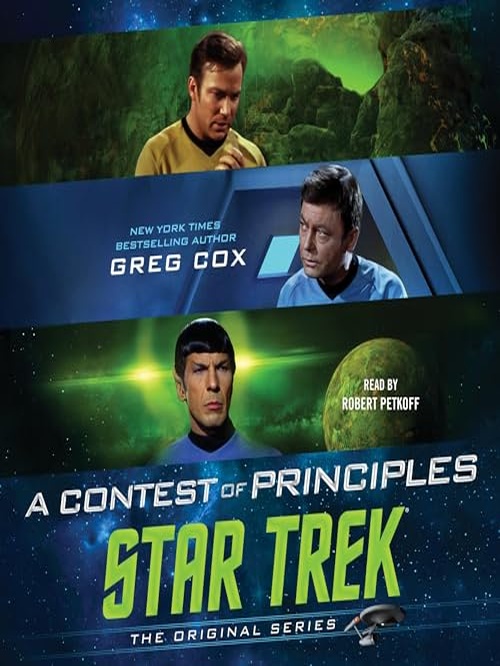
A Contest of Principles Review

When Democracy Meets the Final Frontier: Greg Cox’s A Contest of Principles

There is a particular audacity in taking a franchise as beloved and well-worn as Star Trek and using it to interrogate something as messy, as fundamentally human, as democratic transition. Greg Cox does precisely this in A Contest of Principles, and the result is a novel that feels less like licensed fiction and more like a political thriller dressed in Starfleet uniforms — one that resonates with an almost uncomfortable prescience in our own era of contested elections and institutional fragility.

The premise is deceptively simple: the crew of the Enterprise is sent to observe the first free elections on the planet Vok, a world emerging from the shadow of military authoritarianism. But Cox understands — as any student of history does — that the birth of democracy is never simple. It is violent, conspiratorial, and riddled with the kind of moral ambiguity that makes neutrality feel less like a virtue and more like a form of complicity.

The Impossible Weight of Neutrality

What struck me most forcefully about this novel is how deftly Cox transforms Kirk’s mandate of impartiality into a genuine dramatic engine. We are accustomed to seeing Kirk as a man of action, a captain who bends rules and defies odds with a swagger that borders on the mythological. Here, he is leashed — bound by Starfleet protocol to observe without intervening, even as scandal, conspiracy, and assassination plots coil around Vok’s fragile democratic experiment like serpents.

This is not merely a plot constraint; it is a philosophical provocation. Cox forces us to sit with an uncomfortable question: What is the moral cost of watching injustice unfold in the name of non-interference? The Prime Directive has always been Star Trek‘s most intellectually fertile ground, and Cox tills it with genuine care. Kirk’s struggle is not one of action but of conscience, and that restraint — paradoxically — makes this one of the more compelling portraits of the character I’ve encountered in the expanded literary universe.

A Triptych of Worlds, A Triptych of Crises

The novel’s structural ambition deserves attention. Cox doesn’t settle for a single narrative thread. Instead, he weaves three interconnected planetary storylines — Vok, Braco, and Ozalor — each with its own political ecosystem, its own moral texture.

McCoy’s abduction to Ozalor is where the novel finds its most visceral emotional register. Torn from a mercy mission and pressed into service as a physician for a ruling family’s mysterious ailment, McCoy embodies the oldest tension in medical ethics: the Hippocratic oath versus personal survival. Cox writes McCoy with the gruff tenderness that DeForest Kelley immortalized on screen — a man who cannot stop himself from healing, even when healing serves his captors’ interests. The palace intrigues surrounding him are baroque and satisfying, recalling the best tradition of courtly political fiction transplanted to an alien setting.

Meanwhile, Spock and Chapel’s search for the missing doctor provides a complementary register — methodical, driven by logic yet underscored by genuine concern. Cox handles the Spock-Chapel dynamic with a subtlety that respects their complicated history without descending into melodrama. Their mission threads the needle between rescue operation and detective story, and it works precisely because Cox never lets the urgency flag.

The interplay between these three storylines generates a cumulative effect that elevates the novel beyond episodic adventure. By the final act, when the fates of all three worlds converge, we understand that Cox has been constructing an argument: that power, whether democratic or monarchical, is always contested, always fragile, always susceptible to the ambitions of those who would exploit transition for personal gain.

Greg Cox and the Art of the Tie-In Novel

It is worth contextualizing A Contest of Principles within Greg Cox’s broader body of work. A New York Times bestselling author with an extensive catalogue of Star Trek novels, Cox has long demonstrated a rare facility for honoring the spirit of the source material while pushing it into genuinely literary territory. He understands that the best Star Trek fiction doesn’t merely recreate television episodes in prose form — it exploits the novel’s capacity for interiority, for political complexity, for the kind of slow-burn thematic development that a forty-five-minute episode cannot sustain.

This novel represents Cox at his most structurally ambitious. The triple-helix plot architecture is demanding, and there are moments — particularly in the middle third — where the constant shifting between worlds risks diluting momentum. Yet Cox’s command of pacing, honed over decades of craft, largely prevents this. Each transition arrives at a point of tension, each return to a storyline picks up with renewed energy. It is not flawless — some of the secondary political figures on Vok blur together, their motivations occasionally sketched rather than fully rendered — but the overall effect is one of impressive narrative control.

The Verdict: A Serious Novel in Genre Clothing

I find myself returning to a fundamental conviction about franchise fiction: it is only as good as the questions it dares to ask. A Contest of Principles asks whether democracy can be gifted from the outside or must be fought for from within. It asks what a healer owes to those who imprison him. It asks whether logic and emotion, embodied in Spock and Chapel, can coexist productively in the face of uncertainty.

These are not small questions. And Cox does not offer small answers.

Robert Petkoff’s narration in the audiobook edition — spanning over thirteen hours — deserves particular commendation. His vocal differentiation between the core cast is skilled without being caricature, and his pacing mirrors the novel’s own rhythmic intelligence.

This is a novel for those who believe Star Trek has always been political fiction masquerading as space opera — and who want that political dimension explored with genuine intellectual rigor rather than nostalgic sentiment. It is for readers who appreciate multi-threaded narratives that reward patience. And it is, ultimately, for anyone who has ever watched an election — on this world or any other — and wondered whether the machinery of democracy can survive the people who claim to serve it.

So I’ll leave you with this: In a universe of phasers, warp drives, and alien civilizations, why does the simple act of casting a vote remain the most dangerous thing a society can do?

A Conjuring of Light Review

Empire Fall: Schwab Conclude Magic Arc

Paradigmatic Shift Begin

Equilibrium break. Magic demand blood. A Conjuring of Light face void. Genre require high stakes. I analyze text. Mind engage nuanced perspective.

Narrative Arc Close

V. E. Schwab end trilogy. Author write heavy truth.
Characters bleed. Magic exact cost.
Worlds crash. Intellectual rigor show.
Foes return. Past haunt present.
Prose cut deep. Visceral impact hit hard.
Macmillan Audio publish saga. Kate Reading and Michael Kramer narrate text. Voices elevate words.

Final Judgment

I judge book worthy. Conclusion satisfy. Schwab master craft.
Target audience: Science Fiction & Fantasy fans. Thinkers. Readers seeking grim Fantasy.
Reader reflect. Power demand cost. Buy book. Read text.

A Clash of Kings Review

The Unfolding Tapestry of Kingship and Chaos: A Deep Dive into A Clash of Kings

In the annals of fantasy literature, few sagas have etched themselves into the collective consciousness with the indelible force of A Song of Ice and Fire. Following the seismic shifts of its predecessor, A Clash of Kings by George R.R. Martin does not merely continue the narrative; it elevates the foundational tremors into a full-blown seismic event, reshaping the very landscape of Westeros and, indeed, our expectations of the genre itself. We are plunged headlong into a world where the precarious balance of power has irrevocably shattered, and the stakes for every soul, from peasant to king, have become impossibly high.

Navigating the Charybdis of Crown and Consequence

A Clash of Kings distinguishes itself not merely through its expansive scope but through its unflinching examination of the moral calculus demanded by leadership amidst existential threat. Here, Martin refines his intricate narrative architecture, deftly weaving together disparate threads that illuminate the multifaceted nature of governance and ambition. The titular clash is not solely between armies, but between competing ideologies of rule, each championed by flawed individuals convinced of their own divine right or pragmatic necessity. We witness the brutal pragmatism of Stannis Baratheon, the unsettling messianic fervor surrounding Daenerys Targaryen, the cunning manipulations of the Lannisters, and the tragic heroism of the Stark children, each narrative strand contributing to a tapestry of bewildering complexity. This is not a tale of clear-cut heroes and villains, but rather a profound meditation on the corrosive nature of power and the terrifying burden of sovereignty.

Martin’s genius lies in his refusal to simplify. The strategic brilliance of Tyrion Lannister, for instance, is presented alongside his personal vulnerabilities and the societal prejudices he faces, making him a figure of compelling paradox. Similarly, the burgeoning sense of self in Arya Stark, forced into a harsh education in survival and subterfuge, transcends typical character arcs to explore the psychological toll of trauma and adaptation. These aren’t just characters; they are studies in human resilience and depravity, their choices rippling through the land with devastating consequence. The novel forces us to confront uncomfortable truths about justice, loyalty, and the seductive allure of absolute power, often leaving us to ponder if any victory can ever truly be clean in such a morally compromised world.

Furthermore, the expansion of the known world — from the brutal, ancient lands beyond the Wall, where Martin delves deeper into the chilling mythos of the Others, to the exotic, mercantile city of Qarth — serves not just as exotic scenery but as crucial context for the global implications of Westeros’s internal strife. The growing supernatural elements are seamlessly integrated, reminding us that the human squabbles, however grand, are but one facet of a larger, more ancient struggle for the very fate of the world. This contextualization enriches the thematic depth, adding layers of cosmic dread to the all-too-human political machinations.

The Weight of a World in Turmoil

To immerse oneself in A Clash of Kings is to undertake a journey of intellectual and emotional rigour. It is a work that demands patience and rewards scrutiny, unraveling its layers like a historical document rather than a simple fantasy novel. The prose, while not overtly florid, possesses a vivid, almost painterly quality, particularly in its descriptions of battle, landscape, and the inner turmoil of its sprawling cast. Martin uses language with precision, crafting scenes that resonate with visceral impact and profound psychological insight. We are not merely observers but rather embedded within the shifting allegiances and perilous campaigns, feeling the bite of winter and the heat of ambition.

This is a book for the discerning reader who appreciates a narrative that eschews easy answers and embraces the sprawling, often contradictory nature of human experience. It is for those who find intellectual pleasure in dissecting political intrigue, exploring the nuances of character development, and contemplating the broader philosophical questions embedded within a richly imagined secondary world. If your reading tastes lean towards the intricate tapestries of historical fiction, the moral quandaries of philosophical novels, or the epic scope of classic literature, then A Clash of Kings offers a rewarding, albeit challenging, engagement.

Ultimately, A Clash of Kings is far more than just the second act in a fantasy saga; it is a masterclass in world-building and character-driven storytelling, cementing George R.R. Martin‘s place as a modern literary titan. It invites us not just to read, but to ponder the true cost of ambition, the fragility of order, and what, if anything, remains sacred when a world plunges into chaos. What, we are compelled to ask, defines a king in an age where all crowns are forged in blood and betrayal?

A Clash of Fates Review

When Worlds End, What Remains? A Reckoning with A Clash of Fates

There is a peculiar gravity to final chapters — not just the last pages of a book, but the concluding movement of an entire saga. We arrive carrying the accumulated weight of every alliance forged, every betrayal endured, every world threatened across thousands of pages. Philip C. Quaintrell understands this burden implicitly, and in A Clash of Fates, the capstone of The Echoes Saga, he does something rarer than most fantasy authors dare: he earns his ending.

The Architecture of Consequence

What separates Quaintrell’s work from the crowded field of epic Fantasy is his unrelenting fidelity to consequence. Other saga-closers often buckle under the structural pressure of resolving too many threads, resorting to deus ex machina resolutions or, worse, conveniently trimmed character arcs. A Clash of Fates refuses that easy exit. Every narrative strand introduced across the preceding volumes carries genuine weight here — and Quaintrell pulls them taut rather than cutting them loose.

The result is a kind of narrative accountability that feels almost unfashionable in contemporary epic fantasy. Characters do not merely survive; they are marked by survival. The philosophical underpinning at work here is essentially Greek in its sensibility — that fate is not a destination but a reckoning, and the collision promised in the title is less about armies than it is about the moral debts accumulated by those who dared to shape the world.

Echoes of Everything That Came Before

Quaintrell demonstrates, with considerable craft, that a saga’s final installment is structurally analogous to the last movement of a symphony. The themes introduced in early volumes — identity, sacrifice, the corrupting seductiveness of power — do not resolve so much as they resolve into one another, creating a thematic density that rewards readers who have committed to the full journey.

There is a particular kind of satisfaction, almost archaeological in nature, in watching a writer excavate the implications of his own world-building. The “echoes” of the series title reveal themselves here not as metaphor but as mechanism: the past is not backdrop but active agent. This is sophisticated genre fiction operating at the level of its best ambitions.

Steven Brand‘s narration for Podium Audio deserves specific mention. Brand has long been the vocal architecture through which this saga breathes, and his performance in this installment carries a palpable earned gravity — the weariness in his voice when rendering certain characters feels less like performance than testimony.

Where the Seams Show

Intellectual honesty compels acknowledgment of the work’s friction points. At roughly three hours of runtime for this volume, the pacing in the middle act occasionally strains — certain convergences feel telegraphed a beat too early, robbing key confrontations of their full visceral impact. And while Quaintrell’s prose is reliably serviceable, it rarely achieves the lyrical elevation that might have pushed A Clash of Fates from very good to genuinely great literature. The bones of something transcendent are present; the marrow, occasionally, is not.

These are the critiques of a reader who cares, however. The machinery of the plot operates with impressive precision, and Quaintrell’s genuine affection for his characters — his refusal to treat them as mere instruments of plot — is evident on virtually every page.

The Verdict of an Ending

A Clash of Fates lands where it must: with the quiet devastation of an ending that respects both its world and its readers. The 4.8+ community rating is not, in this case, merely the enthusiasm of a dedicated fanbase — it reflects a saga that delivered on its promises with uncommon integrity.

This is, emphatically, not an entry point. Do not begin here. But for those who have walked the length of The Echoes Saga, this conclusion offers what so few saga-closers genuinely provide: the sense that the journey warranted exactly this destination, and no other.

For readers who hunger for epic Fantasy that treats consequence as sacred, who find moral complexity more compelling than moral simplicity, and who are willing to invest the emotional capital that long-form fantasy demands — Quaintrell’s saga, concluded here, is essential reading.

The final question A Clash of Fates leaves us with is perhaps the most honest one any epic fantasy can pose: not whether the heroes won, but whether winning was ever truly the point.

A Civil Campaign Review

When Love Becomes the Most Dangerous Mission of All

What happens when the galaxy’s most resourceful covert operative — a man who has bluffed his way through blockades, infiltrated enemy fleets, and talked his way out of a death sentence — finds himself utterly, humiliatingly defeated by a single woman who simply doesn’t love him back? A Civil Campaign opens with precisely this predicament, and in doing so, Lois McMaster Bujold announces something extraordinary: she is done writing space opera. Or rather, she is writing something far more treacherous than that.

This ninth entry in the celebrated Vorkosigan Saga — positioned chronologically after Komarr — is, at its structural heart, a Regency comedy of manners transplanted into a feudal-militaristic interstellar society. The ghost of Jane Austen haunts nearly every chapter. The debts to Georgette Heyer are equally conspicuous. And yet A Civil Campaign is neither imitation nor pastiche. It is a genuinely original synthesis, one that manages to be simultaneously hilarious, politically sharp, and emotionally devastating in ways that its genre predecessors rarely achieved.

Miles Vorkosigan and the Limits of Tactical Genius

The novel’s central joke — and it is a joke that Bujold sustains with remarkable structural discipline — is that Miles, whose career has been defined by improvisation under impossible pressure, is catastrophically bad at romance. His “cunning plan” to court the recently widowed Ekaterin Vorsoisson without her awareness constitutes one of the most elaborately self-defeating romantic strategies in modern science fiction. He mistakes manipulation for courtship, information management for intimacy, and his own narrative control for consent.

This is not incidental. Bujold is making an argument here about the psychology of men who are accustomed to being the cleverest person in any room. Miles doesn’t simply want Ekaterin; he wants to orchestrate the conditions under which she will want him. The distinction matters enormously, and the novel’s most morally serious passages turn on whether Miles — and we, as readers who have spent eight previous books adoring him — are willing to sit with the discomfort of that distinction.

When Ekaterin discovers the full scope of his machinations, her fury is not melodrama. It is the legitimate grievance of a woman who has just escaped one controlling relationship and found herself quietly enrolled in another, however well-intentioned. That Bujold allows this confrontation to land with full force, without softening it through Miles’s characteristic wit, represents a level of authorial integrity that elevates the book well beyond its romantic-comedy framing.

A Comedy of Errors With Genuine Consequences

What distinguishes A Civil Campaign from lesser entries in the comedic-SF tradition is Bujold’s refusal to treat her farce as consequence-free. The novel braids together no fewer than four or five simultaneous crisis threads — a District inheritance dispute with genuine legal complexity, a politically explosive petition regarding gender and Barrayaran succession law, a disastrous dinner party that ranks among the great set-pieces of the saga, and a bioengineering venture involving insects that produces some of the book’s most gleefully absurd sequences.

These threads are not merely comic scaffolding. The succession crisis carries real weight because Bujold has spent nine books establishing Barrayar as a society in genuine, painful transition — a planet where feudal tradition and galactic modernity grind against each other with constant friction. When Lord Dono Vorrutyer returns from Beta Colony having undergone a sex change specifically to claim a countship, the narrative doesn’t play this as mere provocation. It becomes a lens through which Bujold examines how institutions calcify around the bodies and identities they were designed to exclude, and how those institutions crack when confronted with individuals willing to exploit their own internal contradictions.

The gender politics here are, for a novel published in 1999, remarkably sophisticated. Bujold doesn’t moralize; she dramatizes. We see the absurdity of Barrayaran gender law not through authorial editorializing but through the cascading legal and social chaos that ensues when someone takes those laws at their most literal.

The Architecture of Ensemble

One of the novel’s genuine structural achievements is its management of ensemble. A Civil Campaign is not Miles’s book alone — it belongs equally to Kareen Koudelka and Mark (navigating the collision between Betan sexual liberation and Barrayaran propriety), to Ivan Vorpatril (deployed here as both comic relief and unexpectedly poignant observer), and to Lord Dono’s champion Olivia Koudelka, who is given considerably more interior complexity than the plot strictly requires.

This generosity toward secondary characters is a Bujold signature, and it pays particular dividends here. The novel’s emotional center of gravity shifts with each chapter, so that what begins as Miles’s story gradually becomes a meditation on what it costs various people — of different genders, classes, and neurological configurations — to pursue genuine agency within a society designed to constrain them.

Ekaterin herself deserves particular attention. She enters the saga in Komarr as a woman whose interiority has been systematically suppressed by a difficult marriage, and A Civil Campaign continues her reclamation of selfhood with a care that refuses to make her merely the object of Miles’s desire. Her decision in the novel’s final act is entirely her own. Bujold earns that moment.

Verdict: A Masterwork Wearing Comic Disguise

A Civil Campaign is, I would argue, the finest entry in a saga that contains several contenders for that title. It is funnier than The Warrior’s Apprentice, more emotionally precise than Mirror Dance, and more politically ambitious than Barrayar. The comedy is real and earned; so is the heartbreak; so is the social critique. That Bujold manages all three simultaneously, without any one register overwhelming the others, is a feat of craft that rewards careful attention.

This is the ideal book for readers who came to the Vorkosigan Saga for the space battles and stayed for the politics, and who suspect, privately, that the best science fiction has always been about the societies we build and the people those societies make it hardest to be. It is also, simply, a deeply pleasurable read — the kind that produces audible laughter in public and quiet reflection at 2 a.m.

The question A Civil Campaign leaves us with is deceptively simple: how many of the systems we live inside were designed, consciously or not, to make certain lives more difficult? And what does it cost — socially, personally, legally — to insist on living otherwise?

Bujold doesn’t answer that question. She does something more useful: she makes us feel its weight, and then makes us laugh at how we all keep trying anyway.

A Charge of Valor Review

The Unyielding Pulse of a Fading World: A Deep Dive into A Charge of Valor

In the sprawling tapestry of modern Fantasy literature, where sagas often stretch across countless tomes, the sixth installment of The Sorcerer’s Ring series, A Charge of Valor, emerges not merely as a continuation but as a crucible for its burgeoning heroes. Author Morgan Rice, with her characteristic blend of urgent narrative and intricate world-building, propels us further into a realm teetering on the brink, demanding from its protagonists not just strength, but an unwavering spirit in the face of insurmountable odds. We find ourselves, as readers, caught in a tempest of valor and despair, where every choice carries the weight of a kingdom.

Echoes of Ancient Prophecy and Personal Trials

From the outset, this volume asserts itself as a pivotal moment in Thorgrin’s arduous quest. His journey, now deep within the malevolent heart of the Empire in pursuit of the stolen Destiny Sword, is more than a mere retrieval mission; it is a profound descent into self-discovery. Rice masterfully orchestrates a series of visceral challenges, forcing Thor and his companions to confront not only monstrous adversaries but also the chilling specter of loss. The depiction of a close-knit group grappling with an unexpected tragedy imbues the narrative with a raw, affecting humanity. It is in these moments of shared grief and renewed camaraderie that the true essence of valor is forged – not in grand victories, but in the unwavering commitment to one another amidst desolation. The trek through the desolate Salt Fields, the suffocating embrace of the Great Tunnel, and the fiery ascent of the Mountains of Fire are not merely scenic backdrops; they are extensions of the internal landscapes of characters pushed to their very limits, demanding “powers greater than he has ever used.”

The Unflinching Gaze of Despair and Resilience

While Thor’s odyssey commands much of our attention, the narrative deftly pivots to the besieged heart of the Ring, where Gwendolyn navigates her own harrowing recovery. Her struggle with the psychological aftermath of an attack, painted with an unflinching portrayal of depression, offers a compelling counterpoint to the external battles. It is here that Rice explores the quiet heroism of enduring, of finding the will to fight when the spirit is broken. The ensuing battle for Silesia, waged by Kendrick and others against impossible odds, becomes a testament to collective defiance and the fierce protection of honor. This multifaceted approach, weaving together grand-scale conflict with intimate personal anguish, lends the series a depth often sought, but rarely fully achieved, in Teen & Young Adult fantasy.

Moreover, the unfolding subplots provide a rich tapestry of intrigue and individual evolution. Godfrey’s transformation behind enemy lines, discovering a unique brand of warrior spirit, and Gareth’s cunning dance with capture, highlight the diverse forms valor can take. Erec’s desperate fight to protect Savaria and his beloved Alistair adds a layer of poignant romance amidst the chaos. And, crucially, the “shocking twist” of Thor learning his true parentage promises a paradigmatic shift, reshaping not just his destiny but the very foundations of the prophecy that underpins the entire saga. It is a narrative bombshell that reverberates with immense potential, propelling the series into uncharted emotional and mythological territory.

The Architect of Grand Escapism

A Charge of Valor is, undeniably, a quintessential installment for aficionados of epic fantasy. Morgan Rice maintains a relentless pace, ensuring that readers are constantly engaged, propelled from one perilous encounter to the next. While some may find certain stylistic choices characteristic of the genre, it is the sheer scope of ambition, the consistent development of its expansive cast, and the unwavering commitment to its central themes of courage, sacrifice, and identity that truly distinguish this volume. It is a testament to the enduring power of storytelling to transport and transform.

This is a book for those who delight in the relentless pursuit of destiny against overwhelming darkness, for readers who appreciate the intricate dance between internal turmoil and external conflict. It serves as a potent reminder that even in the most fantastical of settings, the human (and indeed, non-human) spirit, when tested, can reveal layers of resilience and strength we often overlook. We conclude our journey through this particular chapter not with a sense of closure, but with an insatiable hunger for what comes next, eager to witness the repercussions of Thor’s revelation and the fate of a world teetering on the precipice of its own making.