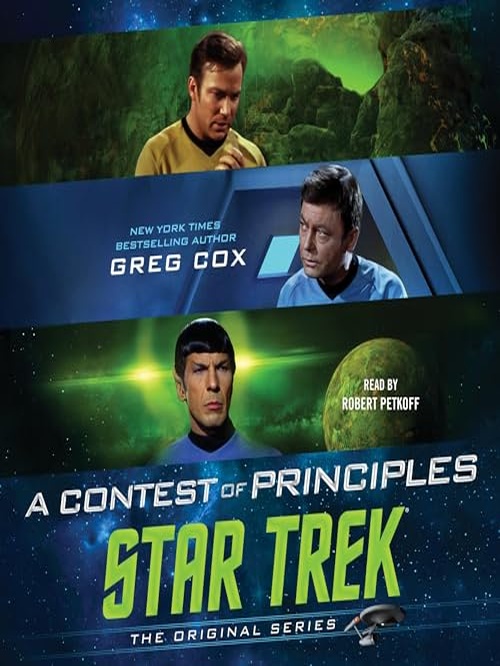
When Democracy Meets the Final Frontier: Greg Cox’s A Contest of Principles
There is a particular audacity in taking a franchise as beloved and well-worn as Star Trek and using it to interrogate something as messy, as fundamentally human, as democratic transition. Greg Cox does precisely this in A Contest of Principles, and the result is a novel that feels less like licensed fiction and more like a political thriller dressed in Starfleet uniforms — one that resonates with an almost uncomfortable prescience in our own era of contested elections and institutional fragility.
The premise is deceptively simple: the crew of the Enterprise is sent to observe the first free elections on the planet Vok, a world emerging from the shadow of military authoritarianism. But Cox understands — as any student of history does — that the birth of democracy is never simple. It is violent, conspiratorial, and riddled with the kind of moral ambiguity that makes neutrality feel less like a virtue and more like a form of complicity.
The Impossible Weight of Neutrality
What struck me most forcefully about this novel is how deftly Cox transforms Kirk’s mandate of impartiality into a genuine dramatic engine. We are accustomed to seeing Kirk as a man of action, a captain who bends rules and defies odds with a swagger that borders on the mythological. Here, he is leashed — bound by Starfleet protocol to observe without intervening, even as scandal, conspiracy, and assassination plots coil around Vok’s fragile democratic experiment like serpents.
This is not merely a plot constraint; it is a philosophical provocation. Cox forces us to sit with an uncomfortable question: What is the moral cost of watching injustice unfold in the name of non-interference? The Prime Directive has always been Star Trek‘s most intellectually fertile ground, and Cox tills it with genuine care. Kirk’s struggle is not one of action but of conscience, and that restraint — paradoxically — makes this one of the more compelling portraits of the character I’ve encountered in the expanded literary universe.
A Triptych of Worlds, A Triptych of Crises
The novel’s structural ambition deserves attention. Cox doesn’t settle for a single narrative thread. Instead, he weaves three interconnected planetary storylines — Vok, Braco, and Ozalor — each with its own political ecosystem, its own moral texture.
McCoy’s abduction to Ozalor is where the novel finds its most visceral emotional register. Torn from a mercy mission and pressed into service as a physician for a ruling family’s mysterious ailment, McCoy embodies the oldest tension in medical ethics: the Hippocratic oath versus personal survival. Cox writes McCoy with the gruff tenderness that DeForest Kelley immortalized on screen — a man who cannot stop himself from healing, even when healing serves his captors’ interests. The palace intrigues surrounding him are baroque and satisfying, recalling the best tradition of courtly political fiction transplanted to an alien setting.
Meanwhile, Spock and Chapel’s search for the missing doctor provides a complementary register — methodical, driven by logic yet underscored by genuine concern. Cox handles the Spock-Chapel dynamic with a subtlety that respects their complicated history without descending into melodrama. Their mission threads the needle between rescue operation and detective story, and it works precisely because Cox never lets the urgency flag.
The interplay between these three storylines generates a cumulative effect that elevates the novel beyond episodic adventure. By the final act, when the fates of all three worlds converge, we understand that Cox has been constructing an argument: that power, whether democratic or monarchical, is always contested, always fragile, always susceptible to the ambitions of those who would exploit transition for personal gain.
Greg Cox and the Art of the Tie-In Novel
It is worth contextualizing A Contest of Principles within Greg Cox’s broader body of work. A New York Times bestselling author with an extensive catalogue of Star Trek novels, Cox has long demonstrated a rare facility for honoring the spirit of the source material while pushing it into genuinely literary territory. He understands that the best Star Trek fiction doesn’t merely recreate television episodes in prose form — it exploits the novel’s capacity for interiority, for political complexity, for the kind of slow-burn thematic development that a forty-five-minute episode cannot sustain.
This novel represents Cox at his most structurally ambitious. The triple-helix plot architecture is demanding, and there are moments — particularly in the middle third — where the constant shifting between worlds risks diluting momentum. Yet Cox’s command of pacing, honed over decades of craft, largely prevents this. Each transition arrives at a point of tension, each return to a storyline picks up with renewed energy. It is not flawless — some of the secondary political figures on Vok blur together, their motivations occasionally sketched rather than fully rendered — but the overall effect is one of impressive narrative control.
The Verdict: A Serious Novel in Genre Clothing
I find myself returning to a fundamental conviction about franchise fiction: it is only as good as the questions it dares to ask. A Contest of Principles asks whether democracy can be gifted from the outside or must be fought for from within. It asks what a healer owes to those who imprison him. It asks whether logic and emotion, embodied in Spock and Chapel, can coexist productively in the face of uncertainty.
These are not small questions. And Cox does not offer small answers.
Robert Petkoff’s narration in the audiobook edition — spanning over thirteen hours — deserves particular commendation. His vocal differentiation between the core cast is skilled without being caricature, and his pacing mirrors the novel’s own rhythmic intelligence.
This is a novel for those who believe Star Trek has always been political fiction masquerading as space opera — and who want that political dimension explored with genuine intellectual rigor rather than nostalgic sentiment. It is for readers who appreciate multi-threaded narratives that reward patience. And it is, ultimately, for anyone who has ever watched an election — on this world or any other — and wondered whether the machinery of democracy can survive the people who claim to serve it.
So I’ll leave you with this: In a universe of phasers, warp drives, and alien civilizations, why does the simple act of casting a vote remain the most dangerous thing a society can do?