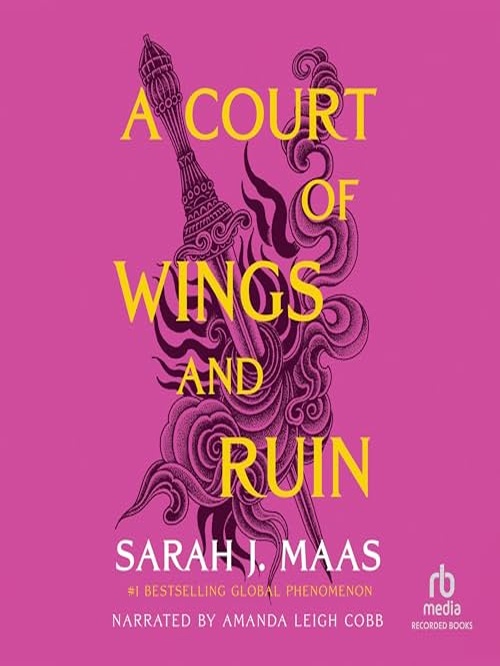
The Weight of Crowns and Consequence: A Critical Look at A Court of Wings and Ruin
The landscape of modern fantasy is replete with sagas of power and peril, yet few authors manage to capture the zeitgeist quite like Sarah J. Maas. With A Court of Wings and Ruin, the third installment in her much-lauded A Court of Thorns and Roses series, Maas plunges her readers deeper into a world teetering on the brink, demanding not just emotional investment, but a considered reflection on the nature of leadership and the price of peace.
The Unveiling of a War-Torn Tapestry
From its very genesis, A Court of Wings and Ruin announces itself with an undeniable gravitas. We are no longer observing a personal quest for survival or a budding romance confined to courtly intrigue; instead, Maas meticulously expands her narrative canvas to encompass an entire realm poised for cataclysm. The publisher’s summary accurately teases the overarching conflict: a looming war that threatens to consume Prythian. However, to merely focus on the impending battle is to miss the intricate groundwork laid by Maas, a testament to her evolving command of epic storytelling.
Feyre, having returned to the treacherous Spring Court, navigates a labyrinth of deceit. This isn’t the wide-eyed human girl we first met, nor even the burgeoning High Lady finding her feet. Here, we witness her transformation into a strategist, a spy, a player in a game where the stakes are existential. Her internal conflict — balancing loyalty, love, and the imperative to protect her people — forms the pulsating heart of the narrative. Maas challenges the traditional hero’s journey, positing that true leadership often demands a descent into moral ambiguities, a willingness to wield shadows for the sake of light. We are compelled to question the boundaries of heroism when survival itself demands acts of calculated betrayal.
Forging Alliances in the Crucible of Conflict
One of the novel’s most compelling strengths lies in its masterful depiction of geopolitical maneuvering. As the war approaches, Feyre and her allies must seek out unexpected partnerships, compelling a grand assembly of High Lords and their respective courts. This expansion of the world, beyond the intimate confines of Velaris or the imposing walls of the Night Court, is where Maas truly flexes her world-building muscles. Each new court introduced, each ancient grievance resurrected, contributes to a rich, layered tapestry that feels both fantastical and disturbingly real in its echoes of historical conflicts.
We observe the delicate dance of diplomacy, the clash of powerful personalities, and the painful sacrifices required to unite disparate factions against a common, existential threat. Maas excels at illustrating the human—or rather, the Fae—cost of war, not just in terms of physical casualties but in the emotional toll exacted upon its leaders and participants. The weight of command, the burden of decision-making under duress, and the inevitable compromises required for collective survival are explored with a nuance that elevates the narrative beyond mere genre tropes. It becomes a study in leadership, courage, and the fragile nature of unity in the face of overwhelming odds.
A Symphony of Swords and Souls
Ultimately, A Court of Wings and Ruin culminates in a sweeping, visceral confrontation that justifies the extensive build-up. The scale of the conflict is immense, yet Maas never loses sight of the individual stories, the personal stakes that anchor the grand spectacle. The prose, while maintaining its characteristic accessibility, rises to the occasion with vivid descriptions of battle, moments of breathtaking heroism, and heartbreaking loss. The emotional impact is profound, ensuring that the reader is not merely an observer but an emotionally invested participant in the fate of Prythian.
While some might argue for occasional indulgences in narrative pacing or a reliance on certain romantic tropes, we find that these are largely overshadowed by the sheer ambition and emotional resonance of the story. Maas has crafted a novel that, despite its fantastical setting, speaks to universal truths about love, loyalty, and the enduring human—or Fae—spirit in the face of existential threats.
A Concluding Affirmation of Resilience
A Court of Wings and Ruin stands as a formidable entry in a beloved series, a testament to Sarah J. Maas‘s ability to weave intricate plots with deeply felt character arcs. It is a work for those who crave sweeping, high-stakes fantasy, replete with political intrigue, complex relationships, and the raw, unvarnished realities of war.
This is a quintessential read for devotees of epic fantasy, particularly those who appreciate a narrative where character development is inextricably linked to grand, world-altering events. It invites us to ponder: what depths must we plumb, what facades must we adopt, when the very survival of our world hangs by a thread? Maas leaves us not with easy answers, but with a vivid, compelling journey into the heart of conflict and the unwavering resilience required to forge a new dawn.