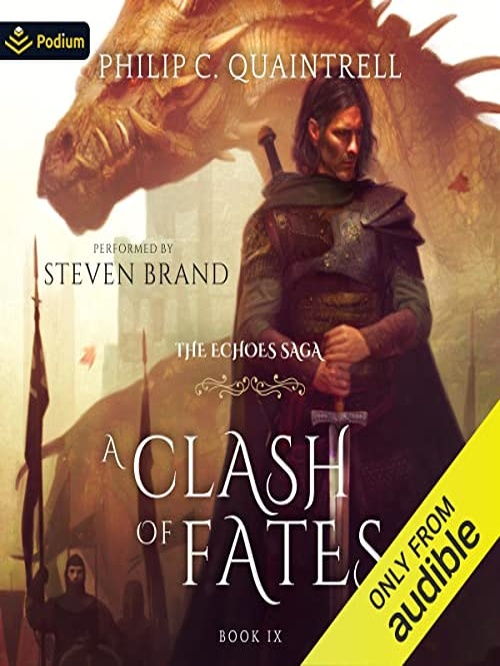
When Worlds End, What Remains? A Reckoning with A Clash of Fates
There is a peculiar gravity to final chapters — not just the last pages of a book, but the concluding movement of an entire saga. We arrive carrying the accumulated weight of every alliance forged, every betrayal endured, every world threatened across thousands of pages. Philip C. Quaintrell understands this burden implicitly, and in A Clash of Fates, the capstone of The Echoes Saga, he does something rarer than most fantasy authors dare: he earns his ending.
The Architecture of Consequence
What separates Quaintrell’s work from the crowded field of epic Fantasy is his unrelenting fidelity to consequence. Other saga-closers often buckle under the structural pressure of resolving too many threads, resorting to deus ex machina resolutions or, worse, conveniently trimmed character arcs. A Clash of Fates refuses that easy exit. Every narrative strand introduced across the preceding volumes carries genuine weight here — and Quaintrell pulls them taut rather than cutting them loose.
The result is a kind of narrative accountability that feels almost unfashionable in contemporary epic fantasy. Characters do not merely survive; they are marked by survival. The philosophical underpinning at work here is essentially Greek in its sensibility — that fate is not a destination but a reckoning, and the collision promised in the title is less about armies than it is about the moral debts accumulated by those who dared to shape the world.
Echoes of Everything That Came Before
Quaintrell demonstrates, with considerable craft, that a saga’s final installment is structurally analogous to the last movement of a symphony. The themes introduced in early volumes — identity, sacrifice, the corrupting seductiveness of power — do not resolve so much as they resolve into one another, creating a thematic density that rewards readers who have committed to the full journey.
There is a particular kind of satisfaction, almost archaeological in nature, in watching a writer excavate the implications of his own world-building. The “echoes” of the series title reveal themselves here not as metaphor but as mechanism: the past is not backdrop but active agent. This is sophisticated genre fiction operating at the level of its best ambitions.
Steven Brand‘s narration for Podium Audio deserves specific mention. Brand has long been the vocal architecture through which this saga breathes, and his performance in this installment carries a palpable earned gravity — the weariness in his voice when rendering certain characters feels less like performance than testimony.
Where the Seams Show
Intellectual honesty compels acknowledgment of the work’s friction points. At roughly three hours of runtime for this volume, the pacing in the middle act occasionally strains — certain convergences feel telegraphed a beat too early, robbing key confrontations of their full visceral impact. And while Quaintrell’s prose is reliably serviceable, it rarely achieves the lyrical elevation that might have pushed A Clash of Fates from very good to genuinely great literature. The bones of something transcendent are present; the marrow, occasionally, is not.
These are the critiques of a reader who cares, however. The machinery of the plot operates with impressive precision, and Quaintrell’s genuine affection for his characters — his refusal to treat them as mere instruments of plot — is evident on virtually every page.
The Verdict of an Ending
A Clash of Fates lands where it must: with the quiet devastation of an ending that respects both its world and its readers. The 4.8+ community rating is not, in this case, merely the enthusiasm of a dedicated fanbase — it reflects a saga that delivered on its promises with uncommon integrity.
This is, emphatically, not an entry point. Do not begin here. But for those who have walked the length of The Echoes Saga, this conclusion offers what so few saga-closers genuinely provide: the sense that the journey warranted exactly this destination, and no other.
For readers who hunger for epic Fantasy that treats consequence as sacred, who find moral complexity more compelling than moral simplicity, and who are willing to invest the emotional capital that long-form fantasy demands — Quaintrell’s saga, concluded here, is essential reading.
The final question A Clash of Fates leaves us with is perhaps the most honest one any epic fantasy can pose: not whether the heroes won, but whether winning was ever truly the point.