A Demon’s Pride A LitRPG Adventure Review

A Demon Walks Into a World That Hates Her — And Refuses to Apologize

What does it mean to be proud of what you are when the entire world has already decided you are monstrous? This is not a question borrowed from some literary fiction darling or a prestige philosophical novel. It comes, perhaps unexpectedly, from the third volume of V.A. Lewis’s Salvos series — a LitRPG web serial turned audiobook that, beneath its stat screens and level-ups, is conducting a surprisingly earnest interrogation of identity, prejudice, and the stubborn, irrational engine of selfhood.

A Demon’s Pride is not high literature. It does not pretend to be. But I find myself increasingly impatient with the assumption that genre fiction operating within progression fantasy frameworks cannot also be doing real thematic work. Lewis’s series has been building toward something, and this installment is where the scaffolding starts to reveal an actual architecture.

The Outsider Who Refuses the Mask

Salvos, our protagonist, is a Demon. Not metaphorically. Not as some edgy aesthetic choice. She is, within the world’s taxonomy, a creature from the Netherworld — alien in cognition, cheerfully sociopathic in her early appearances, and now, three books in, something far more complicated. She has earned her Gold Rank as an adventurer. She has companions she fiercely protects. And yet the world — its institutions, its people, its very System — categorizes her as an existential threat.

The tension Lewis constructs here is deceptively simple but narratively potent: Salvos cannot hide what she is forever, and she refuses to be ashamed of it. In a genre saturated with protagonists who conceal their overpowered nature for strategic advantage, Lewis flips the trope. Salvos’s concealment is not about power fantasy — it is about survival against systemic bigotry. The “pride” in the title is not vanity. It is ontological defiance.

This is where the book earns its weight. The [Cultists], the assassins, the company war she may or may not have accidentally ignited — these are competent action-adventure beats, well-paced and satisfying in the way progression fantasy demands. But they orbit a gravitational center that is genuinely interesting: what happens when a being who defines herself through growth and connection exists within a system designed to deny her both?

Progression as Philosophy, Not Just Mechanics

LitRPG lives or dies on its progression systems, and Lewis understands the contract. Numbers go up. Skills evolve. There are class advancements and satisfying power spikes. But what distinguishes A Demon’s Pride from the mechanical grind of lesser entries in the genre is that Salvos’s progression is inseparable from her psychological development. Each level gained, each new ability unlocked, is also a statement about who she is choosing to become — in a world that insists she has no right to choose at all.

I want to highlight something Lewis does quietly but effectively: Salvos’s naïveté is not static. In the first book, her ignorance of human social norms was played largely for comedy. Here, her misunderstandings carry consequences. She starts a company war through a combination of genuine confusion and an inability to process why beings would organize their economies around exploitation. It is funny. It is also, if you tilt your head slightly, a pointed observation about how normalized systems of power appear absurd when viewed by someone outside them entirely.

Tess Irondale’s narration deserves specific mention. Salvos is a character who could easily become grating — too loud, too impulsive, too relentlessly herself. Irondale threads the needle with precision, finding the vulnerability beneath the bravado, the loneliness beneath the cheerful aggression. At nearly twenty hours of audio, the performance never flags.

Where the Seams Show

I would be dishonest if I did not note the book’s limitations. Lewis’s prose, functional and clear, rarely rises to the level of memorable. The supporting cast, while likeable, tends toward archetypal rather than fully realized — they exist in relation to Salvos rather than as independent centers of narrative gravity. And the pacing in the middle third sags under the weight of sequential encounters that, while individually entertaining, blur together in retrospect.

There is also a structural tension inherent to serialized web fiction adapted into discrete volumes: A Demon’s Pride does not so much end as pause. The emotional arcs reach satisfying waypoints, but the larger story — Salvos’s search for her companion, her reckoning with the Netherworld, the world’s inevitable confrontation with what she truly is — remains deliberately, sometimes frustratingly, unresolved.

Who Should Walk This Road

This is a book for readers who have already bought into progression fantasy’s core promise — that watching a character grow stronger can be genuinely compelling narrative — and who are hungry for a series that asks why that growth matters. If you have bounced off LitRPG before, A Demon’s Pride is unlikely to convert you; it operates firmly within its genre’s conventions. But if you are already a citizen of this space, Lewis’s series represents something approaching its best self: genre fiction that takes its own premise seriously enough to find real meaning in it.

The question Salvos poses, ultimately, is one worth sitting with long after the stats fade from memory: If the world insists you are a monster, and you know you are not, how much of yourself are you willing to sacrifice to prove it? The answer this book offers — nothing, not one fragment — is, I think, more radical than it first appears.
A Deepness in the Sky Review

Dark Star, Bright Mind: Sky Deepness

Star sleep. Star wake. Spiders live below. Men wait above. Qeng Ho trade. Emergents enslave brain. Betrayal strike. Qeng Ho fight.

Space Cold, Truth Deep

Vernor Vinge write heavy Science Fiction & Fantasy. I read. I judge. Book strong.

Emergents break minds. Tech make brain tool. Vinge show dark path. Freedom die. Efficiency win. Qeng Ho fight back. Free trade need free will. Mind freedom beat tech slave.

Spiders hide secret. Men think spiders dumb. Spiders play men. Narrative twist hard. Good trick. Vinge build heavy world.

Courage break chains. Love save innocents. Theme big. Not just space lasers. Human spirit grow.

Final Judge

Book win Hugo Award. Get Nebula nominate. Score hit 4.42. Deserve high score. Zones of Thought series grow strong. Macmillan Audio make sound version. Peter Larkin read. Voice good.

Target: You like smart Fantasy space book? Read this. You like deep think? Read this.

Emergents enslave brains for power. Qeng Ho fight for freedom. Read book.

You trade freedom for tech? Think hard. Decide.

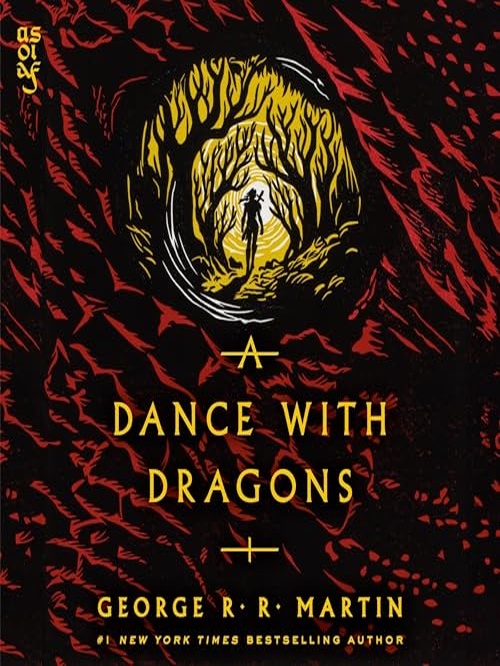
A Dance with Dragons Review

The Throne Is Won in Battle, but Held in Mud and Compromise

There is a moment in A Dance with Dragons — the fifth and, for now, final installment of George R.R. Martin‘s A Song of Ice and Fire — where Daenerys Targaryen, Mother of Dragons, Breaker of Chains, conqueror of cities, sits in a pit surrounded by thousands of screaming spectators and watches men die for sport. She hates it. She permits it anyway. It is, perhaps, the most quietly devastating scene Martin has ever written — not because of its violence, but because of what it says about the cost of ruling. You can burn a kingdom down with dragonfire. Governing what remains? That requires something fire cannot provide.

This is a novel about the morning after the revolution, and it is both Martin’s most ambitious and most polarizing work.


Power Doesn’t Arc — It Erodes

If A Game of Thrones was a masterclass in political betrayal and A Storm of Swords delivered the visceral shock of consequences made real, then A Dance with Dragons concerns itself with a far less cinematic question: what happens when the people who wanted power finally have it?

Jon Snow, the 998th Lord Commander of the Night’s Watch, discovers that commanding men is nothing like earning their respect. His decisions are sound, strategically defensible, even morally necessary — and they breed resentment in every corridor of Castle Black. Martin refuses to grant Jon the narrative armor of a protagonist who is simply misunderstood. Instead, he forces us to sit with an uncomfortable truth: good leadership often looks, from the inside, indistinguishable from tyranny.

Daenerys faces a mirror image of the same dilemma in Meereen. She has liberated a slave city, and now the freed and the former masters alike demand she become something she never prepared to be — an administrator. The dragon queen who swept across Slaver’s Bay with righteous fury finds herself negotiating sewer repairs and brokering marriages she does not want. Martin’s refusal to let Daenerys simply fly west to Westeros is not, as some critics have charged, narrative stalling. It is the entire point. Empire is not conquest; empire is maintenance, and maintenance is inglorious.

The Quiet Architecture of Identity

What struck me most on rereading — and this is a book that genuinely rewards rereading — is how deeply A Dance with Dragons is preoccupied with the question of selfhood. Theon Greyjoy, broken and renamed “Reek” by the sadistic Ramsay Bolton, undergoes one of the most harrowing identity deconstructions in modern fantasy. His chapters are not easy to stomach. They are also, I would argue, among the finest things Martin has ever written. The slow, agonizing process by which Theon claws his way back toward some fractured version of himself — “My name is Theon. You have to know your name” — carries a psychological authenticity that transcends genre. This is not fantasy escapism. This is literary fiction wearing a cloak of ice and snow.

Tyrion Lannister, too, is stripped of every advantage that once defined him — his name, his wealth, his wit as currency — and forced to confront a version of himself that is merely human. His journey down the Rhoyne, through slavery, through self-loathing, is Martin at his most Dostoevskian: a brilliant man who cannot stop destroying himself, narrating his own decline with devastating clarity.

And then there is the mystery of Aegon Targaryen — or whoever he truly is — a plot thread that interrogates the very nature of legitimacy. Does it matter if a king is real, Martin seems to ask, if enough people believe he is?

The Weight — and Worth — of Patience

I will not pretend this is a flawless book. It is not. At nearly forty-nine hours in Roy Dotrice‘s capable narration, A Dance with Dragons demands extraordinary patience. Certain Meereenese political intrigues feel labyrinthine to the point of opacity. Some readers will find the proliferation of new point-of-view characters — Quentyn Martell, Jon Connington, Barristan Selmy — dilutes rather than enriches the central narrative momentum. These are legitimate criticisms.

But I think they miss something essential about what Martin is constructing. This is not a series built on the architecture of payoff. It is built on the architecture of consequence. Every feast has a famine. Every war has an aftermath. Martin’s willingness to inhabit those unglamorous spaces — the council chambers, the sickbeds, the long marches through frozen wastes — is precisely what elevates A Song of Ice and Fire above its imitators. He does not skip to the good parts because he understands that the “boring” parts are where character is forged and meaning is made.

The novel’s final hundred pages, it should be said, deliver some of the most breathtaking cliffhangers in the entire series. Martin earns them precisely because he made us wait.

Who Should Walk This Road

A Dance with Dragons is not for the casual reader seeking quick narrative gratification. It is for those who have invested in this world and are willing to trust that Martin’s patience has purpose. It is for readers who find political complexity as thrilling as swordplay — who understand that a queen choosing whom to marry can carry more dramatic weight than a battle involving ten thousand soldiers.

It is, above all, for readers who believe that fantasy literature at its best does not offer escape from the human condition but a deeper immersion into it.

I finished A Dance with Dragons unsettled, hungry, and haunted — which is, I suspect, exactly how Martin intended it. The question that lingers is not what happens next in Westeros. It is the one the book has been asking all along, in every chapter, through every compromised choice and every shattered ideal:

When the cost of doing the right thing becomes indistinguishable from the cost of doing the wrong thing — how do you know which one you chose?

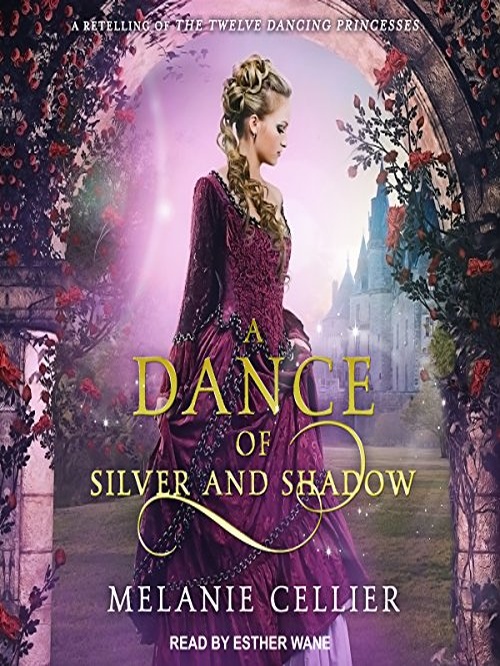
A Dance of Silver and Shadow Review

When Twelve Princesses Dance Underground, the Real Battle Is Above

What happens when you take one of the Grimms’ most enigmatic tales—The Twelve Dancing Princesses—and strip away its passive heroines, its voyeuristic soldier, and its pat resolution, then rebuild the entire architecture around agency, sisterhood, and the cost of sacrifice? You get Melanie Cellier’s A Dance of Silver and Shadow, a novel that is far more intellectually satisfying than its fairy-tale packaging might suggest.

I’ll confess: I approached this book with the skepticism I reserve for most fairy-tale retellings—a genre that too often mistakes surface-level inversion for genuine subversion. Cellier, however, understands something critical that many of her contemporaries do not. The power of a retelling lies not in merely reshuffling the deck but in interrogating why the original story compelled us in the first place.

The Curse as Political Architecture

The most striking move Cellier makes is transforming the enchanted underground ballroom from a site of escapist pleasure into a tournament—a competitive, high-stakes arena where princesses are not victims of their own frivolity but conscripts in a system designed to consume them. This is a paradigmatic shift worth pausing over. The original tale punishes the princesses for their secret nocturnal dancing, framing female desire and autonomy as inherently suspicious. Cellier inverts this entirely: the nightly descent into the magical realm is compulsory, imposed by a curse that threatens to devour the duchy of Marin itself.

Princess Liliana—Lily—is no passive participant. She arrives in Marin as a diplomat’s daughter, an outsider whose foreignness becomes both liability and advantage. The narrative arc Cellier constructs for her is one of escalating entanglement: political, magical, and romantic. What begins as curiosity sharpens into obligation, and obligation hardens into something closer to defiance.

The Twin Bond as Narrative Engine

The secret weapon of this novel—both literally and structurally—is the magical bond between Lily and her twin sister, Sophie. Cellier uses this connection with admirable restraint. It never devolves into a convenient deus ex machina; instead, it functions as a lens through which the book explores its most resonant theme: that strength is fundamentally relational. Lily is formidable not because she is a lone wolf with extraordinary gifts but because she is tethered to someone who sees the world from a different vantage point. Their shared perception becomes a form of intelligence that no single person could replicate.

This is a quietly radical proposition in a genre that still gravitates toward the Chosen One mythos. Cellier seems to argue that the most dangerous thing a corrupt system can face is not a singular hero but a partnership—two minds working in concert, filling each other’s blind spots.

Romance Under Constraint

The love story between Lily and the Marinese prince operates under a set of constraints that elevate it beyond the typical fantasy romance. There is genuine tension here, not manufactured through miscommunication or contrived misunderstandings, but rooted in structural impossibility. Lily cannot afford attachment because the tournament’s endgame demands sacrifice. The prince cannot fully trust an outsider when his duchy is fracturing. Their growing closeness carries the weight of consequence, and Cellier has the discipline to let that weight sit rather than rushing toward resolution.

I found myself thinking of the best slow-burn romances in the genre—Robin McKinley’s The Blue Sword, Shannon Hale’s The Goose Girl—where emotional intimacy is earned through shared purpose rather than manufactured proximity. Cellier belongs in that conversation, even if her prose doesn’t quite reach the lyrical heights of McKinley at her finest.

Where the Shadows Thin

The novel is not without its limitations. The worldbuilding of Marin, while functional, occasionally feels like sketched scenery rather than a lived-in place. The secondary princesses in the tournament blur together—a missed opportunity, given that twelve distinct women competing under duress could have generated a richer tapestry of motivation and conflict. And the pacing in the middle third sags slightly, as Lily’s daytime investigations retread ground without sufficient escalation.

But these are the imperfections of ambition, not laziness. Cellier is juggling a retelling, a political intrigue, a romance, and a magic-system novel simultaneously, and the fact that she mostly succeeds is itself noteworthy.

A Final Reckoning

A Dance of Silver and Shadow is a book that trusts its readers—trusts them to find the darkness inside the fairy tale, to appreciate a heroine who thinks before she acts, and to understand that love stories matter most when they cost something real. Melanie Cellier has crafted a retelling that honors its source material while refusing to be imprisoned by it.

This is for you if: you’ve exhausted the obvious fairy-tale retellings and hunger for one that treats the genre as intellectual territory worth exploring, not merely decorative nostalgia. Fans of Jessica Day George, Juliet Marillier, and the quieter end of YA fantasy will find a kindred spirit here.

I’m left with a question that the best retellings always provoke: What were the original twelve princesses really dancing toward? Cellier’s answer—that they were dancing toward their own destruction, and that the only way out was to refuse the music—strikes me as both truer and more unsettling than anything the Brothers Grimm dared to imagine.

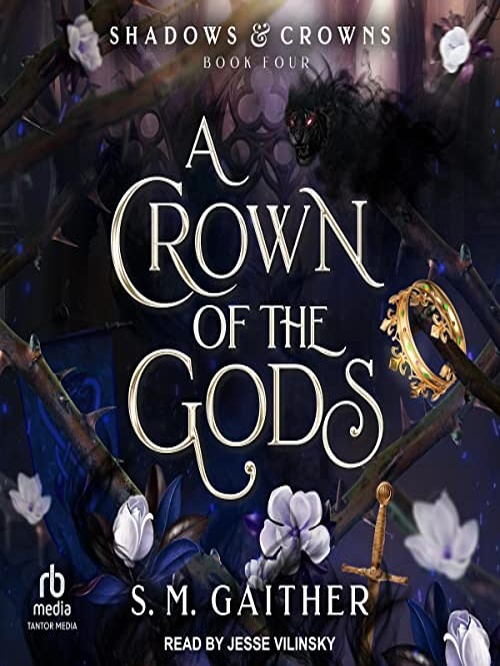
A Crown of the Gods Review

When Gods Fall, Queens Must Rise: S.M. Gaither’s Ambitious Finale

What does it cost to claim a throne you were born to hold — when the very gods conspire to ensure you never sit upon it? This is the question that pulses at the heart of S.M. Gaither’s A Crown of the Gods, the culminating volume of the Shadows and Crowns series, and it is a question that refuses to offer easy answers.

Epic fantasy has long been enamored with the image of the reluctant monarch, the hero who must wrestle destiny into submission before donning the crown. But Gaither does something subtler here, something that elevates this finale beyond the familiar beats of its genre. Casia Greythorne is not reluctant — she is reckoning. And there is a world of difference between the two.

The Weight of an Unfinished Past

The most compelling tension in A Crown of the Gods is not the looming war between mortals and divine beings — though Gaither stages that conflict with considerable narrative ambition. It is the quieter, more corrosive war Casia wages against her own history. The Kethran Empire’s vacant throne is less a seat of power than a mirror, and what it reflects back is a past Casia has spent the entire series strategically avoiding.

This is where Gaither’s storytelling instincts are sharpest. She understands that the most devastating battlefields are interior ones. The external apocalypse — gods ascending, realms blurring, the architecture of reality itself buckling — functions as a magnificent, operatic backdrop to what is fundamentally a story about confrontation with self. Casia’s journey in this final installment is less about accumulating power and more about excavating truth, and Gaither refuses to let her protagonist emerge from that excavation unscathed.

Divinity as Disruption

One of the series’ most intellectually satisfying threads reaches its fullest expression here: the erosion of the boundary between mortal and divine. Gaither treats godhood not as transcendence but as disruption — a force that destabilizes political order, fractures relationships, and corrupts the very concept of agency. The former ruler’s ascension to divinity doesn’t resolve the empire’s crisis; it becomes the crisis. There is a sharp, almost philosophical edge to this conceit. In Gaither’s world, the divine is not salvation. It is the ultimate complication.

This positions the novel within a rich tradition of fantasy that interrogates the nature of power itself — works where crowns and thrones are not endpoints but crucibles. I found myself thinking of Katherine Arden’s Winternight Trilogy and its treatment of old gods colliding with human ambition, though Gaither’s approach is darker, more romantically charged, and less concerned with historical allegory.

Romance as Structural Architecture

Let us address the romance at the novel’s core, because it deserves more than a passing mention. In lesser hands, the romantic thread in a series finale this plot-heavy would feel like obligation — a box to check before the final battle. Gaither weaves it into the narrative’s structural DNA. The romantic relationship here is not decoration; it is load-bearing. The emotional stakes between Casia and her counterpart directly inform the strategic and political decisions that shape the war’s outcome. Love, in this novel, is not a subplot. It is a form of statecraft, a species of defiance, and — in the book’s most affecting passages — a kind of prayer against annihilation.

Jesse Vilinsky’s narration for the Tantor Audio edition deserves particular recognition. Across nearly seventeen hours of audio, Vilinsky sustains the emotional granularity this story demands, shifting between Casia’s steely determination and her more vulnerable reckonings with an almost uncanny precision. It is the kind of performance that doesn’t simply deliver a book — it interprets one.

The Courage to Leave Scars

Where many series finales rush toward catharsis, Gaither makes the braver choice: she lets the story hurt. The novel’s central revelation — that the answers Casia needs may annihilate the future she is fighting for — is not a narrative bluff. Gaither follows through on that premise with a conviction that I found genuinely startling. This is a writer who respects her characters enough to let them break, and who respects her readers enough to trust that they will find meaning in the fractures.

That said, the novel is not without its structural indulgences. The middle act, dense with worldbuilding exposition and political maneuvering, occasionally loses the propulsive urgency that the opening chapters establish so effectively. Gaither’s ambition sometimes outpaces her pacing, and a handful of secondary characters feel more like thematic placeholders than fully realized figures. These are minor grievances in the context of a finale that otherwise delivers on its promises with remarkable emotional precision — but they bear mentioning.

A Throne Worth Claiming

A Crown of the Gods is, ultimately, a novel about the terrible clarity that comes from looking backward in order to move forward. It is a fitting, emotionally devastating conclusion to a series that has consistently refused to simplify the relationship between power, love, and sacrifice.

This is essential reading for those who crave fantasy romance with genuine philosophical weight — readers who want their epic battles accompanied by equally epic interior reckonings. If you have followed Casia Greythorne this far, you owe it to yourself — and to her — to witness the end.

And when you reach the final chapter, ask yourself this: If claiming your crown meant losing the person you became while fighting for it, would you still reach for it?

I suspect Gaither already knows your answer. I suspect that is precisely why this story lingers.

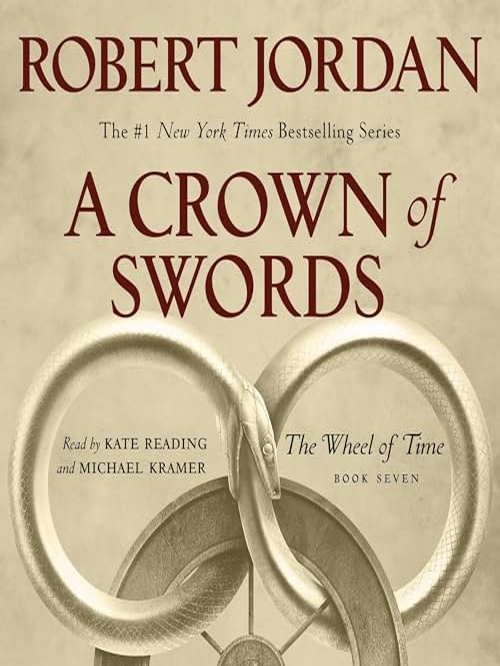
A Crown of Swords Review

A Crown of Swords: Where Victory Tastes of Ash and the World Refuses to Cooperate

What does it mean to win? Not in the clean, triumphant sense that fantasy so often promises — banners raised, enemies routed, the hero standing tall against a golden horizon — but in the bruising, ambiguous sense that real consequence demands. Robert Jordan‘s A Crown of Swords, the seventh installment in The Wheel of Time, poses this question with uncomfortable persistence. Rand al’Thor has broken the Aes Sedai. He has survived Dumai’s Wells. And yet, standing at what should feel like a pinnacle, he finds himself more fractured, more isolated, more dangerous than ever before.

This is not a novel about salvation. It is a novel about the cost of becoming the instrument of salvation.

The Dragon Reborn, Unraveling

Jordan has always been fascinated by the psychological toll of prophecy — the way destiny operates less like a gift and more like a slow confiscation of selfhood. In A Crown of Swords, that preoccupation reaches its most visceral articulation yet. Rand is not merely hardening; he is calcifying. The warmth that made him sympathetic in The Eye of the World has been methodically stripped away, replaced by a cold, geometric logic that borders on sociopathy. He must be hard, he tells himself. He must not break.

Jordan is doing something genuinely sophisticated here. Rand’s psychological deterioration is not dramatic villainy — it is bureaucratic, incremental, terrifyingly mundane. He makes decisions that are militarily sound and humanistically catastrophic, and the narrative refuses to adjudicate cleanly between them. This moral opacity is A Crown of Swords at its most intellectually rigorous, and it elevates the book well above the standard fantasy fare it superficially resembles.

The Texture of an Overcrowded World

One cannot review this novel without addressing its structural ambition — and its structural strain. Jordan’s world at this point in the series has achieved a density that is genuinely unparalleled in epic fantasy. Sea Folk Windfinders, Wise One politics, the internal fractures of the White Tower, the mercantile brutality of Ebou Dar — each thread carries its own weight, its own internal logic, its own cast of characters whose motivations deserve and receive genuine attention.

The Elayne and Mat storyline in Ebou Dar is, frankly, the novel’s most consistently pleasurable engine. Mat Cauthon — gambler, reluctant hero, walking anachronism — reaches something approaching full realization here. His interactions with the Daughter of the Nine Moons carry an erotic charge that Jordan handles with more wit than he is typically credited for. And the hunt for the bowl ter’angreal, MacGuffin though it may be, generates genuine momentum in a book that occasionally struggles to sustain it.

Egwene’s arc, meanwhile, operates in a different register entirely — quieter, more politically textured. Watching her consolidate authority among disparate factions of channelers is a masterclass in soft power, and Jordan renders her competence without rendering her infallible. She earns every inch.

Shadar Logoth and the Question of Ends

The novel’s climax — Rand’s confrontation with the Forsaken Sammael amid the corrupted ruins of Shadar Logoth — deserves particular attention, not for its action choreography but for its philosophical staging. Shadar Logoth is Jordan’s most potent symbol: a city destroyed not by the Shadow but by its own hatred of the Shadow. The evil that consumed it, Mashadar, kills indiscriminately. It does not distinguish between Forsaken and Dragon Reborn.

That Rand chooses this place for his confrontation is not incidental. Jordan is making a pointed argument about the seductive danger of fighting darkness by absorbing it — the very transformation Rand is undergoing on a psychological level. The setting and the character arc rhyme in ways that reward close reading and punish the speed-reader who treats this as mere action spectacle.

Whether the resolution of that confrontation fully satisfies is a matter of legitimate critical debate. Jordan’s handling of consequence here — specifically, what actually happens to Sammael — is elliptical in ways that feel less like artful ambiguity and more like narrative evasion. It is one of the book’s genuine weaknesses, and one worth naming plainly.

Measured Against the Series, Measured on Its Own Terms

A Crown of Swords is not The Shadow Rising, Jordan’s undisputed apex. It lacks that book’s anthropological boldness, its willingness to abandon familiar ground entirely in pursuit of world-mythological depth. Nor does it match Lord of Chaos for sheer structural audacity — the buildup to Dumai’s Wells remains one of the great sustained sequences in modern fantasy.

What it offers instead is consolidation with purpose. It is a novel doing the difficult, unglamorous work of managing an enormous narrative machine: setting pieces in motion, paying off threads laid books earlier, and complicating its central hero in ways that will take another seven volumes to resolve. Judged by those terms, it succeeds with considerable craft.

Kate Reading and Michael Kramer’s audiobook performances, for those engaging with Macmillan Audio‘s production, remain exemplary — their vocal differentiation across Jordan’s sprawling cast is an achievement that deserves acknowledgment in any honest accounting.

Who Needs This Book, and Why

A Crown of Swords belongs to readers who have already surrendered themselves to Jordan’s project — who understand that The Wheel of Time is not a series of self-contained novels but a single, vast work of philosophical fantasy published in installments. For those readers, this volume is essential: the psychological portrait of Rand alone justifies the investment.

For newcomers hoping to sample the series here: don’t. The rewards are real, but they are not portable. This is fiction that demands its full context.

The deeper question A Crown of Swords leaves resonating is one Jordan never quite states aloud but embeds in every interaction Rand has with the people who love him: At what point does the weapon aimed at the Dark One become indistinguishable from the darkness itself? Jordan does not answer. He is too honest for that. He simply keeps turning the Wheel.

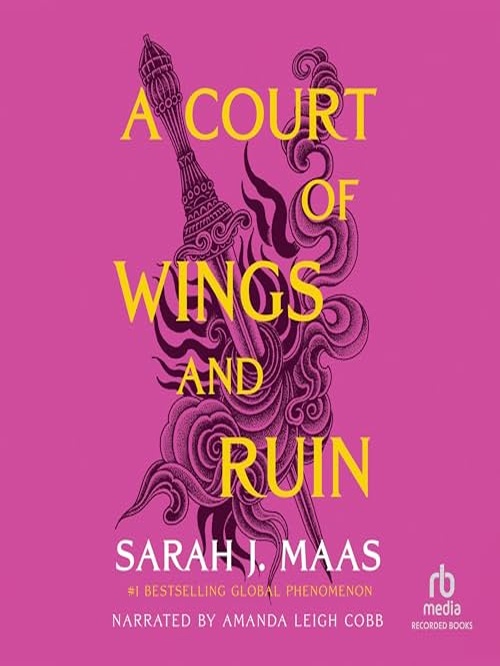
A Court of Wings and Ruin Review

The Weight of Crowns and Consequence: A Critical Look at A Court of Wings and Ruin

The landscape of modern fantasy is replete with sagas of power and peril, yet few authors manage to capture the zeitgeist quite like Sarah J. Maas. With A Court of Wings and Ruin, the third installment in her much-lauded A Court of Thorns and Roses series, Maas plunges her readers deeper into a world teetering on the brink, demanding not just emotional investment, but a considered reflection on the nature of leadership and the price of peace.

The Unveiling of a War-Torn Tapestry

From its very genesis, A Court of Wings and Ruin announces itself with an undeniable gravitas. We are no longer observing a personal quest for survival or a budding romance confined to courtly intrigue; instead, Maas meticulously expands her narrative canvas to encompass an entire realm poised for cataclysm. The publisher’s summary accurately teases the overarching conflict: a looming war that threatens to consume Prythian. However, to merely focus on the impending battle is to miss the intricate groundwork laid by Maas, a testament to her evolving command of epic storytelling.

Feyre, having returned to the treacherous Spring Court, navigates a labyrinth of deceit. This isn’t the wide-eyed human girl we first met, nor even the burgeoning High Lady finding her feet. Here, we witness her transformation into a strategist, a spy, a player in a game where the stakes are existential. Her internal conflict — balancing loyalty, love, and the imperative to protect her people — forms the pulsating heart of the narrative. Maas challenges the traditional hero’s journey, positing that true leadership often demands a descent into moral ambiguities, a willingness to wield shadows for the sake of light. We are compelled to question the boundaries of heroism when survival itself demands acts of calculated betrayal.

Forging Alliances in the Crucible of Conflict

One of the novel’s most compelling strengths lies in its masterful depiction of geopolitical maneuvering. As the war approaches, Feyre and her allies must seek out unexpected partnerships, compelling a grand assembly of High Lords and their respective courts. This expansion of the world, beyond the intimate confines of Velaris or the imposing walls of the Night Court, is where Maas truly flexes her world-building muscles. Each new court introduced, each ancient grievance resurrected, contributes to a rich, layered tapestry that feels both fantastical and disturbingly real in its echoes of historical conflicts.

We observe the delicate dance of diplomacy, the clash of powerful personalities, and the painful sacrifices required to unite disparate factions against a common, existential threat. Maas excels at illustrating the human—or rather, the Fae—cost of war, not just in terms of physical casualties but in the emotional toll exacted upon its leaders and participants. The weight of command, the burden of decision-making under duress, and the inevitable compromises required for collective survival are explored with a nuance that elevates the narrative beyond mere genre tropes. It becomes a study in leadership, courage, and the fragile nature of unity in the face of overwhelming odds.

A Symphony of Swords and Souls

Ultimately, A Court of Wings and Ruin culminates in a sweeping, visceral confrontation that justifies the extensive build-up. The scale of the conflict is immense, yet Maas never loses sight of the individual stories, the personal stakes that anchor the grand spectacle. The prose, while maintaining its characteristic accessibility, rises to the occasion with vivid descriptions of battle, moments of breathtaking heroism, and heartbreaking loss. The emotional impact is profound, ensuring that the reader is not merely an observer but an emotionally invested participant in the fate of Prythian.

While some might argue for occasional indulgences in narrative pacing or a reliance on certain romantic tropes, we find that these are largely overshadowed by the sheer ambition and emotional resonance of the story. Maas has crafted a novel that, despite its fantastical setting, speaks to universal truths about love, loyalty, and the enduring human—or Fae—spirit in the face of existential threats.

A Concluding Affirmation of Resilience

A Court of Wings and Ruin stands as a formidable entry in a beloved series, a testament to Sarah J. Maas‘s ability to weave intricate plots with deeply felt character arcs. It is a work for those who crave sweeping, high-stakes fantasy, replete with political intrigue, complex relationships, and the raw, unvarnished realities of war.

This is a quintessential read for devotees of epic fantasy, particularly those who appreciate a narrative where character development is inextricably linked to grand, world-altering events. It invites us to ponder: what depths must we plumb, what facades must we adopt, when the very survival of our world hangs by a thread? Maas leaves us not with easy answers, but with a vivid, compelling journey into the heart of conflict and the unwavering resilience required to forge a new dawn.

A Court of Thorns and Roses Review

When the Hunter Becomes the Hunted: Sarah J. Maas and the Alchemy of Desire

There is a moment in every great fairy tale retelling when the familiar architecture of the story you thought you knew collapses — and something wilder, more dangerous, more honest rises from the wreckage. A Court of Thorns and Roses is that collapse. It is Sarah J. Maas detonating the polite foundations of “Beauty and the Beast” and rebuilding them with blood, thorns, and a heroine whose hunger — for survival, for agency, for love — feels less like fantasy and more like a mirror held uncomfortably close.

I’ll confess: I approached this book with the skepticism one reserves for any novel that carries the weight of a global phenomenon. Bestseller lists are not, after all, arbiters of literary merit. And yet, by the final act, I found myself confronting something I hadn’t expected — not just a romance wrapped in faerie glamour, but a surprisingly muscular meditation on captivity, transformation, and the terrible cost of selflessness.


A Huntress Stripped of Her Arrows

Feyre — nineteen, starving, holding her fractured family together with nothing but a bow and sheer, grinding will — is one of the more compelling entry points into a fantasy series I’ve encountered in recent years. Maas does something shrewd here: she doesn’t introduce us to a Chosen One bathed in prophecy. She gives us a girl who kills a wolf because her sisters need to eat. The moral calculus is immediate, unglamorous, and deeply human.

When a faerie lord named Tamlin drags her across the border into the immortal lands of Prythian as retribution, the novel’s central tension snaps into place — not as a kidnapping romance (though it flirts dangerously with that territory), but as a study in displacement. Feyre is a creature of pragmatism thrust into a world that operates on ancient rules she cannot read. Her illiteracy, both literal and cultural, becomes a quiet but devastating motif. She is powerful precisely because she is unfinished.

The Architecture of Seduction — and Its Limits

Let’s address the romance directly, because it is both the engine and the Achilles’ heel of this novel. The slow-burn tension between Feyre and Tamlin is, in its early stages, genuinely well-constructed. Maas understands pacing — the lingering glance, the accidental touch, the conversation that reveals one layer while concealing three others. There is a physicality to their attraction that feels earned rather than imposed.

And yet, I found myself more intellectually engaged by what surrounds the romance than by the romance itself. Tamlin, for all his brooding magnetism, remains somewhat opaque — a figure defined more by his curse than by his interiority. He is, in this first volume, more symbol than person: the beast who is not always a beast, the protector who cannot protect himself. Maas would go on to interrogate this archetype with devastating precision in later installments, but here, Tamlin functions largely as a catalyst for Feyre’s awakening rather than as a fully autonomous consciousness.

Where Maas truly excels is in the visceral texture of desire itself — not merely romantic desire, but Feyre’s desire for beauty, for paint and color, for a life that extends beyond survival. The scenes in which she begins to create art in Tamlin’s manor carry a quiet, aching power that surpasses many of the more overtly dramatic set pieces. This is the real love story: a woman discovering that she is allowed to want things that are not strictly necessary.

The Shadow Beneath the Glamour

The novel’s final act pivots sharply from romance into something closer to psychological horror, and it is here that Maas reveals the full scope of her ambition. The ancient evil lurking beneath Prythian — embodied by the cruel and calculating Amarantha — transforms the narrative from a love story into a trial of endurance. Feyre is stripped of every advantage, every ally, every comfort. What remains is will.

The three trials Under the Mountain are brutal, deliberately so. They force both Feyre and the reader to confront an uncomfortable question that pulses beneath the entire novel: What are you willing to destroy — including parts of yourself — to save someone you love? Maas does not offer a clean answer. The victory, when it comes, is stained. It costs something irreversible. And that refusal to sanitize the consequences elevates the book beyond the conventions of its genre.

I would argue that Amarantha, despite her relatively limited page time, represents one of Maas’s sharpest creations — a villain whose cruelty is not arbitrary but rooted in a twisted mirror-logic of the same possessive love the novel ostensibly celebrates. She is what desire looks like when it curdles into domination. The parallels between her obsession with Tamlin and Feyre’s devotion to him are, I suspect, entirely intentional and deeply unsettling.

The Prose Question

A word on craft. Maas’s prose is not what one would call restrained. It is lush, sometimes excessively so — adjectives bloom like the roses of the title, and there are passages where the emotional register tips from intensity into melodrama. For readers calibrated to the austere minimalism of literary fiction, this will grate.

But I think that criticism, while valid on a sentence level, misses the larger point. Maas writes in the tradition of Gothic romance — Brontë, du Maurier, Rice — where excess is the aesthetic, where the emotional landscape is meant to overwhelm. The prose mirrors Feyre’s own sensory overload as she moves from a grey, starving world into one saturated with color, magic, and danger. It is maximalist by design, and within that design, it largely succeeds.

Who Should Walk Through This Door

A Court of Thorns and Roses is not a perfect novel. Its pacing sags slightly in the middle act, Tamlin’s characterization demands patience that only subsequent books will reward, and there are moments where the worldbuilding prioritizes atmosphere over internal logic.

But it is a potent one. It is a book that understands, on a structural and emotional level, that the most interesting fairy tales are the ones that refuse to let their heroines remain passive. Feyre does not wait to be rescued. She paints, she hunts, she bleeds, she solves riddles in the dark, and she makes choices that leave permanent marks on her soul.

This is a book for readers who crave fantasy that takes female desire seriously — not as a subplot, but as the gravitational center of the narrative. It is for those who loved the dark enchantment of Uprooted by Naomi Novik or the fierce romanticism of The Cruel Prince by Holly Black, but who want something rawer, more urgent, less interested in politeness. It is the opening movement of a series that will grow considerably more complex, more morally ambiguous, and more rewarding.

And perhaps the question it leaves us with is this: When we strip away the faerie glamour, the immortal courts, the curses and the roses — what remains is a nineteen-year-old girl who was never taught to read, standing in a room full of paint, realizing for the first time that survival and living are not the same thing.

That distinction, I think, is worth every page.

A Court of Silver Flames (Part 1 of 2) (Dramatized Adaptation) Review

Echoes of Resilience: Dissecting the Silver Flames of Nesta’s Odyssey

The sprawling tapestries of Sarah J. Maas‘s A Court of Thorns and Roses series have long captivated a global readership, drawing us into a realm where magic intertwines with raw emotion. Yet, it is with A Court of Silver Flames (Part 1 of 2) (Dramatized Adaptation) that we are invited to linger on a character often relegated to the periphery of our empathy: Nesta Archeron. This Graphic Audio LLC production, an immersive dramatized adaptation, casts a compelling spotlight on the ‘prickly’ sister, inviting us to delve into the complex, often uncomfortable, terrain of her psyche.

The Unburdening of a Broken Spirit

From the outset, Nesta has been an enigma – a proud, tempestuous figure whose sharp edges have kept both allies and adversaries at bay. Here, however, we witness a deliberate, painstaking excavation of her character. The narrative bravely confronts the aftermath of trauma, specifically the indelible scars left by the war with Hybern and her unwilling transformation into High Fae. We observe a woman grappling with identity, haunted by loss, and fiercely resistant to the healing hand of those who surround her. This is not a journey of instant catharsis, but a laborious ascent from the depths of despair, characterized by an almost visceral struggle against self-destruction. Maas‘s writing, brought to life by an expansive ensemble of narrators, paints a portrait of resilience born from profound brokenness, challenging our preconceived notions of strength.

The Crucible of Passion: Cassian’s Enduring Light

Central to Nesta’s arduous path to acceptance is her tumultuous relationship with Cassian, the battle-scarred warrior whose steadfast presence paradoxically both infuriates and ignites her. Their dynamic is the very heart of this installment, a tempestuous dance between raw vulnerability and scorching passion. What is particularly striking is how Cassian, despite his own burdens, serves as an unwavering anchor, his unwavering patience a stark contrast to Nesta’s volatility. The dramatized adaptation truly shines in these exchanges; the nuanced delivery from Colleen Delany (as Nesta) and Anthony Palmini (as Cassian), alongside the broader cast including Natalie Van Sistine and Jon Vertullo, elevates their exchanges beyond mere dialogue. We are not just told of their undeniable fire; we feel it, a palpable force that pushes both characters towards self-reckoning. It is a testament to the power of shared struggle, suggesting that true healing often begins when one finds a mirror, however challenging, in another’s gaze.

Whispers of War and the Echoes of a Larger World

While the emotional core of A Court of Silver Flames resides within Nesta’s personal evolution, the overarching geopolitical landscape of the Fantasy realm is not forgotten. The ominous alliance forged by the treacherous human queens serves as a persistent undercurrent of external peril, threatening the fragile peace established after the previous conflicts. This external threat subtly yet effectively underscores the internal battles waged by Nesta and Cassian. Their individual journeys are not isolated; rather, they are intrinsically linked to the fate of their world. The stakes, therefore, are dual: personal redemption and collective survival, a thematic resonance that enriches the narrative beyond mere character study.

The Theatricality of Sound: A Masterclass in Auditory Immersion

To engage with A Court of Silver Flames in this dramatized adaptation format is to experience storytelling elevated. Graphic Audio LLC has truly crafted a theatrical event for the ears. The collective efforts of over two dozen narrators, including Amanda Forstrom, Nora Achrati, Matthew Bassett, and Renee Dorian, create a tapestry of voices that lends distinct personality to every character, however minor. Beyond the vocal performances, the judicious application of sound effects and musical scoring immerses the listener completely, transforming mundane descriptions into vivid sensory experiences. This is not simply an audiobook; it is a full-scale audio play, allowing the listener to inhabit the vibrant, perilous world of Prythian in a uniquely intimate way.

A Journey of Fire and Forgiveness

Ultimately, A Court of Silver Flames (Part 1 of 2) is a bold exploration of self-acceptance and the arduous road to recovery. It asks us to look beyond superficial judgments and consider the profound complexities that shape even the most challenging personalities. I find myself thoroughly impressed by Maas‘s decision to dedicate such extensive narrative real estate to Nesta’s journey, validating the often-unseen struggles of those who appear ‘difficult.’ This is a testament to the idea that healing is rarely linear, and sometimes, the most profound transformations emerge from the fiercest fires.

This adaptation is an indispensable experience for devotees of the A Court of Thorns and Roses series, particularly those who have yearned for a deeper understanding of Nesta. It is also highly recommended for listeners who appreciate character-driven Fantasy narratives steeped in emotional complexity and enjoy the rich, immersive quality of full-cast audio dramas. As we await the concluding part, one cannot help but reflect on the courage it takes to face one’s own shadows, and the quiet power of finding solace in unexpected embraces.

A Court of Silver Flames Review

When the Broken Ones Rise: A Court of Silver Flames and the Alchemy of Healing

There is a question that fantasy rarely has the courage to ask: what happens to the survivor after the war is won? Sarah J. Maas, to her considerable credit, refuses to look away.

A Court of Silver Flames — the fifth installment in the A Court of Thorns and Roses series — is not, despite what its packaging might suggest, simply another chapter in Feyre and Rhysand’s saga. It is, in fact, a radical act of narrative displacement. The throne is handed to the character most readers had written off as irredeemable: Nesta Archeron, the eldest sister, the difficult one, the one who bites. And it is precisely this choice that elevates the novel from competent fantasy romance into something far more psychologically honest.

The Sister No One Wanted to Understand

I’ll say it plainly: Nesta Archeron is not designed to be liked. She is abrasive, self-destructive, and armored in a contempt so thorough it functions as a second skin. Where Feyre’s arc in previous volumes followed the familiar grammar of the chosen one — suffering, transformation, triumph — Nesta’s trajectory is messier, uglier, and infinitely more recognizable. She drinks. She sleeps with strangers. She pushes away everyone who reaches for her. She is, in clinical terms, a woman in the grip of post-traumatic stress disorder, and Maas renders this with a visceral specificity that caught me off guard.

The brilliance here is structural. By shifting perspective away from the established protagonists, Maas accomplishes something that few series authors manage mid-run: she interrogates her own world from the inside. The Night Court, so luminous and aspirational through Feyre’s eyes, becomes a gilded cage when viewed through Nesta’s. The Inner Circle, so beloved by readers, reveals its capacity for judgment, its blind spots, its quiet cruelties dressed up as concern. This is not accidental. This is an author interrogating the mythology she herself built, and finding it insufficient.

Steel Forged in the Staircase

The novel’s central metaphor — Nesta’s grueling physical training at the House of Wind, including the punishing ten-thousand-step staircase she must climb daily — operates on multiple registers simultaneously. On the surface, it is a training montage. Beneath that, it is a meditation on the relationship between body and psyche, on the way physical discipline can become a scaffold for emotional reconstruction. And deeper still, it is about the radical vulnerability required to accept help without interpreting it as weakness.

Cassian, the male lead and Nesta’s romantic counterpart, deserves particular mention. Their dynamic avoids the trap that ensnares so many fantasy romances — the notion that love alone is curative. Cassian does not fix Nesta. He cannot. What he does, with a patience that is itself a form of quiet heroism, is refuse to abandon her while she fixes herself. The distinction matters enormously. Their relationship burns slowly, combatively, and when it finally ignites, the heat is earned rather than manufactured.

Three insights anchor the novel’s emotional architecture:

First, that anger and love are not opposites but often cohabitants — Nesta’s fury at the world is inseparable from her capacity to protect it. Second, that healing is not linear, and Maas is unafraid to show her protagonist regressing, relapsing, clawing back ground she had already gained. Third, that female friendship — particularly Nesta’s bond with Gwyn and Emerie — can be as transformative as any romantic love, perhaps more so. The Valkyrie subplot, in which these three women train together and forge an identity beyond their trauma, is among the finest material Maas has ever written.

Where the Flames Flicker

The novel is not without its indulgences. At over 750 pages, there are stretches where the pacing sags under the weight of world-building tangents and political subplots that feel more like scaffolding for future installments than organic story. The Blood Rite sequence in the final act, while propulsive, relies on familiar action-fantasy beats that feel somewhat conventional after the psychological acuity of everything preceding it. And certain secondary characters — Amren in particular — are handled with a bluntness that borders on caricature.

Stina Nielsen’s narration in the audiobook edition deserves recognition: she differentiates Nesta’s brittle exterior from her interior monologue with remarkable precision, making the listening experience an genuinely complementary mode of engagement.

A Mirror, Not an Escape

Here is my conviction: A Court of Silver Flames is the most emotionally mature novel in the ACOTAR series, and it achieves this precisely because it is willing to be uncomfortable. It asks us to sit with a protagonist who does not apologize for her damage, who does not perform recovery for our comfort, who earns her redemption in increments so small they would be invisible if Maas were a less attentive writer.

This book is for readers who have grown weary of heroines whose pain is decorative. It is for those who understand that the hardest battle in any fantasy epic is not the one fought with swords. And it is, quietly but unmistakably, for anyone who has ever stood at the bottom of an impossible staircase and taken the first step anyway.

What armor are you still wearing that you’ve mistaken for skin?