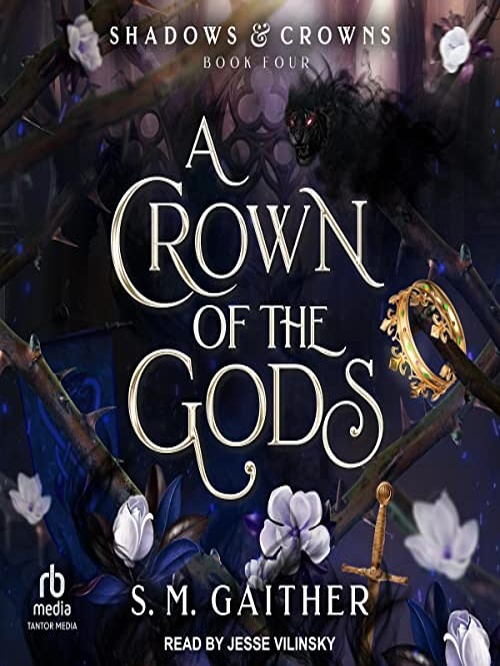
When Gods Fall, Queens Must Rise: S.M. Gaither’s Ambitious Finale
What does it cost to claim a throne you were born to hold — when the very gods conspire to ensure you never sit upon it? This is the question that pulses at the heart of S.M. Gaither’s A Crown of the Gods, the culminating volume of the Shadows and Crowns series, and it is a question that refuses to offer easy answers.
Epic fantasy has long been enamored with the image of the reluctant monarch, the hero who must wrestle destiny into submission before donning the crown. But Gaither does something subtler here, something that elevates this finale beyond the familiar beats of its genre. Casia Greythorne is not reluctant — she is reckoning. And there is a world of difference between the two.
The Weight of an Unfinished Past
The most compelling tension in A Crown of the Gods is not the looming war between mortals and divine beings — though Gaither stages that conflict with considerable narrative ambition. It is the quieter, more corrosive war Casia wages against her own history. The Kethran Empire’s vacant throne is less a seat of power than a mirror, and what it reflects back is a past Casia has spent the entire series strategically avoiding.
This is where Gaither’s storytelling instincts are sharpest. She understands that the most devastating battlefields are interior ones. The external apocalypse — gods ascending, realms blurring, the architecture of reality itself buckling — functions as a magnificent, operatic backdrop to what is fundamentally a story about confrontation with self. Casia’s journey in this final installment is less about accumulating power and more about excavating truth, and Gaither refuses to let her protagonist emerge from that excavation unscathed.
Divinity as Disruption
One of the series’ most intellectually satisfying threads reaches its fullest expression here: the erosion of the boundary between mortal and divine. Gaither treats godhood not as transcendence but as disruption — a force that destabilizes political order, fractures relationships, and corrupts the very concept of agency. The former ruler’s ascension to divinity doesn’t resolve the empire’s crisis; it becomes the crisis. There is a sharp, almost philosophical edge to this conceit. In Gaither’s world, the divine is not salvation. It is the ultimate complication.
This positions the novel within a rich tradition of fantasy that interrogates the nature of power itself — works where crowns and thrones are not endpoints but crucibles. I found myself thinking of Katherine Arden’s Winternight Trilogy and its treatment of old gods colliding with human ambition, though Gaither’s approach is darker, more romantically charged, and less concerned with historical allegory.
Romance as Structural Architecture
Let us address the romance at the novel’s core, because it deserves more than a passing mention. In lesser hands, the romantic thread in a series finale this plot-heavy would feel like obligation — a box to check before the final battle. Gaither weaves it into the narrative’s structural DNA. The romantic relationship here is not decoration; it is load-bearing. The emotional stakes between Casia and her counterpart directly inform the strategic and political decisions that shape the war’s outcome. Love, in this novel, is not a subplot. It is a form of statecraft, a species of defiance, and — in the book’s most affecting passages — a kind of prayer against annihilation.
Jesse Vilinsky’s narration for the Tantor Audio edition deserves particular recognition. Across nearly seventeen hours of audio, Vilinsky sustains the emotional granularity this story demands, shifting between Casia’s steely determination and her more vulnerable reckonings with an almost uncanny precision. It is the kind of performance that doesn’t simply deliver a book — it interprets one.
The Courage to Leave Scars
Where many series finales rush toward catharsis, Gaither makes the braver choice: she lets the story hurt. The novel’s central revelation — that the answers Casia needs may annihilate the future she is fighting for — is not a narrative bluff. Gaither follows through on that premise with a conviction that I found genuinely startling. This is a writer who respects her characters enough to let them break, and who respects her readers enough to trust that they will find meaning in the fractures.
That said, the novel is not without its structural indulgences. The middle act, dense with worldbuilding exposition and political maneuvering, occasionally loses the propulsive urgency that the opening chapters establish so effectively. Gaither’s ambition sometimes outpaces her pacing, and a handful of secondary characters feel more like thematic placeholders than fully realized figures. These are minor grievances in the context of a finale that otherwise delivers on its promises with remarkable emotional precision — but they bear mentioning.
A Throne Worth Claiming
A Crown of the Gods is, ultimately, a novel about the terrible clarity that comes from looking backward in order to move forward. It is a fitting, emotionally devastating conclusion to a series that has consistently refused to simplify the relationship between power, love, and sacrifice.
This is essential reading for those who crave fantasy romance with genuine philosophical weight — readers who want their epic battles accompanied by equally epic interior reckonings. If you have followed Casia Greythorne this far, you owe it to yourself — and to her — to witness the end.
And when you reach the final chapter, ask yourself this: If claiming your crown meant losing the person you became while fighting for it, would you still reach for it?
I suspect Gaither already knows your answer. I suspect that is precisely why this story lingers.