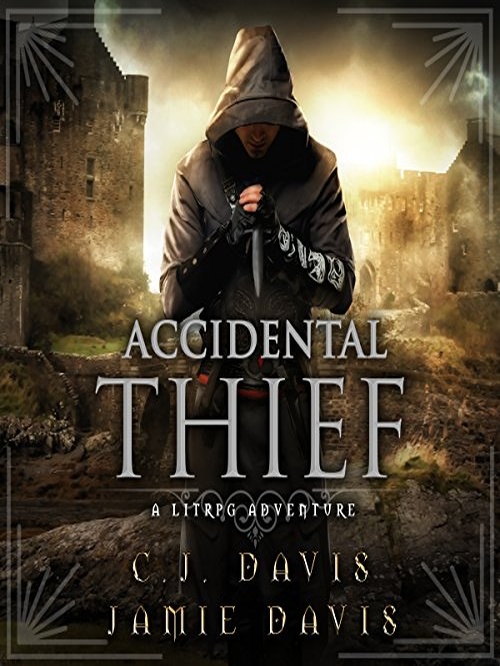
Navigating the Labyrinth of the Self: An Accidental Journey into Fantasma
In an age increasingly defined by the permeable membrane between the digital and the mundane, where the allure of virtual realities promises respite from the quotidian, Accidental Thief by Jamie Davis and C.J. Davis presents a timely, albeit subtly disquieting, premise. We are introduced to Hal Dix, a figure so thoroughly steeped in the grey banality of unfulfilled aspirations that his very existence seems to echo the collective sigh of the unremarkable. An IT help desk drone, overshadowed by his executive spouse, his self-worth is a fragile construct, perpetually assailed by the world’s dismissive gaze. It is a predicament that resonates, perhaps uncomfortably, with the quiet desperations many of us harbor.
One might ask: what happens when the desperate wish for a different life, for a chance at agency, is unexpectedly granted? The authors explore this through Hal’s fateful acquisition of a bootleg game – a relic of illicit charm promising escape into the highly anticipated realm of Fantasma. But as the narrative unfolds, we, alongside Hal, are reminded that one should indeed “be careful what one wishes for,” for the game’s embrace is far more encompassing and demanding than a mere weekend diversion.
The Unwilling Hero’s Genesis
What truly elevates Accidental Thief beyond a mere genre exercise is its nuanced portrayal of Hal’s reluctant metamorphosis. The LitRPG landscape, often populated by characters readily embracing their new, overpowered roles, finds a poignant counterpoint in Hal. He is not a “chosen one” in the archetypal sense, but an “accidental traveler,” thrust into a world where his only advantage might be his very lack of innate heroism. This inversion of the hero’s journey allows for a more authentic exploration of self-discovery. We witness Hal’s struggle not merely with monsters or quests, but with his own ingrained insecurities, his history of being overlooked, and the profound discomfort of suddenly having to define himself through action rather than passive acceptance. The game’s mechanics become a crucible, forcing him to shed the skin of his previous identity, albeit awkwardly, even clumsily.
The Ontological Weight of the ‘Game’
The narrative’s most compelling intellectual thrust lies in its probing of the boundaries between the real and the simulated. The “bootleg release” of Fantasma subtly implies an imperfect, perhaps even dangerous, entry point, immediately imbuing Hal’s adventure with an undercurrent of systemic instability. Is this a game, a new reality, or a liminal space where the rules are still being written, and perhaps, exploited? The authors artfully navigate this thematic ambiguity, suggesting that the escape Hal so desperately craved might be a more profound, perhaps even ontological, shift than he ever anticipated. His burgeoning skills as an Accidental Thief are not just game mechanics; they represent a stark, often morally grey, path to self-actualization. This invites a deeper reflection on how our environments, be they real or virtual, can compel us towards identities we might never have envisioned for ourselves.
An Unconventional Path to Agency
The core of Hal’s journey, then, is less about mastering a game and more about reclaiming his narrative agency. His life prior to Fantasma was one dictated by external perceptions and internal resignation. Within the labyrinthine confines of this new, fantastical world, he is afforded the rare, terrifying opportunity to forge his own path, however circuitous or unexpected. The narrative deftly employs the LitRPG framework to illustrate this personal evolution: each skill point, each encounter, each difficult choice, serves as a tangible metric of his growing self-reliance and the slow, arduous process of building a new identity from the shards of his old, broken one. It is a testament to the power of unforeseen circumstances to ignite dormant strengths, making Hal a genuinely relatable, if flawed, protagonist.
A Deliberate Introduction to a Grand Adventure
Ultimately, Accidental Thief offers a thoughtfully constructed overture to what promises to be an epic LitRPG fantasy trilogy. It eschews bombast for character-driven immersion, drawing us into Hal’s world with an empathetic hand. The authors have crafted a debut that is both a critique of modern ennui and a celebration of the human spirit’s capacity for adaptation, even when adaptation means embracing an unforeseen, perhaps unsavory, role.
This is a book for those who appreciate the slower burn of character development over immediate gratification, for readers who find themselves contemplating the existential quandaries posed by our increasingly digital lives, and for enthusiasts of the LitRPG genre who crave a narrative with thematic depth alongside the satisfying crunch of leveling up. Accidental Thief reminds us that sometimes, the most profound journeys begin not with a grand quest, but with a simple, desperate wish, and the accidental discovery of a self we never knew we could be. We encourage you to step into Fantasma and consider what it truly means to be the master of your own (accidental) destiny.