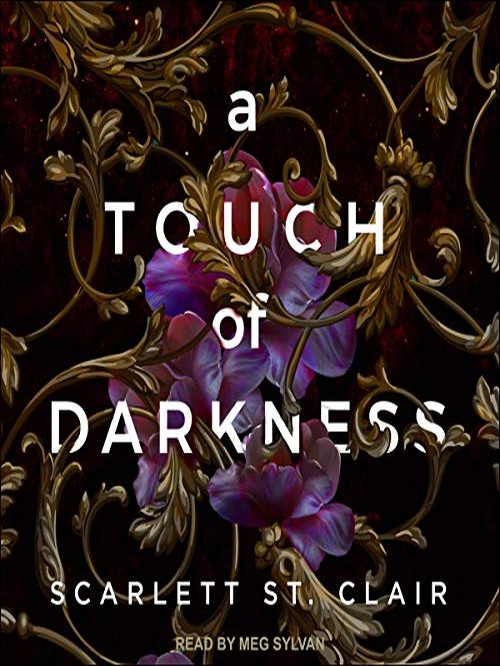
A Resonant Echo in the Underworld: A Critical Gaze at A Touch of Darkness
The enduring allure of ancient myths, those archetypal narratives woven into the very fabric of human consciousness, finds a compelling, albeit decidedly contemporary, reinterpretation in A Touch of Darkness, the inaugural volume of Scarlett St. Clair’s much-discussed Hades & Persephone series. One might ask, in an age saturated with retellings, what new ground can be tilled from such hallowed soil? St. Clair answers this with a tale that grounds its divine protagonists in a world both recognizably modern and steeped in primordial power, prompting us to reconsider the delicate balance between fate and desire.
Reimagining the Divine in a Modern Gilded Cage
St. Clair plunges us into a New Athens where gods walk among mortals, albeit with vastly different spheres of influence and existential burdens. Our introduction to Persephone is not of the radiant maiden of spring, but of a goddess burdened by a peculiar failure: her touch withers, rather than nurtures. This inversion of her intrinsic nature immediately establishes a poignant internal conflict, a struggle for identity that resonates deeply. She seeks anonymity, a life devoid of her mother Demeter’s stifling expectations, and attempts to forge a path as a mortal journalist. This contemporary veneer, however, merely masks a deeper, more ancient predicament.
Opposite her stands Hades, the God of the Dead, rendered here not as a shadowy recluse, but as a formidable entrepreneur whose gambling empire thrives in the mortal world. His character is imbued with an intriguing blend of ancient authority and modern ruthlessness, a figure whose power is both tangible and terrifying. The juxtaposition of these two deities – one struggling with an absent power, the other wielding it with chilling proficiency – forms the narrative’s magnetic core.
The Crucible of an Impossible Bargain
The central conceit of A Touch of Darkness hinges on an impossible contract between Hades and Persephone. Following a fateful, albeit somewhat contrived, encounter, Persephone finds herself bound to the God of the Dead with terms that threaten her very freedom: she must cultivate life in the barren Underworld. This pivotal agreement serves as a brilliant narrative device, forcing Persephone to confront her perceived inadequacy as a goddess of spring and challenging her dormant powers. It is in this struggle, as she endeavors to bring forth even the slightest flicker of verdure in a realm of eternal night, that her true mettle is tested and her latent strength begins to unfurl. The narrative shrewdly explores themes of self-discovery and agency, as Persephone navigates the labyrinthine politics of the Underworld and her own burgeoning identity.
A Love Forged in Shadow and Defiance
As one might anticipate from the premise, the relationship between Hades and Persephone forms the passionate heart of the novel. The development of their forbidden connection, sparked by an unlikely bargain, is portrayed with an escalating intensity. St. Clair does not shy away from the “mature themes” noted in the synopsis, portraying a romance that is explicit in its sensuality and raw in its emotional depth. It is a relationship built on power dynamics, mutual fascination, and a shared understanding of isolation. Their interactions are charged, a dance between dominance and submission, vulnerability and defiance, which explores the boundaries of consent and desire within a mythical framework. This is a love story that thrives in the shadows, challenging societal norms and ancient decrees, suggesting that perhaps true connection transcends even the dictates of the gods.
The Resonance of Meg Sylvan’s Narration
For those engaging with this saga through Tantor Audio’s production, the performance of Meg Sylvan is an undeniable anchor. Over the course of its eleven-hour duration, Sylvan skillfully navigates the varied emotional landscapes of the narrative. Her vocalizations lend distinct personalities to the diverse cast, allowing Hades’s commanding presence and Persephone’s evolving resolve to reverberate with palpable authenticity. The nuance she brings to key dialogues and internal monologues significantly enhances the immersive quality of the listening experience, transforming what might otherwise be purely textual encounters into vivid, auditory revelations.
A Judgement on Mythic Recasting
A Touch of Darkness is, ultimately, a compelling and often provocative retelling, one that succeeds in imbuing its ancient source material with a fresh, contemporary verve. While some might find the narrative’s pacing occasionally uneven or its dramatic declarations overtly theatrical, there is no denying the visceral impact of St. Clair’s vision. It is a work that asks us to consider the price of freedom, the nature of power, and the transformative potential of forbidden love.
This novel is tailor-made for readers who revel in dark, passionate romance, especially those with an affinity for myth retellings that embrace a modern sensibility. It will particularly resonate with those who appreciate morally ambiguous characters and a protagonist’s journey of self-actualization against formidable odds. One is left pondering: can love truly conquer all, even the ancient, immutable laws of the cosmos? St. Clair offers a compelling, if audacious, argument that it just might.