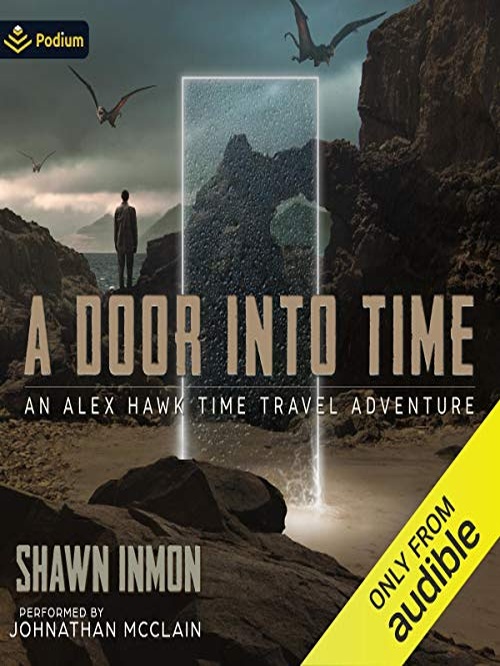
When the Wall Comes Down: A Soldier’s Accidental Journey Through Time
What does a man do when the architecture of his own home becomes a metaphor for everything he cannot explain about his life? A Door into Time, the first entry in Shawn Inmon‘s An Alex Hawk Time Travel Adventure series, opens with precisely that question — and it is a more compelling one than it first appears.
The Premise That Earns Its Audacity
Alex Hawk is not your archetypal science fiction protagonist. He carries the particular weight of a Special Forces veteran navigating the unglamorous aftermath of service: a fractured marriage, a daughter he is perpetually on the verge of failing, and a mind trained to notice what others dismiss. It is this last quality — the soldier’s compulsive attention to anomaly — that sets the plot in motion. One wall in his house is measurably too short. Most men would let it go. Alex Hawk does not let things go.
This is Inmon‘s shrewdest narrative move. By grounding the inciting incident not in cosmic accident or scientific hubris, but in the obsessive competence of a damaged man trying to fill time before his daughter’s birthday party, the author transforms what could have been a pulpy genre contrivance into something with genuine psychological texture. The time travel portal is not a wonder — it is a consequence of character.
Competence as Currency
What A Door into Time trades in, more than temporal paradox or worldbuilding spectacle, is the currency of competence. Alex’s Special Forces background is not mere window dressing; it becomes the novel’s central philosophical argument. In a future that is deliberately disorienting and stripped of familiar social scaffolding, Hawk’s capacity to observe, adapt, and execute provides both his survival mechanism and his emotional through-line.
This is a recurring obsession in adventure fiction — the Heinleinian notion that a sufficiently capable individual can impose order on any chaos — and Inmon handles it with more restraint than the genre typically demands. Alex is capable, yes, but he is not invulnerable. The emotional stakes surrounding his daughter, planted firmly in the opening chapters, do not evaporate once the portal swallows him. They persist, creating a quiet ache beneath the action that prevents the narrative from becoming mere wish fulfillment.
Johnathan McClain‘s narration deserves particular acknowledgment here. His vocal register for Alex strikes a precise balance between granite competence and suppressed vulnerability — he sounds, convincingly, like a man who has learned to keep his softer frequencies buried just below the surface.
A Future Unlike Anything Imagined — Or Is It?
The novel’s marketing leans heavily on the promise of a radically reimagined future. This claim warrants a degree of measured skepticism. Inmon‘s future is vivid and functionally realized, but readers steeped in the genre’s richer traditions — Le Guin’s anthropological rigour, Wolfe’s labyrinthine ambiguity — may find the worldbuilding more serviceable than revelatory. What it lacks in paradigmatic originality, however, it compensates for in narrative momentum. The pacing is disciplined; the world unfolds through Alex’s eyes rather than expository declaration, which is the right instinct.
The note pinned by a knife beside the doorway — a warning Alex chooses to ignore — is the novel’s most elegantly economical image. It acknowledges the genre’s conventions with a knowing wink while simultaneously asking the reader to consider: how many warnings do we walk past in our own lives, held up by nothing more than stubbornness and curiosity?
Final Reckoning
A Door into Time is not a book that will trouble the canon. It does not aspire to. What it offers instead is something more honestly valuable: a propulsive, emotionally grounded adventure that uses the machinery of Science Fiction & Fantasy to explore a genuinely interesting character under extraordinary pressure. Shawn Inmon writes with the confidence of someone who trusts his protagonist, and that trust is, more often than not, infectious.
The 4.3 listener rating it carries on Audible is a fair accounting. This is not a revelation — it is a reliable, well-crafted entertainment with a beating human heart at its center.
Ideal for readers who prefer their time travel stories anchored in character rather than theoretical physics — particularly those who appreciate military fiction’s emphasis on psychological endurance and find themselves drawn to the question of whether competence, alone, is sufficient armor against the truly unknown.
The door is open. The warning is on the wall. The only question worth asking, really, is whether you are the kind of person who reads notes before stepping through.