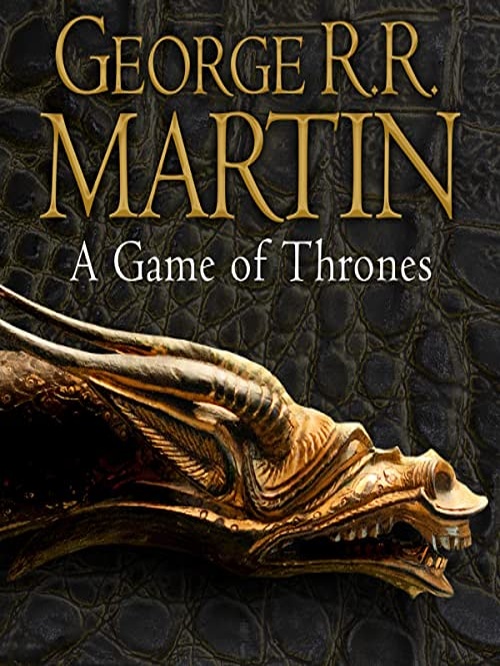
Where Winter Lingers: The Enduring Resonance of A Game of Thrones
Long before dragons soared across our television screens, A Game of Thrones, the foundational pillar of George R.R. Martin’s epic A Song of Ice and Fire saga, had already captivated a readership hungry for narratives that dared to defy the comfortable conventions of Fantasy. We approach this seminal work not merely as a chronicle of warring houses and mythical creatures, but as a profound meditation on power, morality, and the human condition, intricately woven into a tapestry of unparalleled scope and grit.
The Unflinching Gaze of Power
What strikes us immediately within these pages is Martin’s audacious dismantling of traditional heroic archetypes. This is not a world where good always triumphs, or where valor guarantees survival. Instead, Westeros is a brutal, Machiavellian landscape where allegiances are fluid, and the pursuit of the Iron Throne is a zero-sum game played with devastating consequences. The narrative refuses to shy away from the visceral impact of ambition, depicting political machinations with a chilling realism that often feels more akin to historical fiction than conventional Fantasy. Lord Eddard Stark, a man whose honor is both his shield and his fatal flaw, serves as our moral compass, yet his journey swiftly teaches us that righteousness alone offers little protection in a realm defined by treachery. This unflinching honesty, this willingness to subvert expectation and expose the raw nerves of power, is one of the book’s most transformative insights. It forces us to confront uncomfortable truths about leadership, sacrifice, and the often-ephemeral nature of justice.
A Tapestry of Contradictions and Consequence
Martin’s prose, while direct, possesses an evocative rhythm that draws the reader deep into his meticulously crafted world. We are offered a kaleidoscope of perspectives, shifting between noble lords and cunning queens, exiled princes and nascent warriors, each voice contributing a crucial thread to the grand narrative. This multi-POV structure is not merely a stylistic choice; it is a critical tool that allows for a nuanced exploration of character motivation and the subjective nature of truth. No character exists in a moral vacuum; their actions, however seemingly virtuous or villainous, ripple outwards, creating a dense web of cause and effect. The very notion of heroism is constantly challenged, as protagonists are often driven by flawed desires, and even antagonists possess moments of surprising humanity. This intricate dance of contradictions elevates A Game of Thrones beyond simple escapism, inviting intellectual engagement with the ethical dilemmas faced by its inhabitants.
The Looming Shadow of Winter
Beyond the immediate human conflict, Martin masterfully conjures a world steeped in ancient magic and primal fear. The pervasive threat of “winter coming” serves as a constant, almost philosophical, backdrop to the internecine squabbles of humanity. It represents the larger, existential dangers that humanity often ignores in its petty squabbles for dominance. The ancient gods, the whispered legends, and the chilling presence “beyond the Wall” infuse the narrative with a sense of vast history and impending doom, reminding us of forces far greater than any king or queen. This layering of supernatural menace over political drama lends the book a unique depth, suggesting that even as societies tear themselves apart, greater perils often lie unheeded at the fringes of perception.
The Throne’s Enduring Legacy
A Game of Thrones is, without equivocation, a seminal work that reshaped the landscape of modern Fantasy. It presented a paradigm shift, proving that the genre could harbor the complexity of character and the moral ambiguity typically reserved for literary fiction or historical epics. It is a work that demands patience and rewards scrutiny, unraveling its layers with each rereading. We find its sustained popularity not merely in its sprawling plot, but in its relentless examination of human nature under duress, its critique of power structures, and its bold assertion that even in the most fantastical settings, the greatest monsters often wear human faces.
This is a book for those who seek more than simple escapism; it is for the reader who relishes intellectual rigour and thematic depth in their narratives. It’s a must-read for anyone interested in the evolution of storytelling, the psychology of power, or indeed, the very question of what it means to lead in a world where moral certainties are a luxury few can afford. We are left to ponder: in the grand game of thrones, does anyone ever truly win, or are we all merely pieces, destined to fall?