A Seventeen-Year-Old Spy, a Deranged Duke, and the Dangerous Commerce of Rare Books
What happens when you hand a teenage girl a list of incunabula to acquire and a secondary mandate to gather political intelligence across enemy lines? If you’re Diana Gabaldon, you craft a novella that turns the genteel world of rare book dealing into a theater of espionage, grief, and unexpected desire — all in under six hours of narration.
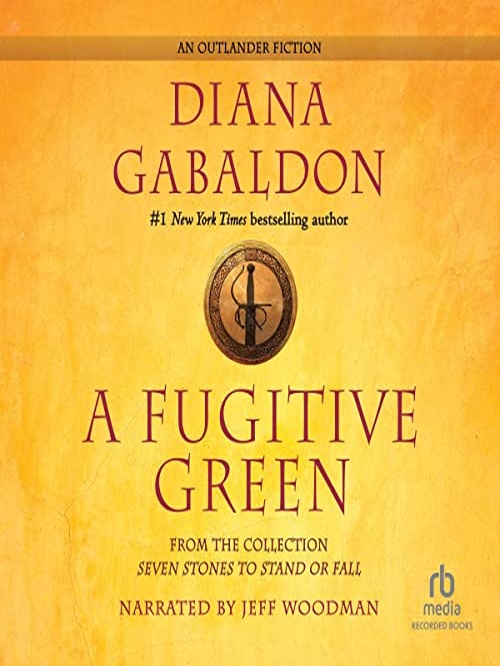
A Fugitive Green, one of the final novellas in Gabaldon’s collection Seven Stones to Stand or Fall, is a prequel of sorts — not to Claire and Jamie’s sprawling saga, but to the quieter, more cerebral corners of the Outlander universe. Here, we meet Minerva “Minnie” Renault before she becomes Minerva Grey, before she becomes anyone’s mother or wife. She is simply a girl with an extraordinary education, a father who trades in secrets as readily as in vellum, and an assignment in England that will reshape the trajectory of her life.
The Education of a Young Operative
Gabaldon has always excelled at writing women who are competent before they are romantic, and Minnie is no exception. At seventeen, she can appraise a medieval Book of Hours with surgical precision and navigate a drawing room full of aristocrats with equal dexterity. Her father has raised her not merely as a bibliophile but as an instrument — fluent in languages, trained in observation, comfortable with moral ambiguity.
What I find most compelling about this setup is its refusal to sentimentalize youth. Minnie is not naive. She is not wide-eyed. She operates in a world where information is currency and books are both objects of beauty and vessels for coded correspondence. Gabaldon treats her protagonist’s competence as a given rather than a revelation, which is a quietly radical narrative choice. We are not asked to marvel at a young woman’s capability; we are simply invited to watch her deploy it.
Harold Grey and the Architecture of Grief
The emotional core of this novella — and the element that elevates it beyond a charming historical caper — is Harold Grey, Duke of Pardloe. Lord John’s elder brother arrives in this story widowed, volatile, and described with the loaded word “deranged.” But Gabaldon, ever the precise architect, reveals that what looks like madness is merely grief without a socially acceptable container.
Harold is a man whose inner world has been demolished, and he lacks the vocabulary — or the permission — to say so. In an era that demanded stoicism from its men of rank, his raw emotional state reads as pathology. Gabaldon explores this with characteristic subtlety: she doesn’t psychoanalyze Harold so much as she lets us observe the wreckage and draw our own conclusions.
The interplay between Minnie’s controlled professionalism and Harold’s unraveling vulnerability creates a tension that is far more interesting than conventional romance. These are two people who meet at the intersection of duty and damage, and their connection feels earned precisely because Gabaldon never rushes it.
Espionage in the Margins
Gabaldon understands something fundamental about espionage fiction that many thriller writers miss: the best intelligence work happens in the margins of ordinary life. Minnie isn’t scaling walls or decoding ciphers by candlelight — she’s evaluating book collections, making polite conversation, and noting which aristocrats seem nervous about their finances. The tradecraft is embedded in the mundane, which makes it feel authentic and, paradoxically, more thrilling.
The novella’s Paris-to-England trajectory also gives Gabaldon room to sketch the political landscape of the era with her usual granular detail. She never info-dumps; instead, she filters historical context through Minnie’s professional eye. We learn about the geopolitics of the period because Minnie needs to know them to do her job. It’s exposition disguised as character work — one of Gabaldon’s most reliable tricks, and one she executes here with practiced elegance.
The Constraints and Rewards of the Short Form
At roughly five hours and forty-eight minutes in Jeff Woodman’s capable narration, A Fugitive Green necessarily lacks the sprawling, digressive richness of Gabaldon’s full-length novels. There are no hundred-page detours into herbalism or Highland culture. What we get instead is a disciplined, tightly wound narrative that proves Gabaldon can work in miniature without losing her voice.
That said, the novella’s brevity is both its strength and its limitation. Harold Grey deserves more pages. The political intrigues Minnie uncovers feel sketched rather than fully rendered. And the ending, while satisfying, arrives with a swiftness that leaves the reader slightly breathless — not in a good way, but in the manner of a conversation cut short just as it was getting truly interesting.
A Gem for the Committed, a Puzzle for the Uninitiated
I’ll be direct: this novella is not a point of entry into the Outlander universe. Its pleasures are deeply referential — the thrill of meeting Minnie decades before her appearances in the main series, the satisfaction of seeing how the Grey family’s complicated emotional DNA was established long before Lord John became a fan favorite. Readers unfamiliar with the broader saga will find a perfectly competent historical novella. Readers steeped in Gabaldon’s world will find something richer: a keystone that quietly supports an entire narrative architecture.
A Fugitive Green is for those who believe that the most dangerous weapon in any century is not a sword or a pistol but a young woman with a sharp mind, a careful eye, and a father who taught her that every book is a door — and every door can be either opened or weaponized. The question Gabaldon leaves us with is deceptively simple: When you’ve been raised to see people as sources of information, what does it cost you to finally see one as a human being?