A Storm of Swords Review

The Unrelenting Tempest: A Deeper Look into A Storm of Swords

In the vast, intricate tapestry woven by George R.R. Martin, A Storm of Swords, the third installment in the epic A Song of Ice and Fire series, stands not merely as a continuation but as a veritable watershed moment. We find ourselves, as readers, caught in a maelstrom far more ferocious and unpredictable than anything hinted at in its predecessors. This is where the grim prophecies coalesce into brutal realities, where the familiar contours of fantasy tropes are not just bent but irrevocably shattered.

The Crucible of Conflict: Where All Hope Lies Bleeding

To speak of A Storm of Swords is to grapple with the sheer, unflinching audacity of its narrative. Martin, with a precision both surgical and devastating, elevates the stakes to an almost unbearable degree. We witness the full, horrific fruition of the wars that have simmered and raged across Westeros. Alliances are forged only to be betrayed with breathtaking savagery, and the quest for power consumes its adherents in a conflagration of ambition and despair. The Lannisters may hold the Iron Throne, but their grip is tenuous, their dominion haunted by the ghosts of their victims and the whispers of their enemies. Robb Stark, the young wolf, struggles to maintain his rebellion, his destiny entwined with a fate as cruel as any Shakespearean tragedy. And across the narrow sea, Daenerys Targaryen, mistress of the last three dragons, continues her inexorable march, her burgeoning power a beacon of both hope and potential devastation.

What sets this volume apart is its relentless commitment to consequence. Martin understands that in war, heroes often fall, and villains can find moments of unexpected humanity. The moral landscape is not merely grey; it is a sprawling, blood-soaked morass where every decision carries an existential weight. Characters we have grown to love, or perhaps despise, are subjected to tortures both physical and psychological, pushing them beyond their limits and revealing facets of their being we scarcely imagined. This isn’t just a story about kings and queens; it is a profound exploration of human resilience, depravity, and the elusive nature of justice in a world governed by brutal power dynamics.

Beyond the Wall: The True Darkness Gathers

While the internal conflicts of the Seven Kingdoms dominate much of the narrative, Martin masterfully broadens the canvas, reminding us of the far greater, more ancient threats looming on the horizon. The barbaric wildlings, driven south by an even more terrifying menace, arrive en masse, their desperation and savagery a chilling counterpoint to the political machinations of the south. In their vanguard marches the mythical Others, a supernatural army of the living dead, whose animated corpses are unstoppable. This unfolding crisis from the outermost lines of civilization serves as a stark, chilling reminder that the petty squabbles for the Iron Throne pale in comparison to the existential threat that truly endangers all of humanity. It is a brilliant narrative device, forcing characters and readers alike to confront the ultimate folly of internecine conflict when a greater darkness descends.

A Literary Feat: The Art of the Narrative Shockwave

Martin’s prose in A Storm of Swords is as sharp and multifaceted as the blades wielded by his characters. He wields detail and foreshadowing with surgical precision, building tension with a slow, agonizing burn before unleashing narrative shockwaves that reverberate long after the final page. The depth of characterization, the intricate plotting, and the sheer audacity of his storytelling choices are unparalleled in contemporary Fantasy. We are not simply reading a story; we are immersing ourselves in a living, breathing world, fraught with danger, beauty, and inescapable sorrow. The audiobook narration by Roy Dotrice only amplifies this immersion, lending each character a distinct voice that resonates deeply.

The Enduring Impact and Who Should Brave the Storm

A Storm of Swords is not a book for the faint of heart, nor for those seeking simplistic escapism. It is a monumental achievement in modern Science Fiction & Fantasy, a work that challenges our preconceived notions of heroism, villainy, and the very nature of storytelling. We emerge from its pages not merely entertained, but fundamentally altered, perhaps a touch more cynical about power, but also deeply appreciative of the intricate ballet of human triumph and tragedy.

This volume is essential reading for anyone who appreciates literature that dares to be bold, complex, and unsparingly realistic in its portrayal of war and human nature. It is for those who crave a narrative that rewards deep engagement and analytical thought, an experience that transcends genre boundaries. For literary enthusiasts seeking a masterclass in world-building and character development, and particularly for those who believe that Fantasy can explore profound humanistic questions with intellectual rigour, this book is an absolute imperative. Dive into this storm, but be warned: you may never look at stories—or the world—the same way again.
A Game of Thrones Review

Where Winter Lingers: The Enduring Resonance of A Game of Thrones

Long before dragons soared across our television screens, A Game of Thrones, the foundational pillar of George R.R. Martin’s epic A Song of Ice and Fire saga, had already captivated a readership hungry for narratives that dared to defy the comfortable conventions of Fantasy. We approach this seminal work not merely as a chronicle of warring houses and mythical creatures, but as a profound meditation on power, morality, and the human condition, intricately woven into a tapestry of unparalleled scope and grit.

The Unflinching Gaze of Power

What strikes us immediately within these pages is Martin’s audacious dismantling of traditional heroic archetypes. This is not a world where good always triumphs, or where valor guarantees survival. Instead, Westeros is a brutal, Machiavellian landscape where allegiances are fluid, and the pursuit of the Iron Throne is a zero-sum game played with devastating consequences. The narrative refuses to shy away from the visceral impact of ambition, depicting political machinations with a chilling realism that often feels more akin to historical fiction than conventional Fantasy. Lord Eddard Stark, a man whose honor is both his shield and his fatal flaw, serves as our moral compass, yet his journey swiftly teaches us that righteousness alone offers little protection in a realm defined by treachery. This unflinching honesty, this willingness to subvert expectation and expose the raw nerves of power, is one of the book’s most transformative insights. It forces us to confront uncomfortable truths about leadership, sacrifice, and the often-ephemeral nature of justice.

A Tapestry of Contradictions and Consequence

Martin’s prose, while direct, possesses an evocative rhythm that draws the reader deep into his meticulously crafted world. We are offered a kaleidoscope of perspectives, shifting between noble lords and cunning queens, exiled princes and nascent warriors, each voice contributing a crucial thread to the grand narrative. This multi-POV structure is not merely a stylistic choice; it is a critical tool that allows for a nuanced exploration of character motivation and the subjective nature of truth. No character exists in a moral vacuum; their actions, however seemingly virtuous or villainous, ripple outwards, creating a dense web of cause and effect. The very notion of heroism is constantly challenged, as protagonists are often driven by flawed desires, and even antagonists possess moments of surprising humanity. This intricate dance of contradictions elevates A Game of Thrones beyond simple escapism, inviting intellectual engagement with the ethical dilemmas faced by its inhabitants.

The Looming Shadow of Winter

Beyond the immediate human conflict, Martin masterfully conjures a world steeped in ancient magic and primal fear. The pervasive threat of “winter coming” serves as a constant, almost philosophical, backdrop to the internecine squabbles of humanity. It represents the larger, existential dangers that humanity often ignores in its petty squabbles for dominance. The ancient gods, the whispered legends, and the chilling presence “beyond the Wall” infuse the narrative with a sense of vast history and impending doom, reminding us of forces far greater than any king or queen. This layering of supernatural menace over political drama lends the book a unique depth, suggesting that even as societies tear themselves apart, greater perils often lie unheeded at the fringes of perception.

The Throne’s Enduring Legacy

A Game of Thrones is, without equivocation, a seminal work that reshaped the landscape of modern Fantasy. It presented a paradigm shift, proving that the genre could harbor the complexity of character and the moral ambiguity typically reserved for literary fiction or historical epics. It is a work that demands patience and rewards scrutiny, unraveling its layers with each rereading. We find its sustained popularity not merely in its sprawling plot, but in its relentless examination of human nature under duress, its critique of power structures, and its bold assertion that even in the most fantastical settings, the greatest monsters often wear human faces.

This is a book for those who seek more than simple escapism; it is for the reader who relishes intellectual rigour and thematic depth in their narratives. It’s a must-read for anyone interested in the evolution of storytelling, the psychology of power, or indeed, the very question of what it means to lead in a world where moral certainties are a luxury few can afford. We are left to ponder: in the grand game of thrones, does anyone ever truly win, or are we all merely pieces, destined to fall?

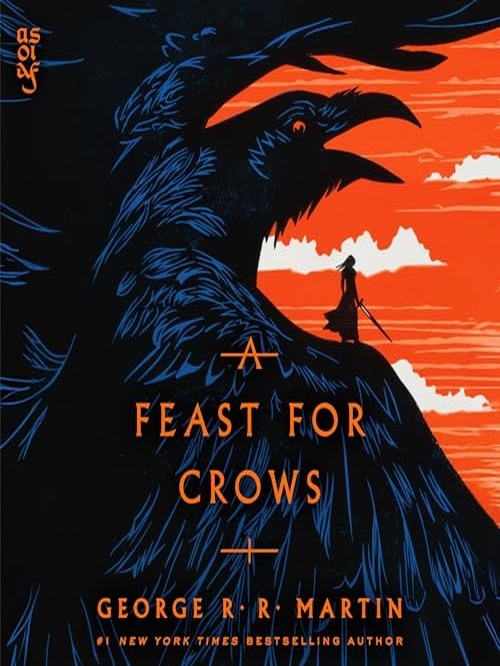
A Feast for Crows Review

The Kingdom Bleeds Out: On the Quiet Devastation of A Feast for Crows

What happens when the war ends but nobody wins? George R.R. Martin poses this question not with triumph or resolution, but with the unsettling image of carrion birds descending on a battlefield. The title itself—A Feast for Crows—is a thesis statement. This is not a book about victors. It is a book about scavengers, about the hollow men and women who remain standing when the dust settles, grasping at power with blood still drying under their fingernails.

And yet, for all its brilliance, this is the volume in A Song of Ice and Fire that divides the faithful most sharply. I’d argue that division is precisely the point.


The Silence Where Dragons Should Be

Let’s address the elephant—or rather, the absent dragon—in the room. A Feast for Crows was famously split from its sibling volume, A Dance with Dragons, meaning fan-favorite characters like Daenerys, Tyrion, and Jon Snow are entirely absent here. For readers who came to Martin’s saga seeking the momentum of war and the spectacle of dragonfire, this omission stings. It stings deliberately.

What Martin gives us instead is something rarer and, I would argue, more courageous: a study in entropy. The Seven Kingdoms are exhausted. The great houses have bled themselves nearly dry. And into that vacuum creep figures who are not conquerors but administrators, zealots, and opportunists—people for whom the aftermath is the opportunity. Martin is asking us to sit with discomfort, to watch a world try to rebuild itself with broken tools and compromised people. It is not a crowd-pleasing choice. It is, however, a profoundly honest one.

Cersei Lannister and the Architecture of Self-Destruction

If this book belongs to anyone, it belongs to Cersei. And what Martin accomplishes with her point of view is nothing short of a masterclass in unreliable narration and tragic irony.

We have watched Cersei from the outside for three books—calculating, cruel, formidable. Now Martin takes us inside her mind, and the revelation is devastating: she is none of those things. Or rather, she believes she is all of those things, and that belief is the engine of her undoing. Cersei fancies herself a female Tywin, a strategic genius shackled by a patriarchal world. The truth, which Martin lets us perceive through the gap between her self-narration and reality, is that she is paranoid, impulsive, and catastrophically poor at reading people.

This is not misogyny on Martin’s part—it is a portrait of what happens when a genuinely intelligent person is denied education, denied agency, denied respect for an entire lifetime, and then handed absolute power. Cersei’s chapters are a slow-motion car wreck narrated by the driver who insists she’s winning a race. I found them excruciating, mesmerizing, and among the finest character work in the entire series.

The Broken and the Reborn

Martin’s thematic preoccupation in A Feast for Crows is identity—specifically, the way violence strips identity away and the desperate, often futile ways people try to reconstruct themselves afterward.

Consider Brienne of Tarth, whose chapters have been criticized as repetitive wandering. I see something else entirely: a medieval road narrative that functions as a moral inventory of Westeros from the ground level. Brienne moves through a landscape of burned villages, broken men, and orphaned children. She is searching for Sansa Stark, yes, but she is also searching for proof that honor still means something in a world that has systematically punished her for believing in it. Her chapters are slow. They are meant to be. The slowness is the argument—that decency is a long, unglamorous, often thankless road.

Then there is the Jaime Lannister of this volume, a man literally and figuratively disarmed, attempting to become something other than the Kingslayer. And Arya Stark, surrendering her name at the House of Black and White, trading identity itself for the promise of power. And the introduction of the Ironborn and Dornish plotlines, cultures defined by their relationship to legacy and vengeance—people who construct identity entirely around what was taken from them.

Martin weaves these threads into a tapestry that asks a single, haunting question: when everything you were has been destroyed, what do you choose to become?

A Different Kind of Danger

The prose in A Feast for Crows is Martin at his most elegiac. The visceral shock of the Red Wedding is replaced by a creeping dread, a sense that the real catastrophe is not the war that was fought but the peace that is being built on rotten foundations. The rise of the Faith Militant under the High Sparrow—a plotline that resonates with uncomfortable contemporary relevance—is a slow burn that demonstrates how power vacuums are filled not by the strongest, but by the most fanatical.

Roy Dotrice’s narration in the audiobook edition deserves particular mention. His voice, weathered and textured like old parchment, suits this particular volume’s tone better than perhaps any other in the series. There is a weariness in his delivery that mirrors the weariness of Westeros itself.

The Verdict of the Crows

I will not pretend A Feast for Crows is flawless. The Ironborn chapters, particularly those centered on Aeron Greyjoy, can feel like detours into a saga we did not ask to enter. The pacing, by design, demands patience that not every reader will feel the story has earned. And the structural decision to split the narrative geographically rather than chronologically creates an inevitable sense of incompleteness—we are reading half a book, and we feel it.

But here is what I keep returning to, years after my first read: A Feast for Crows is the volume that trusts its readers the most. It trusts us to find drama in politics rather than battles, in psychology rather than spectacle, in the quiet horror of a kingdom eating itself alive rather than the loud horror of swords and fire. It is Martin’s most literary novel, his most thematically coherent, and—I suspect—the one that will age the best.

This book is for: readers who understand that the most interesting part of any war story is what comes after. Those who appreciate character studies drawn with surgical precision. Anyone who has ever watched someone in power and thought, they have no idea what they’re doing. And for those willing to accept that in Martin’s world, the feast is never a celebration—it is a funeral that hasn’t realized it yet.

So I leave you with this: in a genre that overwhelmingly celebrates the seizing of power, what does it mean that Martin wrote an entire novel about the cost of holding it? And what does it say about us that we found it so much harder to read?

A Dance with Dragons Review

The Throne Is Won in Battle, but Held in Mud and Compromise

There is a moment in A Dance with Dragons — the fifth and, for now, final installment of George R.R. Martin‘s A Song of Ice and Fire — where Daenerys Targaryen, Mother of Dragons, Breaker of Chains, conqueror of cities, sits in a pit surrounded by thousands of screaming spectators and watches men die for sport. She hates it. She permits it anyway. It is, perhaps, the most quietly devastating scene Martin has ever written — not because of its violence, but because of what it says about the cost of ruling. You can burn a kingdom down with dragonfire. Governing what remains? That requires something fire cannot provide.

This is a novel about the morning after the revolution, and it is both Martin’s most ambitious and most polarizing work.


Power Doesn’t Arc — It Erodes

If A Game of Thrones was a masterclass in political betrayal and A Storm of Swords delivered the visceral shock of consequences made real, then A Dance with Dragons concerns itself with a far less cinematic question: what happens when the people who wanted power finally have it?

Jon Snow, the 998th Lord Commander of the Night’s Watch, discovers that commanding men is nothing like earning their respect. His decisions are sound, strategically defensible, even morally necessary — and they breed resentment in every corridor of Castle Black. Martin refuses to grant Jon the narrative armor of a protagonist who is simply misunderstood. Instead, he forces us to sit with an uncomfortable truth: good leadership often looks, from the inside, indistinguishable from tyranny.

Daenerys faces a mirror image of the same dilemma in Meereen. She has liberated a slave city, and now the freed and the former masters alike demand she become something she never prepared to be — an administrator. The dragon queen who swept across Slaver’s Bay with righteous fury finds herself negotiating sewer repairs and brokering marriages she does not want. Martin’s refusal to let Daenerys simply fly west to Westeros is not, as some critics have charged, narrative stalling. It is the entire point. Empire is not conquest; empire is maintenance, and maintenance is inglorious.

The Quiet Architecture of Identity

What struck me most on rereading — and this is a book that genuinely rewards rereading — is how deeply A Dance with Dragons is preoccupied with the question of selfhood. Theon Greyjoy, broken and renamed “Reek” by the sadistic Ramsay Bolton, undergoes one of the most harrowing identity deconstructions in modern fantasy. His chapters are not easy to stomach. They are also, I would argue, among the finest things Martin has ever written. The slow, agonizing process by which Theon claws his way back toward some fractured version of himself — “My name is Theon. You have to know your name” — carries a psychological authenticity that transcends genre. This is not fantasy escapism. This is literary fiction wearing a cloak of ice and snow.

Tyrion Lannister, too, is stripped of every advantage that once defined him — his name, his wealth, his wit as currency — and forced to confront a version of himself that is merely human. His journey down the Rhoyne, through slavery, through self-loathing, is Martin at his most Dostoevskian: a brilliant man who cannot stop destroying himself, narrating his own decline with devastating clarity.

And then there is the mystery of Aegon Targaryen — or whoever he truly is — a plot thread that interrogates the very nature of legitimacy. Does it matter if a king is real, Martin seems to ask, if enough people believe he is?

The Weight — and Worth — of Patience

I will not pretend this is a flawless book. It is not. At nearly forty-nine hours in Roy Dotrice‘s capable narration, A Dance with Dragons demands extraordinary patience. Certain Meereenese political intrigues feel labyrinthine to the point of opacity. Some readers will find the proliferation of new point-of-view characters — Quentyn Martell, Jon Connington, Barristan Selmy — dilutes rather than enriches the central narrative momentum. These are legitimate criticisms.

But I think they miss something essential about what Martin is constructing. This is not a series built on the architecture of payoff. It is built on the architecture of consequence. Every feast has a famine. Every war has an aftermath. Martin’s willingness to inhabit those unglamorous spaces — the council chambers, the sickbeds, the long marches through frozen wastes — is precisely what elevates A Song of Ice and Fire above its imitators. He does not skip to the good parts because he understands that the “boring” parts are where character is forged and meaning is made.

The novel’s final hundred pages, it should be said, deliver some of the most breathtaking cliffhangers in the entire series. Martin earns them precisely because he made us wait.

Who Should Walk This Road

A Dance with Dragons is not for the casual reader seeking quick narrative gratification. It is for those who have invested in this world and are willing to trust that Martin’s patience has purpose. It is for readers who find political complexity as thrilling as swordplay — who understand that a queen choosing whom to marry can carry more dramatic weight than a battle involving ten thousand soldiers.

It is, above all, for readers who believe that fantasy literature at its best does not offer escape from the human condition but a deeper immersion into it.

I finished A Dance with Dragons unsettled, hungry, and haunted — which is, I suspect, exactly how Martin intended it. The question that lingers is not what happens next in Westeros. It is the one the book has been asking all along, in every chapter, through every compromised choice and every shattered ideal:

When the cost of doing the right thing becomes indistinguishable from the cost of doing the wrong thing — how do you know which one you chose?

A Clash of Kings Review

The Unfolding Tapestry of Kingship and Chaos: A Deep Dive into A Clash of Kings

In the annals of fantasy literature, few sagas have etched themselves into the collective consciousness with the indelible force of A Song of Ice and Fire. Following the seismic shifts of its predecessor, A Clash of Kings by George R.R. Martin does not merely continue the narrative; it elevates the foundational tremors into a full-blown seismic event, reshaping the very landscape of Westeros and, indeed, our expectations of the genre itself. We are plunged headlong into a world where the precarious balance of power has irrevocably shattered, and the stakes for every soul, from peasant to king, have become impossibly high.

Navigating the Charybdis of Crown and Consequence

A Clash of Kings distinguishes itself not merely through its expansive scope but through its unflinching examination of the moral calculus demanded by leadership amidst existential threat. Here, Martin refines his intricate narrative architecture, deftly weaving together disparate threads that illuminate the multifaceted nature of governance and ambition. The titular clash is not solely between armies, but between competing ideologies of rule, each championed by flawed individuals convinced of their own divine right or pragmatic necessity. We witness the brutal pragmatism of Stannis Baratheon, the unsettling messianic fervor surrounding Daenerys Targaryen, the cunning manipulations of the Lannisters, and the tragic heroism of the Stark children, each narrative strand contributing to a tapestry of bewildering complexity. This is not a tale of clear-cut heroes and villains, but rather a profound meditation on the corrosive nature of power and the terrifying burden of sovereignty.

Martin’s genius lies in his refusal to simplify. The strategic brilliance of Tyrion Lannister, for instance, is presented alongside his personal vulnerabilities and the societal prejudices he faces, making him a figure of compelling paradox. Similarly, the burgeoning sense of self in Arya Stark, forced into a harsh education in survival and subterfuge, transcends typical character arcs to explore the psychological toll of trauma and adaptation. These aren’t just characters; they are studies in human resilience and depravity, their choices rippling through the land with devastating consequence. The novel forces us to confront uncomfortable truths about justice, loyalty, and the seductive allure of absolute power, often leaving us to ponder if any victory can ever truly be clean in such a morally compromised world.

Furthermore, the expansion of the known world — from the brutal, ancient lands beyond the Wall, where Martin delves deeper into the chilling mythos of the Others, to the exotic, mercantile city of Qarth — serves not just as exotic scenery but as crucial context for the global implications of Westeros’s internal strife. The growing supernatural elements are seamlessly integrated, reminding us that the human squabbles, however grand, are but one facet of a larger, more ancient struggle for the very fate of the world. This contextualization enriches the thematic depth, adding layers of cosmic dread to the all-too-human political machinations.

The Weight of a World in Turmoil

To immerse oneself in A Clash of Kings is to undertake a journey of intellectual and emotional rigour. It is a work that demands patience and rewards scrutiny, unraveling its layers like a historical document rather than a simple fantasy novel. The prose, while not overtly florid, possesses a vivid, almost painterly quality, particularly in its descriptions of battle, landscape, and the inner turmoil of its sprawling cast. Martin uses language with precision, crafting scenes that resonate with visceral impact and profound psychological insight. We are not merely observers but rather embedded within the shifting allegiances and perilous campaigns, feeling the bite of winter and the heat of ambition.

This is a book for the discerning reader who appreciates a narrative that eschews easy answers and embraces the sprawling, often contradictory nature of human experience. It is for those who find intellectual pleasure in dissecting political intrigue, exploring the nuances of character development, and contemplating the broader philosophical questions embedded within a richly imagined secondary world. If your reading tastes lean towards the intricate tapestries of historical fiction, the moral quandaries of philosophical novels, or the epic scope of classic literature, then A Clash of Kings offers a rewarding, albeit challenging, engagement.

Ultimately, A Clash of Kings is far more than just the second act in a fantasy saga; it is a masterclass in world-building and character-driven storytelling, cementing George R.R. Martin‘s place as a modern literary titan. It invites us not just to read, but to ponder the true cost of ambition, the fragility of order, and what, if anything, remains sacred when a world plunges into chaos. What, we are compelled to ask, defines a king in an age where all crowns are forged in blood and betrayal?