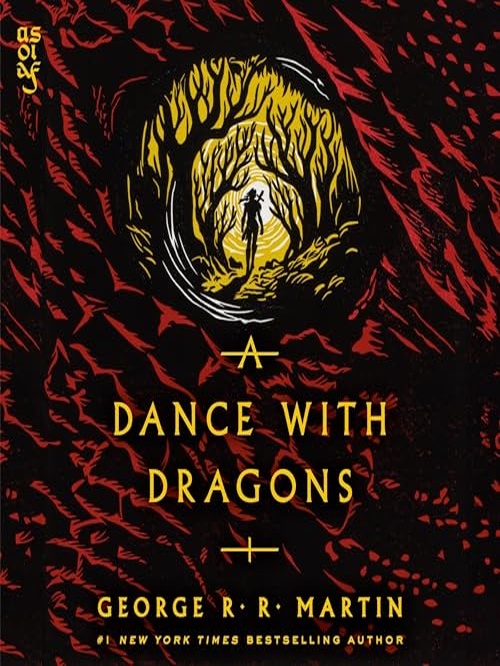
The Throne Is Won in Battle, but Held in Mud and Compromise
There is a moment in A Dance with Dragons — the fifth and, for now, final installment of George R.R. Martin‘s A Song of Ice and Fire — where Daenerys Targaryen, Mother of Dragons, Breaker of Chains, conqueror of cities, sits in a pit surrounded by thousands of screaming spectators and watches men die for sport. She hates it. She permits it anyway. It is, perhaps, the most quietly devastating scene Martin has ever written — not because of its violence, but because of what it says about the cost of ruling. You can burn a kingdom down with dragonfire. Governing what remains? That requires something fire cannot provide.
This is a novel about the morning after the revolution, and it is both Martin’s most ambitious and most polarizing work.
Power Doesn’t Arc — It Erodes
If A Game of Thrones was a masterclass in political betrayal and A Storm of Swords delivered the visceral shock of consequences made real, then A Dance with Dragons concerns itself with a far less cinematic question: what happens when the people who wanted power finally have it?
Jon Snow, the 998th Lord Commander of the Night’s Watch, discovers that commanding men is nothing like earning their respect. His decisions are sound, strategically defensible, even morally necessary — and they breed resentment in every corridor of Castle Black. Martin refuses to grant Jon the narrative armor of a protagonist who is simply misunderstood. Instead, he forces us to sit with an uncomfortable truth: good leadership often looks, from the inside, indistinguishable from tyranny.
Daenerys faces a mirror image of the same dilemma in Meereen. She has liberated a slave city, and now the freed and the former masters alike demand she become something she never prepared to be — an administrator. The dragon queen who swept across Slaver’s Bay with righteous fury finds herself negotiating sewer repairs and brokering marriages she does not want. Martin’s refusal to let Daenerys simply fly west to Westeros is not, as some critics have charged, narrative stalling. It is the entire point. Empire is not conquest; empire is maintenance, and maintenance is inglorious.
The Quiet Architecture of Identity
What struck me most on rereading — and this is a book that genuinely rewards rereading — is how deeply A Dance with Dragons is preoccupied with the question of selfhood. Theon Greyjoy, broken and renamed “Reek” by the sadistic Ramsay Bolton, undergoes one of the most harrowing identity deconstructions in modern fantasy. His chapters are not easy to stomach. They are also, I would argue, among the finest things Martin has ever written. The slow, agonizing process by which Theon claws his way back toward some fractured version of himself — “My name is Theon. You have to know your name” — carries a psychological authenticity that transcends genre. This is not fantasy escapism. This is literary fiction wearing a cloak of ice and snow.
Tyrion Lannister, too, is stripped of every advantage that once defined him — his name, his wealth, his wit as currency — and forced to confront a version of himself that is merely human. His journey down the Rhoyne, through slavery, through self-loathing, is Martin at his most Dostoevskian: a brilliant man who cannot stop destroying himself, narrating his own decline with devastating clarity.
And then there is the mystery of Aegon Targaryen — or whoever he truly is — a plot thread that interrogates the very nature of legitimacy. Does it matter if a king is real, Martin seems to ask, if enough people believe he is?
The Weight — and Worth — of Patience
I will not pretend this is a flawless book. It is not. At nearly forty-nine hours in Roy Dotrice‘s capable narration, A Dance with Dragons demands extraordinary patience. Certain Meereenese political intrigues feel labyrinthine to the point of opacity. Some readers will find the proliferation of new point-of-view characters — Quentyn Martell, Jon Connington, Barristan Selmy — dilutes rather than enriches the central narrative momentum. These are legitimate criticisms.
But I think they miss something essential about what Martin is constructing. This is not a series built on the architecture of payoff. It is built on the architecture of consequence. Every feast has a famine. Every war has an aftermath. Martin’s willingness to inhabit those unglamorous spaces — the council chambers, the sickbeds, the long marches through frozen wastes — is precisely what elevates A Song of Ice and Fire above its imitators. He does not skip to the good parts because he understands that the “boring” parts are where character is forged and meaning is made.
The novel’s final hundred pages, it should be said, deliver some of the most breathtaking cliffhangers in the entire series. Martin earns them precisely because he made us wait.
Who Should Walk This Road
A Dance with Dragons is not for the casual reader seeking quick narrative gratification. It is for those who have invested in this world and are willing to trust that Martin’s patience has purpose. It is for readers who find political complexity as thrilling as swordplay — who understand that a queen choosing whom to marry can carry more dramatic weight than a battle involving ten thousand soldiers.
It is, above all, for readers who believe that fantasy literature at its best does not offer escape from the human condition but a deeper immersion into it.
I finished A Dance with Dragons unsettled, hungry, and haunted — which is, I suspect, exactly how Martin intended it. The question that lingers is not what happens next in Westeros. It is the one the book has been asking all along, in every chapter, through every compromised choice and every shattered ideal:
When the cost of doing the right thing becomes indistinguishable from the cost of doing the wrong thing — how do you know which one you chose?