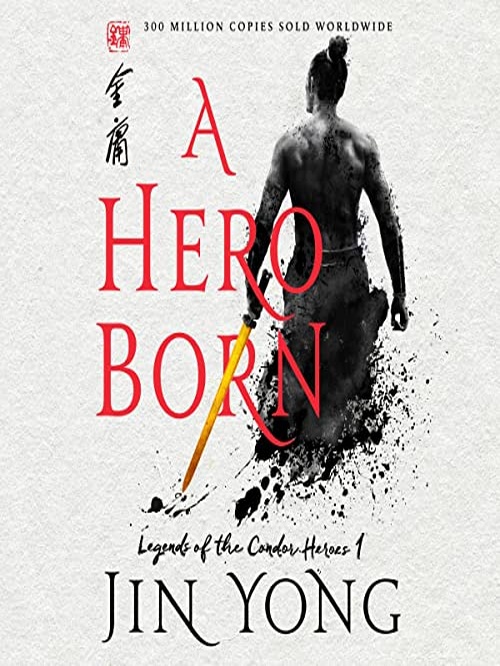
The Wuxia Epic the West Almost Never Got to Read
What does it mean that arguably the most widely read novelist of the twentieth century—a writer whose works have sold over 300 million copies—remained virtually unknown to English-speaking audiences until 2018? Jin Yong‘s A Hero Born, the first volume of the Legends of the Condor Heroes tetralogy, is not merely a fantasy novel. It is a cultural artifact of staggering significance, a foundational text for an entire genre, and a mirror held up to a civilization’s deepest anxieties about loyalty, identity, and the moral weight of violence. That it took nearly six decades for this book to cross the linguistic divide is less a publishing curiosity than a quiet indictment of Western literary insularity.
A Story Forged in the Crucible of Empires
The novel opens in the dying light of the Southern Song dynasty, around AD 1200, a period of existential fragmentation for China. Two sworn brothers—patriotic soldiers of modest means—see their families torn apart by political treachery and Jurchen aggression. One child, Guo Jing, survives alongside his mother, fleeing northward into the Mongolian steppe, where they find unlikely refuge among the rising forces of a young warlord named Temüjin—the man history will remember as Genghis Khan.
What unfolds from this premise is not, however, a historical novel in any conventional Western sense. Jin Yong builds a world in which kung fu operates as both martial discipline and philosophical language, where combat sequences function as elaborate metaphors for moral argument. Guo Jing is, by design, no prodigy. He is slow-witted, stubborn, and almost comically earnest—a deliberate subversion of the gifted-hero archetype that dominates both Eastern and Western fantasy traditions. His education under the Seven Heroes of the South is less a training montage than a prolonged meditation on what it costs to become decent in a world that rewards cunning.
I find this choice quietly radical. In an era saturated with “chosen one” narratives and protagonists whose specialness is innate and effortless, Guo Jing earns every inch of his journey through sheer, unglamorous persistence. He is not born exceptional. He is born loyal. And Jin Yong asks us to consider whether that might be enough.
The Architecture of Wuxia, Decoded
For readers approaching wuxia fiction for the first time, a word of recalibration is necessary. The genre operates under narrative conventions that differ markedly from the Western fantasy canon shaped by Tolkien and his descendants. Where Western epic fantasy tends toward world-building through geography and lore—maps, appendices, invented languages—wuxia builds its architecture through martial lineage. Schools of fighting are schools of thought. A character’s shifu (master) matters more than their birthplace. Allegiance is demonstrated not through oaths sworn before thrones but through the specific way one throws a punch.
Jin Yong is a master of this idiom, and A Hero Born showcases three of his most distinctive strengths:
First, the choreography of violence as storytelling. The fight sequences in this novel are extraordinary—not because they are brutal, but because they are legible. Each combatant’s style encodes their psychology. The flamboyant techniques of the villainous martial artists contrast sharply with the grounded, orthodox methods of the Seven Heroes. Combat becomes characterization, and Jin Yong renders it with the precision of a dramatist blocking a stage play.
Second, the layering of historical and mythic registers. The novel weaves real historical events—the Mongol unification, the geopolitics of the Jin-Song conflict—into a fabric of invented martial arts lineages and supernatural feats with remarkable fluency. This is not history dressed up in fantasy costumes. It is an imaginative reckoning with history, a way of asking what loyalty and heroism look like when empires collapse and ordinary people are ground between tectonic forces they cannot control.
Third, the moral complexity beneath the adventure. Guo Jing’s journey toward his destined confrontation is not simply a matter of acquiring sufficient skill to defeat an opponent. It is a reckoning with inheritance—with the sins and promises of fathers, with the question of whether a child can escape the trajectory set by forces that predate their birth. The rival he must face carries a connection to his own family’s history, and Jin Yong refuses to reduce this antagonism to a simple good-versus-evil binary. There are betrayals on every side. There are reasons for every treachery.
What the Translation Reveals—and Conceals
Anna Holmwood’s English translation deserves specific acknowledgment. Translating wuxia is an act of controlled impossibility: the genre’s vocabulary is deeply embedded in Chinese literary, philosophical, and somatic traditions that have no direct English equivalents. Holmwood navigates this with considerable grace, opting for transparency over domestication. She preserves terms like shifu and qinggong where anglicization would flatten their meaning, and her rendering of the fight choreography maintains a kinetic clarity that is no small feat.
That said, I suspect something ineffable is lost—the rhythmic density of Jin Yong‘s Chinese prose, which readers familiar with the original describe as almost musical in its cadences. The audiobook narration by Carolyn Oldershaw and Daniel York Loh partially compensates, lending the text an oral-storytelling quality that feels appropriate to a genre born from Chinese storytelling traditions. York Loh in particular brings a cross-cultural sensibility that serves the material’s hybrid energy.
Still, the translation occasionally stumbles in pacing. Sections that likely crackle in Mandarin can feel episodic and digressive in English, particularly in the novel’s middle third, where the accumulation of new martial arts encounters risks becoming catalogic rather than propulsive. Western readers accustomed to tighter narrative economy may need to adjust their expectations—and their patience. This is a novel that rewards surrender to its rhythms rather than resistance.
More Than a Fantasy Novel—A Gateway to a Literary Continent
What strikes me most forcefully about A Hero Born is not any single narrative moment but rather the dawning recognition, as I read, of how vast and sophisticated a literary tradition I had been ignorant of. Jin Yong is often called “the Tolkien of Chinese literature,” but this comparison, while useful as marketing shorthand, is ultimately reductive. Tolkien was a philologist constructing a mythology for England. Jin Yong was a journalist and political commentator using the wuxia framework to interrogate the moral compromises of power, the fragility of brotherhood, and the question of what constitutes genuine heroism in a corrupted world. His concerns are less mythological than ethical.
A Hero Born is the opening movement of a much larger symphony—the first of four volumes, and one can feel the deliberate pacing of a novelist who knows he has room to develop his themes across thousands of pages. As a standalone experience, it is not without its frustrations: the characterization of women remains largely peripheral in this volume, and Guo Jing’s slowness, while thematically purposeful, can test one’s engagement. But as an invitation into a narrative world of extraordinary richness and moral seriousness, it is compelling.
This book is for readers who have exhausted the Tolkien-Martin-Le Guin axis of Western fantasy and hunger for something genuinely other—not exotic in the superficial sense, but structurally, philosophically, and aesthetically different. It is for anyone who suspects that the global canon of epic storytelling extends far beyond the boundaries we’ve been taught to recognize. It is for the reader willing to be a beginner again.
I finished A Hero Born with a question I haven’t been able to shake: How many other literary traditions of this magnitude are sitting just beyond the edge of our awareness, waiting for a translator brave enough to carry them across? And what does it say about us that we haven’t gone looking sooner?