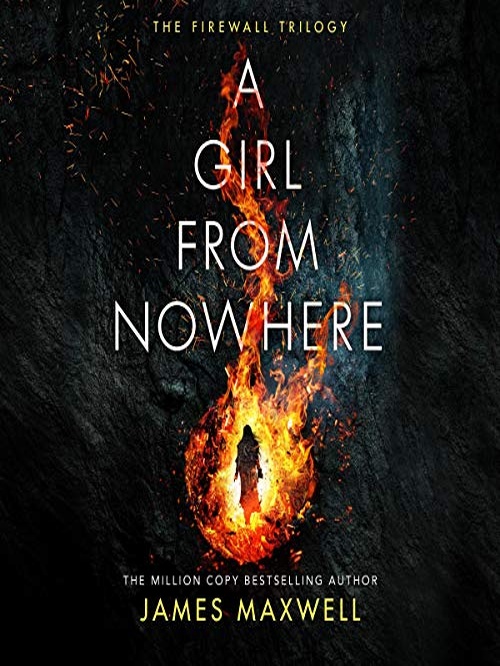
When the Sun Burns Twice: James Maxwell’s Unforgiving Desert Epic
What does it mean to survive in a world that was never designed for your survival? It’s a question as old as speculative fiction itself, from Frank Herbert’s Arrakis to Cormac McCarthy’s ashen wastelands. In James Maxwell’s A Girl from Nowhere, the opening volume of The Firewall Trilogy, the answer arrives not through grand philosophical monologues but through blistered feet, a crippled leg, and the stubborn, almost irrational refusal to die. This is a novel that earns its emotional weight through deprivation—stripping its characters down to bone and sinew before asking us whether anything meaningful can be built from what remains.
A Wasteland That Breathes
Maxwell constructs his world with an economy that I find genuinely admirable. Two suns scorch the land. Water is currency. Survival is not metaphor—it is the plot. The wasteland here is not mere backdrop; it functions as an antagonist with its own rhythms, its own cruelties, its own indifferent logic. Raiders roam. Strange creatures hunt. And the land itself seems to reject the very notion of civilization.
What elevates this beyond standard post-apocalyptic fare is the texture of daily existence Maxwell renders. We feel the heat. We taste the dust. There is a physicality to this world-building that recalls the best traditions of Fantasy survival narratives—where the environment doesn’t simply threaten the characters but fundamentally shapes who they become. Taimin’s disability isn’t a plot device to be conveniently resolved; it is the lens through which he understands power, vulnerability, and the cost of depending on others in a place where dependency can kill you.
Two Broken Compasses Pointing Toward the Same Myth
The dual-protagonist structure is where Maxwell’s narrative instincts prove sharpest. Taimin—orphaned, crippled, burning with a revenge that gives him direction even as it hollows him out—is a familiar archetype, yes. The bereaved young man seeking blood. We’ve walked this road before. But Maxwell earns our patience by refusing to let revenge remain uncomplicated. The moment Taimin meets Selena, a mystic carrying her own invisible wounds and her own desperate faith in a place called the white city, the novel quietly pivots from a revenge thriller into something richer: a story about whether hope is a rational response to a world that offers no evidence for it.
Selena is the more interesting character, and I suspect Maxwell knows it. Her mystical abilities—hinted at, never fully explained in this first volume—introduce an epistemological tension into a narrative otherwise grounded in brutal realism. She knows things. Or believes she does. And Taimin, for all his pragmatic survivalism, chooses to follow her knowing toward a city that may not exist. This is not romance in any conventional sense. It is two people constructing a shared delusion sturdy enough to walk on.
The White City as Philosophical Wager
The fabled white city operates in this novel the way El Dorado operates in colonial narratives or the way the Green Light operates in Gatsby—as an organizing myth whose power lies precisely in its distance. Maxwell is wise enough not to deliver easy answers about what the city is or whether it deserves the faith Taimin and Selena invest in it. The journey is the argument. Every mile survived is evidence both for and against the proposition that sanctuary exists.
I’ll confess: there are moments where the pacing slows, where the episodic structure of encounter-danger-survive-move begins to feel mechanical. Maxwell’s prose, competently rendered through Simon Vance’s characteristically polished narration in the audio edition, is workmanlike rather than lyrical. He will never be accused of overwriting. Whether that restraint is a virtue or a limitation depends entirely on what you bring to the page. I found it appropriate—ornate language would feel dishonest in a world this merciless.
A Foundation Built on Honest Ground
A Girl from Nowhere is not a novel that reinvents Science Fiction & Fantasy. It is, however, a novel that honors the genre’s deepest impulse: to place human beings in impossible conditions and watch what they refuse to surrender. Maxwell builds his trilogy’s foundation on character rather than spectacle, on moral complexity rather than magic systems, and I respect the gamble. The 4.5 rating this book carries from its readership feels earned—not through pyrotechnics, but through the quiet accumulation of trust between author and audience.
This is a book for readers who find sustenance in desert narratives, who appreciate the slow burn of world-building that trusts you to keep walking even when the horizon offers nothing. If you loved the ecological brutality of Dune but craved something leaner, more intimate, less interested in empire and more interested in two people choosing each other against all rational evidence—start here.
The white city may or may not exist. But I suspect the real question Maxwell is asking across this trilogy is simpler and far more dangerous: Does it matter?