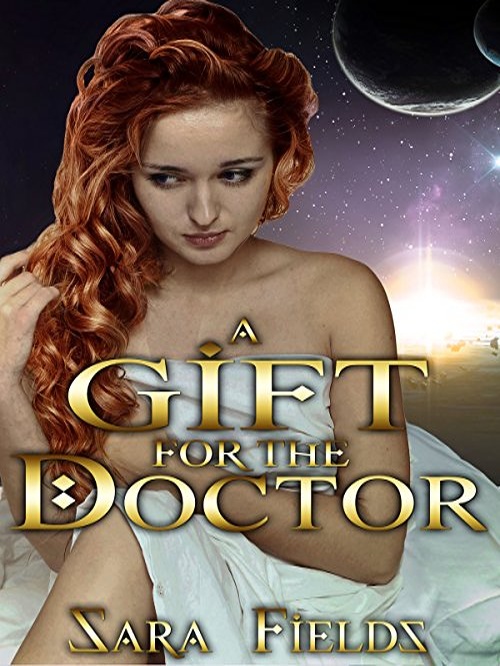
When Captivity Becomes Liberation: The Paradox of Power in Sara Fields’ A Gift for the Doctor
What does it mean to surrender — not out of weakness, but from a position of extraordinary strength? It’s a question that pulses beneath the surface of Sara Fields’ A Gift for the Doctor, the second installment in her Terranovum Brides series, and one that elevates what might otherwise be a straightforward paranormal romance into something more psychologically textured than its premise initially suggests.
Morgana is no damsel. She is, we are told, her kingdom’s most powerful sorceress — a woman who chooses captivity to protect the people she loves. That single act of agency sets the entire narrative in motion, and it’s worth pausing on, because it reframes everything that follows. Every moment of vulnerability, every scene of submission to the alpha shifter Kade, exists in tension with the knowledge that this woman could, presumably, burn it all down if she wished.
The Architecture of Desire and Defiance
Fields constructs her central dynamic with a clarity that borders on architectural precision. Kade is the doctor, the examiner, the man who literally holds power over Morgana’s exposed body. The medical play elements — clinical, intimate, deliberately transgressive — serve as more than erotic set dressing. They function as a metaphor for the stripping away of pretense, the dismantling of the armor Morgana has built around herself as both sorceress and survivor.
What I find genuinely interesting here is the layered deception at the story’s core. Kade has been ordered to claim Morgana, to breed a child that would merge two powerful bloodlines for a tyrant’s benefit. Yet his true allegiance lies with the rebellion. Morgana believes she is a prisoner submitting to an enemy’s tool; Kade knows he is a double agent falling for the woman he was meant to exploit. Neither possesses the full truth, and Fields milks this asymmetry of knowledge for considerable dramatic tension.
The power exchange in their relationship is rarely simple. It oscillates — spanking scenes that enforce dominance sit alongside moments where Kade’s protectiveness reveals his own vulnerability. Fields understands, at least intuitively, that the most compelling BDSM-inflected narratives are not about the subjugation of one party but about the mutual risk of emotional exposure.
Sorceress, Shifter, and the Politics of Bodies
The worldbuilding of Terranovum remains somewhat sketched rather than fully rendered — this is, after all, a novella-length work clocking in at just over five hours in Logan McAllister’s narration. But Fields weaves enough political scaffolding into the romance to give it stakes beyond the bedroom. Civil war looms. A tyrant manipulates bloodlines like a breeder selecting livestock. The commodification of Morgana’s body — her womb, specifically — echoes real-world anxieties about reproductive autonomy that lend the fantasy elements an unexpected bite.
As a sequel to A Gift for the King, this installment benefits from an established universe but also suffers slightly from sequel syndrome: certain emotional beats feel accelerated, as though the narrative trusts that readers arriving from the first book will fill in the gaps of worldbuilding and emotional context that newcomers might find thin.
McAllister’s narration deserves mention. He navigates the tonal shifts — from tender to commanding to politically charged — with a steadiness that keeps the audiobook from tipping into melodrama, a real risk given the material’s intensity.
The Tension Between Formula and Feeling
I won’t pretend this is a work of subversive literary fiction. Fields writes within a well-established genre framework, and she honors its conventions: the dominant alpha, the reluctant but aroused heroine, the escalating physical encounters that mirror deepening emotional connection. The publisher’s note is admirably transparent about what readers will encounter — spanking, medical play, BDSM elements — and that honesty is itself a form of respect for the audience.
Where Fields succeeds most is in the emotional throughline. Morgana’s internal conflict — between her identity as an independent, powerful woman and her growing desire to yield to Kade — never fully resolves into easy comfort. Even at the story’s climax, when romance and revolution converge, there’s a sense that submission remains a choice she makes daily, not a state she falls into permanently. That distinction matters enormously, and it’s what separates competent erotic romance from the genuinely compelling variety.
Where the book stumbles is in pacing. The transition from captive-and-captor tension to allied lovers fighting a common enemy happens with a swiftness that undercuts the political narrative. The civil war feels more like a backdrop than a fully realized conflict, and the resolution arrives with a neatness that the story’s darker undertones don’t entirely earn.
Who Should Open This Book — and Why
A Gift for the Doctor is crafted for readers who appreciate their romance dark, their fantasy unapologetic, and their power dynamics rendered with emotional specificity rather than mere shock value. If you found yourself drawn to the psychological complexity beneath works like Katee Robert’s Dark Olympus series or Ruby Dixon’s more intense offerings, Fields operates in adjacent territory with her own distinctive voice.
It is not a book for everyone — nor does it aspire to be, and that self-awareness is one of its quiet strengths.
Here is the question I’m left with: In a genre so often dismissed as mere escapism, why does the fantasy of chosen surrender resonate so deeply with readers who, in their waking lives, fight relentlessly for control? Perhaps because fiction remains the one space where we can safely explore the terrifying, exhilarating possibility that letting go might not destroy us — it might, against all logic, set us free.