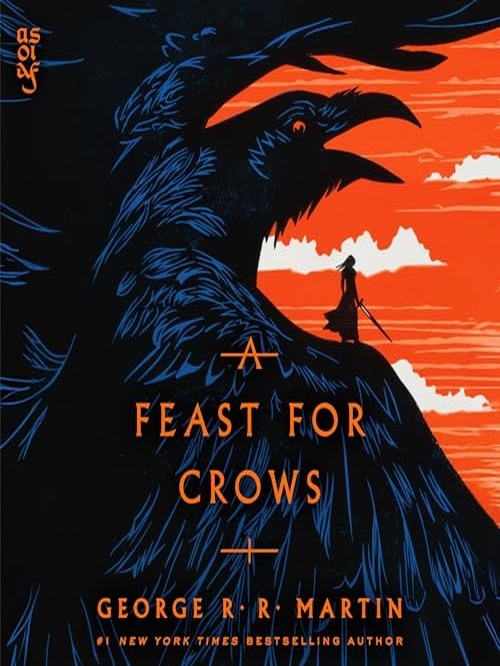
The Kingdom Bleeds Out: On the Quiet Devastation of A Feast for Crows
What happens when the war ends but nobody wins? George R.R. Martin poses this question not with triumph or resolution, but with the unsettling image of carrion birds descending on a battlefield. The title itself—A Feast for Crows—is a thesis statement. This is not a book about victors. It is a book about scavengers, about the hollow men and women who remain standing when the dust settles, grasping at power with blood still drying under their fingernails.
And yet, for all its brilliance, this is the volume in A Song of Ice and Fire that divides the faithful most sharply. I’d argue that division is precisely the point.
The Silence Where Dragons Should Be
Let’s address the elephant—or rather, the absent dragon—in the room. A Feast for Crows was famously split from its sibling volume, A Dance with Dragons, meaning fan-favorite characters like Daenerys, Tyrion, and Jon Snow are entirely absent here. For readers who came to Martin’s saga seeking the momentum of war and the spectacle of dragonfire, this omission stings. It stings deliberately.
What Martin gives us instead is something rarer and, I would argue, more courageous: a study in entropy. The Seven Kingdoms are exhausted. The great houses have bled themselves nearly dry. And into that vacuum creep figures who are not conquerors but administrators, zealots, and opportunists—people for whom the aftermath is the opportunity. Martin is asking us to sit with discomfort, to watch a world try to rebuild itself with broken tools and compromised people. It is not a crowd-pleasing choice. It is, however, a profoundly honest one.
Cersei Lannister and the Architecture of Self-Destruction
If this book belongs to anyone, it belongs to Cersei. And what Martin accomplishes with her point of view is nothing short of a masterclass in unreliable narration and tragic irony.
We have watched Cersei from the outside for three books—calculating, cruel, formidable. Now Martin takes us inside her mind, and the revelation is devastating: she is none of those things. Or rather, she believes she is all of those things, and that belief is the engine of her undoing. Cersei fancies herself a female Tywin, a strategic genius shackled by a patriarchal world. The truth, which Martin lets us perceive through the gap between her self-narration and reality, is that she is paranoid, impulsive, and catastrophically poor at reading people.
This is not misogyny on Martin’s part—it is a portrait of what happens when a genuinely intelligent person is denied education, denied agency, denied respect for an entire lifetime, and then handed absolute power. Cersei’s chapters are a slow-motion car wreck narrated by the driver who insists she’s winning a race. I found them excruciating, mesmerizing, and among the finest character work in the entire series.
The Broken and the Reborn
Martin’s thematic preoccupation in A Feast for Crows is identity—specifically, the way violence strips identity away and the desperate, often futile ways people try to reconstruct themselves afterward.
Consider Brienne of Tarth, whose chapters have been criticized as repetitive wandering. I see something else entirely: a medieval road narrative that functions as a moral inventory of Westeros from the ground level. Brienne moves through a landscape of burned villages, broken men, and orphaned children. She is searching for Sansa Stark, yes, but she is also searching for proof that honor still means something in a world that has systematically punished her for believing in it. Her chapters are slow. They are meant to be. The slowness is the argument—that decency is a long, unglamorous, often thankless road.
Then there is the Jaime Lannister of this volume, a man literally and figuratively disarmed, attempting to become something other than the Kingslayer. And Arya Stark, surrendering her name at the House of Black and White, trading identity itself for the promise of power. And the introduction of the Ironborn and Dornish plotlines, cultures defined by their relationship to legacy and vengeance—people who construct identity entirely around what was taken from them.
Martin weaves these threads into a tapestry that asks a single, haunting question: when everything you were has been destroyed, what do you choose to become?
A Different Kind of Danger
The prose in A Feast for Crows is Martin at his most elegiac. The visceral shock of the Red Wedding is replaced by a creeping dread, a sense that the real catastrophe is not the war that was fought but the peace that is being built on rotten foundations. The rise of the Faith Militant under the High Sparrow—a plotline that resonates with uncomfortable contemporary relevance—is a slow burn that demonstrates how power vacuums are filled not by the strongest, but by the most fanatical.
Roy Dotrice’s narration in the audiobook edition deserves particular mention. His voice, weathered and textured like old parchment, suits this particular volume’s tone better than perhaps any other in the series. There is a weariness in his delivery that mirrors the weariness of Westeros itself.
The Verdict of the Crows
I will not pretend A Feast for Crows is flawless. The Ironborn chapters, particularly those centered on Aeron Greyjoy, can feel like detours into a saga we did not ask to enter. The pacing, by design, demands patience that not every reader will feel the story has earned. And the structural decision to split the narrative geographically rather than chronologically creates an inevitable sense of incompleteness—we are reading half a book, and we feel it.
But here is what I keep returning to, years after my first read: A Feast for Crows is the volume that trusts its readers the most. It trusts us to find drama in politics rather than battles, in psychology rather than spectacle, in the quiet horror of a kingdom eating itself alive rather than the loud horror of swords and fire. It is Martin’s most literary novel, his most thematically coherent, and—I suspect—the one that will age the best.
This book is for: readers who understand that the most interesting part of any war story is what comes after. Those who appreciate character studies drawn with surgical precision. Anyone who has ever watched someone in power and thought, they have no idea what they’re doing. And for those willing to accept that in Martin’s world, the feast is never a celebration—it is a funeral that hasn’t realized it yet.
So I leave you with this: in a genre that overwhelmingly celebrates the seizing of power, what does it mean that Martin wrote an entire novel about the cost of holding it? And what does it say about us that we found it so much harder to read?