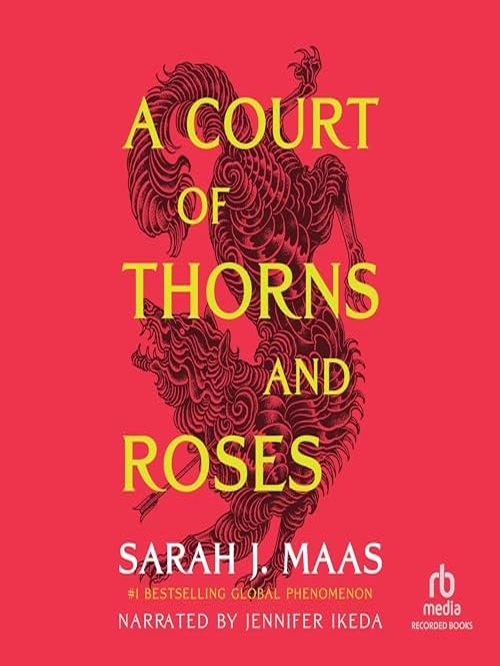
When the Hunter Becomes the Hunted: Sarah J. Maas and the Alchemy of Desire
There is a moment in every great fairy tale retelling when the familiar architecture of the story you thought you knew collapses — and something wilder, more dangerous, more honest rises from the wreckage. A Court of Thorns and Roses is that collapse. It is Sarah J. Maas detonating the polite foundations of “Beauty and the Beast” and rebuilding them with blood, thorns, and a heroine whose hunger — for survival, for agency, for love — feels less like fantasy and more like a mirror held uncomfortably close.
I’ll confess: I approached this book with the skepticism one reserves for any novel that carries the weight of a global phenomenon. Bestseller lists are not, after all, arbiters of literary merit. And yet, by the final act, I found myself confronting something I hadn’t expected — not just a romance wrapped in faerie glamour, but a surprisingly muscular meditation on captivity, transformation, and the terrible cost of selflessness.
A Huntress Stripped of Her Arrows
Feyre — nineteen, starving, holding her fractured family together with nothing but a bow and sheer, grinding will — is one of the more compelling entry points into a fantasy series I’ve encountered in recent years. Maas does something shrewd here: she doesn’t introduce us to a Chosen One bathed in prophecy. She gives us a girl who kills a wolf because her sisters need to eat. The moral calculus is immediate, unglamorous, and deeply human.
When a faerie lord named Tamlin drags her across the border into the immortal lands of Prythian as retribution, the novel’s central tension snaps into place — not as a kidnapping romance (though it flirts dangerously with that territory), but as a study in displacement. Feyre is a creature of pragmatism thrust into a world that operates on ancient rules she cannot read. Her illiteracy, both literal and cultural, becomes a quiet but devastating motif. She is powerful precisely because she is unfinished.
The Architecture of Seduction — and Its Limits
Let’s address the romance directly, because it is both the engine and the Achilles’ heel of this novel. The slow-burn tension between Feyre and Tamlin is, in its early stages, genuinely well-constructed. Maas understands pacing — the lingering glance, the accidental touch, the conversation that reveals one layer while concealing three others. There is a physicality to their attraction that feels earned rather than imposed.
And yet, I found myself more intellectually engaged by what surrounds the romance than by the romance itself. Tamlin, for all his brooding magnetism, remains somewhat opaque — a figure defined more by his curse than by his interiority. He is, in this first volume, more symbol than person: the beast who is not always a beast, the protector who cannot protect himself. Maas would go on to interrogate this archetype with devastating precision in later installments, but here, Tamlin functions largely as a catalyst for Feyre’s awakening rather than as a fully autonomous consciousness.
Where Maas truly excels is in the visceral texture of desire itself — not merely romantic desire, but Feyre’s desire for beauty, for paint and color, for a life that extends beyond survival. The scenes in which she begins to create art in Tamlin’s manor carry a quiet, aching power that surpasses many of the more overtly dramatic set pieces. This is the real love story: a woman discovering that she is allowed to want things that are not strictly necessary.
The Shadow Beneath the Glamour
The novel’s final act pivots sharply from romance into something closer to psychological horror, and it is here that Maas reveals the full scope of her ambition. The ancient evil lurking beneath Prythian — embodied by the cruel and calculating Amarantha — transforms the narrative from a love story into a trial of endurance. Feyre is stripped of every advantage, every ally, every comfort. What remains is will.
The three trials Under the Mountain are brutal, deliberately so. They force both Feyre and the reader to confront an uncomfortable question that pulses beneath the entire novel: What are you willing to destroy — including parts of yourself — to save someone you love? Maas does not offer a clean answer. The victory, when it comes, is stained. It costs something irreversible. And that refusal to sanitize the consequences elevates the book beyond the conventions of its genre.
I would argue that Amarantha, despite her relatively limited page time, represents one of Maas’s sharpest creations — a villain whose cruelty is not arbitrary but rooted in a twisted mirror-logic of the same possessive love the novel ostensibly celebrates. She is what desire looks like when it curdles into domination. The parallels between her obsession with Tamlin and Feyre’s devotion to him are, I suspect, entirely intentional and deeply unsettling.
The Prose Question
A word on craft. Maas’s prose is not what one would call restrained. It is lush, sometimes excessively so — adjectives bloom like the roses of the title, and there are passages where the emotional register tips from intensity into melodrama. For readers calibrated to the austere minimalism of literary fiction, this will grate.
But I think that criticism, while valid on a sentence level, misses the larger point. Maas writes in the tradition of Gothic romance — Brontë, du Maurier, Rice — where excess is the aesthetic, where the emotional landscape is meant to overwhelm. The prose mirrors Feyre’s own sensory overload as she moves from a grey, starving world into one saturated with color, magic, and danger. It is maximalist by design, and within that design, it largely succeeds.
Who Should Walk Through This Door
A Court of Thorns and Roses is not a perfect novel. Its pacing sags slightly in the middle act, Tamlin’s characterization demands patience that only subsequent books will reward, and there are moments where the worldbuilding prioritizes atmosphere over internal logic.
But it is a potent one. It is a book that understands, on a structural and emotional level, that the most interesting fairy tales are the ones that refuse to let their heroines remain passive. Feyre does not wait to be rescued. She paints, she hunts, she bleeds, she solves riddles in the dark, and she makes choices that leave permanent marks on her soul.
This is a book for readers who crave fantasy that takes female desire seriously — not as a subplot, but as the gravitational center of the narrative. It is for those who loved the dark enchantment of Uprooted by Naomi Novik or the fierce romanticism of The Cruel Prince by Holly Black, but who want something rawer, more urgent, less interested in politeness. It is the opening movement of a series that will grow considerably more complex, more morally ambiguous, and more rewarding.
And perhaps the question it leaves us with is this: When we strip away the faerie glamour, the immortal courts, the curses and the roses — what remains is a nineteen-year-old girl who was never taught to read, standing in a room full of paint, realizing for the first time that survival and living are not the same thing.
That distinction, I think, is worth every page.