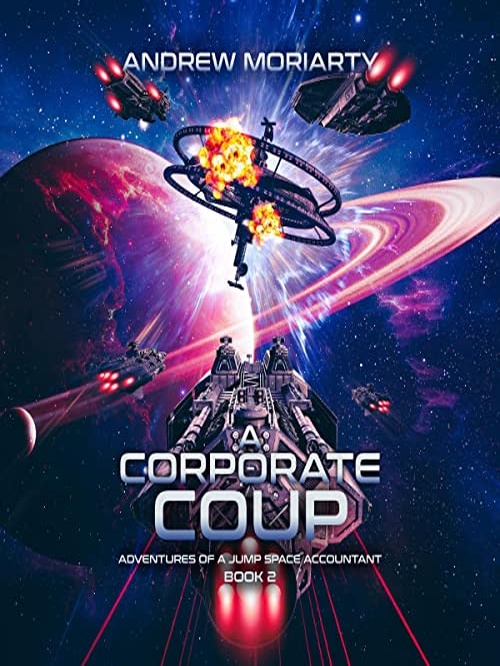
When the Spreadsheets Hit the Fan: Strategy as Spectacle in A Corporate Coup
What happens when you hand the fate of a collapsing interstellar order not to a soldier, not to a diplomat, but to an accountant? Andrew Moriarty has been exploring this delicious premise across his Adventures of a Jump Space Accountant series, and by book four, he’s refined the answer into something genuinely compelling: you get a protagonist who survives not by pulling triggers faster, but by reading the room—and the balance sheet—better than anyone else in it.
A Corporate Coup opens in the thick of chaos. Shootings in the vacuum of space, violence spilling through streets, alliances fracturing like cheap hull plating under pressure. And at the center of it all stands Jake, a man whose primary instinct is not to fight or flee, but to calculate. It’s a narrative posture that shouldn’t work in a genre so often drunk on spectacle. And yet it does—precisely because Moriarty understands something most space opera authors overlook: revolutions are won in logistics.
The Geometry of Loyalty
The thematic engine driving this installment is deceptively simple: whose side are you on? But Moriarty refuses to let that question resolve into comfortable binaries. Jake is surrounded by figures whose motivations resist easy categorization. Dashi, the enigmatic strategist who “always knows what he’s doing,” sends Jake on what appears to be a fool’s errand—hunting a lost ship while civilization burns. Jose is inexplicably purchasing welding equipment in the middle of an insurrection. And Nadine, whose sudden friendliness registers as more alarming than any firefight, volunteers to help with an eagerness that sets off every internal alarm Jake possesses.
What Moriarty constructs here is a kind of chess game narrated from the perspective of a pawn who suspects—correctly—that he’s being played, but can’t quite see the board. The pleasure lies not in dramatic revelations but in the slow, grinding process of figuring it out. Each character operates according to their own internal logic, and part of the intellectual satisfaction of the novel is watching those logics collide, overlap, and occasionally combust.
Strategy Over Spectacle
I want to dwell on what the book’s own description advertises: “strategy over tactics, and thought before action.” This is not mere marketing copy—it’s a genuine statement of literary intent. Moriarty writes action sequences that matter not because of their kinetic intensity but because of their consequences. A welding torch purchased in chapter three becomes a plot-critical object by chapter twelve. A detour to find a missing vessel isn’t a digression; it’s the spine of the entire narrative, disguised as busywork.
This is world-building through operational detail, and it demands a specific kind of reader patience. The payoffs are real, but they’re earned through accumulated understanding rather than sudden spectacle. William Turbett’s narration in the audiobook format—spanning just over ten hours—reportedly serves this pacing well, lending conversational warmth to passages that might otherwise read as dry exposition on paper.
The Accountant as Unlikely Everyman
There’s a quietly subversive quality to the entire series that crystallizes in this fourth volume. Science fiction loves its chosen ones, its military geniuses, its rogue captains with hearts of gold. Jake is none of these things. He’s a man whose core competency is noticing when the numbers don’t add up—and in a revolution built on lies, misdirection, and competing propaganda, that turns out to be the most dangerous skill in the galaxy.
Moriarty isn’t writing literary fiction dressed in a spacesuit; let’s be clear about that. The prose is functional, occasionally workmanlike, and the characterization operates more through action and dialogue than interior depth. But within the constraints of its genre, A Corporate Coup achieves something admirable: it makes thinking exciting. It trusts its audience to follow threads rather than explosions.
The Final Ledger
This is not the entry point for newcomers—the relationships between Jake, Dashi, Jose, Nadine, and the Admiral carry accumulated weight from three prior volumes that Moriarty wisely declines to over-explain. But for readers already invested in this series, A Corporate Coup represents a confident escalation of stakes and complexity.
Perfect for: readers who devour The Expanse for its politics rather than its battles, fans of Lois McMaster Bujold’s Miles Vorkosigan novels, and anyone who’s ever suspected that the most powerful person in any organization isn’t the one with the biggest weapon—it’s the one who controls the spreadsheet.
Here’s the question Moriarty leaves simmering long after the final chapter: in a universe where everyone claims to be fighting for the right side, is the most moral act not choosing a side at all—but simply refusing to let the books be cooked?