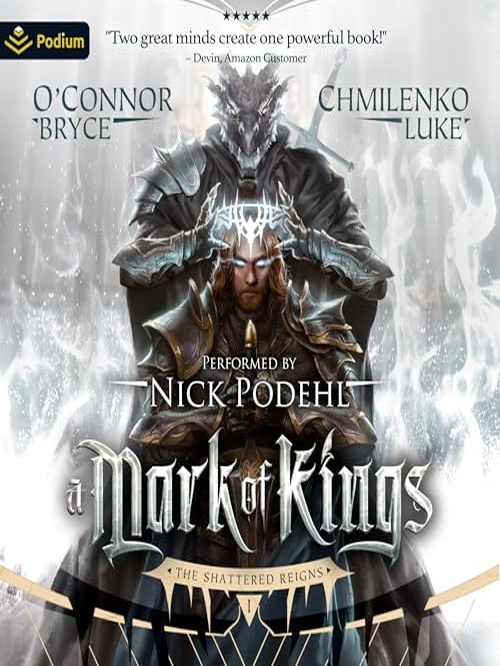
Blood, Blades, and the Weight of Lineage: A Mark of Kings Delivers a Ferocious Promise
What does it mean to inherit a destiny you never asked for — one written not in parchment but in your very blood? It’s a question fantasy literature has circled for centuries, from Tolkien’s reluctant hobbits to Sanderson’s tortured Mistborn. Bryce O’Connor and Luke Chmilenko stake their claim on this well-trodden ground with A Mark of Kings, the opening salvo of The Shattered Reigns Series, and they do so with a confidence that borders on audacious. The result is a novel that, while not without its rough edges, pulses with a visceral energy that marks both authors as voices worth tracking in the progression fantasy space.
A Mercenary with Royal Ghosts in His Veins
At its core, A Mark of Kings is a coming-of-power story — and I use that phrase deliberately over “coming-of-age,” because Declan Idrys is no wide-eyed farmboy. He’s a seasoned mercenary, blooded and scarred, who has spent a decade navigating the grim economy of sword-for-hire work alongside Ryn, his enigmatic companion described only as “a beast of rather peculiar talent.” O’Connor and Chmilenko make a shrewd narrative choice here: they give us a protagonist who already understands violence, already knows the world is cruel, and then systematically dismantle every assumption he’s built his survival on.
The inciting contract-gone-wrong is functional rather than revolutionary, but it serves its purpose efficiently — a trapdoor that drops Declan into a conflict of mythic proportions. Dead men claw from graves. Ancient horrors descend from northern ranges. And the central revelation — that Declan’s blood carries the echo of kings — unfolds with the kind of deliberate pacing that rewards patience. This isn’t a twist thrown at the reader for shock value; it’s an inevitability the narrative earns through careful foreshadowing.
The Alchemy of Dual Authorship
One of the more fascinating aspects of this novel is how seamlessly O’Connor and Chmilenko merge their sensibilities. O’Connor, known for the brutal, arena-forged intensity of his Warformed series, brings a kinetic ferocity to the combat sequences — and there are many, each rendered with a choreographic specificity that avoids the trap of generic sword-clashing. Chmilenko, whose Ascend Online demonstrated a talent for systematic world-building, contributes a structural rigor to the magic system and political architecture of Viridian.
The synthesis isn’t always invisible. There are moments, particularly in the middle act, where expository passages about the realm’s history feel slightly decoupled from the narrative momentum — as if one author’s architectural instincts temporarily overrode the other’s dramatic ones. But these are minor seams in what is, overwhelmingly, a cohesive and propulsive read.
Ryn: The Companion Who Steals the Book
I want to linger on Ryn, because he represents perhaps the novel’s sharpest creative decision. Fantasy is littered with animal companions — wolves, dragons, sentient swords — but Ryn occupies a more ambiguous space. The narrative teases his true nature with admirable restraint, and his relationship with Declan provides the book’s emotional spine in ways the larger geopolitical conflict does not. Their bond is not sentimental; it’s forged in shared survival, mutual dependence, and — crucially — secrets. When the text hints that Declan’s “oldest friend might just be more than he appears,” it’s not merely a plot mechanism. It’s a meditation on how intimacy coexists with concealment, how the people closest to us can be the most unknowable.
The Ancient Rising and Its Familiar Shadows
Let me be candid: the macro-level threat — undead armies, descending beasts, an ancient evil reawakening — is the least original element of A Mark of Kings. We’ve seen this eschatological scaffolding in Tolkien, in Jordan, in Martin, in a hundred lesser imitators. O’Connor and Chmilenko don’t reinvent this wheel so much as polish it to a high sheen. What elevates their execution above pastiche is the specificity of their world’s decay. Viridian doesn’t feel like a kingdom threatened by abstract evil; it feels like a place already fraying at its edges, where mercenary guilds fill the vacuum left by weakened institutions and where the line between lawful authority and organized violence has long since blurred.
This sociological texture — the sense that the world was broken before the supernatural threat arrived — gives the narrative a grounding that pure epic fantasy often lacks. Declan’s “profane choice” between flight and confrontation gains weight precisely because the world he’s being asked to save was never particularly worth saving in conventional terms. It’s worth saving because it’s his, because the people in it are real to him, and because the alternative is ash.
Nick Podehl and the Audiobook Dimension
A brief but necessary note on Nick Podehl’s narration, given that many will encounter this book in its Podium Audio format across eighteen-plus hours: Podehl is one of the most reliable performers in fantasy audiobook narration, and his work here is characteristically excellent. His Declan carries the right balance of weariness and emerging authority, and his vocal distinction between characters — particularly Ryn — adds a dimensionality that the prose alone doesn’t always achieve. If you’re an audiobook listener, this is one of those cases where the performance genuinely elevates the material.
Who Should Walk This Road
A Mark of Kings is not a subtle book. It is not interested in the quiet domestic dramas of literary fantasy or the moral gray zones that define grimdark. It is a novel that believes in heroism — earned, bloody, reluctant heroism — and it delivers that belief with conviction and craft. At a 4.5 rating from its readership, it has clearly found its audience, and deservedly so.
This is a book for readers who devoured Michael J. Sullivan’s Riyria chronicles and wanted something with sharper teeth. It’s for those who appreciate progression fantasy’s systematic approach to power but crave a narrative framework more rooted in classical epic tradition. It’s for anyone who has ever suspected that the most interesting thing about a chosen one is not the choosing, but what they do when they realize the crown comes pre-bloodied.
I walked away from A Mark of Kings with a single question lodged in my mind — one that, I suspect, O’Connor and Chmilenko intended: If the blood of kings does not fade, does that make it a gift, or a sentence? The Shattered Reigns series, on this evidence, has the ambition and the raw talent to answer that question in ways that matter.
The only question left is whether you’re willing to bleed alongside Declan to find out.