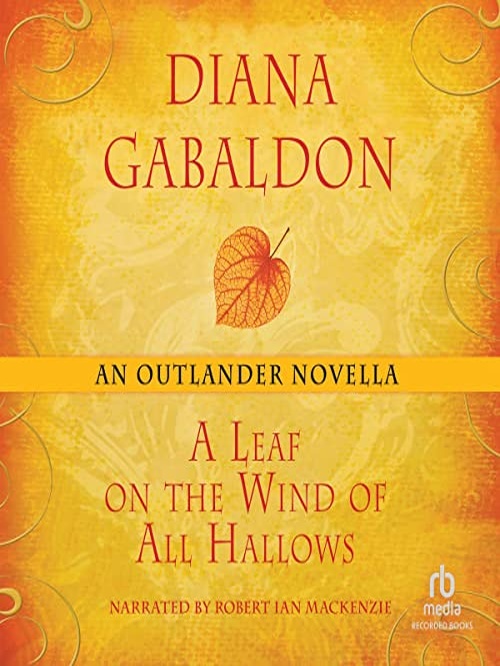
When the Sky Itself Becomes a Door: Diana Gabaldon’s Quietest Heartbreak
What do we owe the dead? More precisely, what do we owe the stories of those who vanished into the machinery of war — not heroically, not cleanly, but in the confused, ragged way that real disappearances happen? Diana Gabaldon has spent decades building the sprawling, time-crossed universe of Outlander, but in A Leaf on the Wind of All Hallows, she does something remarkably restrained: she tells a small story. A war story. A love story. A ghost story. And at barely two hours of audio, it cuts deeper than many novels ten times its length.
The Weight of a Missing Father
Roger MacKenzie Wakefield has always been one of the Outlander saga’s most quietly tragic figures — a man defined as much by absence as by presence. Orphaned during World War II, he carried a clean, digestible narrative: mother lost to the Blitz, father killed in RAF combat. Tidy. Heroic. Utterly incomplete.
This novella dismantles that tidiness with surgical care. We are placed not in Roger’s searching hands but in the cockpit and cramped domestic world of his father, Jerry MacKenzie — a young RAF pilot navigating the twin terrors of aerial combat and the dawning, impossible realization that the world contains doors that should not exist. Gabaldon’s genius here is in her refusal to romanticize. Jerry is not a time-traveler by ambition or destiny. He is a man caught — literally — in a phenomenon he cannot name, cannot control, and cannot survive intact.
War as Liminal Space
What strikes me most forcefully about this novella is how Gabaldon collapses the distance between the supernatural and the historically mundane. The standing stones — that iconic mechanism of the Outlander mythology — are not presented here as portals of adventure. They are a horror. They are the war itself made metaphysical: a force that tears a man from his wife, his infant son, his own timeline, with the same indifferent brutality as a Messerschmitt’s guns.
There is a passage — brief, almost throwaway — where Jerry feels the shift in the air, the wrongness of time bending around him mid-flight. Gabaldon renders this not with the lush, swooning prose of Claire’s original journey through the stones, but with the clipped, adrenaline-soaked perception of a combat pilot. The effect is devastating. We are reminded that the fantastical, stripped of wonder, is simply another form of violence.
Robert Ian MacKenzie’s narration deserves particular mention. His reading carries the weight of Scottish cadence without tipping into caricature, and he handles the story’s tonal shifts — from domestic tenderness to aerial terror to metaphysical bewilderment — with an economy that mirrors Gabaldon’s own prose.
A Mother’s Story, Half-Told
The novella’s other quiet revolution is its treatment of Marjorie, Jerry’s wife. She is not merely the woman left behind. Gabaldon grants her agency, intelligence, and a form of terrible knowledge that the narrative only partially reveals. We see in Marjorie the outline of a woman who understands more than she should — about the stones, about what her husband’s disappearance truly means — and who makes choices that are neither passive nor fully explained. It is a portrait sketched in deliberate incompleteness, and I find that restraint more compelling than any explicit revelation could be.
This is, I think, Gabaldon’s deepest thematic preoccupation across the entire Outlander series made crystalline: the people we love are not ours to keep, and the stories we tell about their loss are almost never the true ones.
Small Canvas, Permanent Mark
Let me be direct: A Leaf on the Wind of All Hallows is not a standalone experience. Readers unfamiliar with the Outlander world will find it moving but incomplete, a chapter torn from a larger book — which, in a sense, it is. Its emotional payload detonates fully only if you have walked with Roger through his own discovery in An Echo in the Bone, only if you understand the particular cruelty of learning that your origin story was a lie told out of love.
But for those already invested in this universe, this novella is essential. Not because it fills a plot hole — though it does — but because it reframes everything we thought we understood about inheritance, loss, and the thin membrane between one world and the next.
Perfect for: devoted Outlander readers hungry for the emotional archaeology of Roger’s lineage; lovers of wartime fiction that refuses sentimentality; anyone who believes the best speculative fiction asks not what if we could travel through time but what would it cost us.
I am left with a question that Gabaldon, characteristically, refuses to answer fully: If you knew the sky could open and swallow you whole — erase you from your own son’s memory — would you still fly? Jerry MacKenzie flew. And the leaf fell. And we are still listening for where it landed.