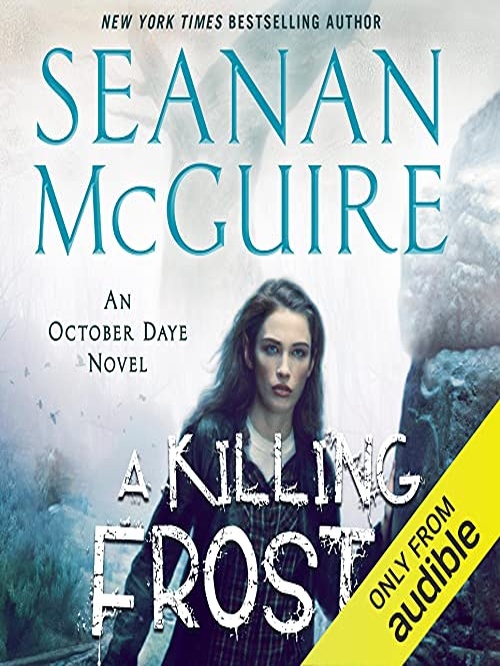
When the Past Demands a Seat at the Table: A Review of A Killing Frost
What does it cost to build a future when the past refuses to stay buried? Seanan McGuire asks this question with surgical precision in A Killing Frost, the fourteenth installment of her October Daye series — and the answer, as ever in Faerie, is paid in blood, obligation, and the particular agony of complicated love.
Fourteen Books In, and Still Finding New Ways to Wound You
There is a peculiar achievement embedded in long-running urban fantasy series that critics rarely acknowledge: the accumulation of consequence. Lesser authors treat each installment as a reset, a fresh wound sutured clean by the novel’s end. McGuire refuses that mercy. A Killing Frost operates with the full gravitational weight of thirteen preceding volumes pressing against every scene. Toby Daye’s world does not forget. Her history does not forgive. And Simon Torquill — legally her father through Faerie’s labyrinthine marriage traditions, morally her tormentor through years of inflicted trauma — cannot simply be uninvited from the wedding table without unraveling the political fabric of the Kingdom in the Mists.
This is where McGuire demonstrates her most sophisticated narrative instinct: she constructs plots from obligations, not conveniences. Toby doesn’t pursue Simon because she wants to. She does it because Faerie’s archaic structures demand it, because political reality supersedes personal trauma, and because somewhere beneath the scar tissue of her own history, there is a reckoning that has always been deferred. A Killing Frost is, at its structural core, a story about the debt we owe to understanding even those who have harmed us — and the radical, uncomfortable possibility of context reframing monstrosity.
The Architecture of Reluctant Forgiveness
What elevates this volume above standard quest-narrative mechanics is McGuire’s unflinching interrogation of complicity, coercion, and culpability. Simon Torquill is not rehabilitated cheaply here. The novel does not offer the reader the easy satisfaction of a villain-turned-ally whose past crimes dissolve under the warmth of redemption arc sentimentality. Instead, McGuire builds something far more psychologically rigorous: a portrait of a man whose monstrous actions were themselves the product of coercion, and the deeply unsettling moral question of whether that distinction matters to the people left broken in his wake.
Toby herself — sharp-edged, grief-worn, perpetually underestimating her own capacity for both destruction and compassion — serves as the ideal lens for this interrogation. Her resistance to softening toward Simon never feels performative. It feels earned, the product of fourteen books of accumulated pain. When she moves, however incrementally, toward something resembling comprehension, it lands with the visceral impact of a truth the reader has also been reluctant to accept.
Mary Robinette Kowal‘s narration, it must be noted, is essential architecture here. Her vocal rendering of Toby’s sardonic weariness and the emotional undertow beneath it transforms already strong prose into something genuinely immersive. Kowal understands that Toby’s humor is armor, and she plays both the shield and what it protects with equal skill.
Politics, Prophecy, and the Weight of Commitment
McGuire has always been astute about Faerie as a political landscape — a world where tradition operates as law, and law operates as trap. A Killing Frost expands this acuity. The wedding, ostensibly a celebration, becomes a nexus of political consequence, a reminder that in Faerie, private joy is never truly private. Every choice Toby makes radiates outward, touching courts and bloodlines and centuries-old alliances she neither asked for nor desired.
This is the paradigmatic tension at the series’ heart, and McGuire sharpens it here to a fine point: Toby Daye is a woman who wanted a quiet life and inherited an enormous fate. The irony has never grown stale across fourteen volumes because McGuire never lets Toby — or the reader — forget the specific, mundane human cost of epic destiny. The quest in A Killing Frost is framed as political necessity, but it is experienced as personal reckoning, and that dual register is where McGuire’s craft consistently operates at its most compelling.
For the Reader Who Has Earned This Book
Let me be direct about audience, because this matters: A Killing Frost is not a point of entry. Attempting to read it without the preceding thirteen volumes would be an act of narrative self-sabotage — the emotional resonance is cumulative, the political landscape requires cartographic familiarity, and the weight of Simon Torquill as a figure depends entirely on what the reader already carries into his presence.
For those who have made the journey, however, this is Seanan McGuire operating at the height of her powers in this world — morally complex, structurally confident, and emotionally unsparing in the very best sense. A Killing Frost belongs to that category of series installments that justify the entire investment that preceded them.
A Question Worth Sitting With
The book leaves its reader, as all great speculative fiction should, with an unresolved tension masquerading as resolution. Understanding the architecture of someone’s harm does not obligate forgiveness. But it does, perhaps, obligate something — some harder, less comfortable acknowledgment that people are rarely the uncomplicated villains our pain requires them to be.
Is that wisdom, or is it a burden Toby — and we — deserve to set down? McGuire, characteristically, doesn’t answer. She simply makes certain you cannot stop thinking about the question.