Traversing the Cosmic Divide: A Meditation on A Fire Upon the Deep
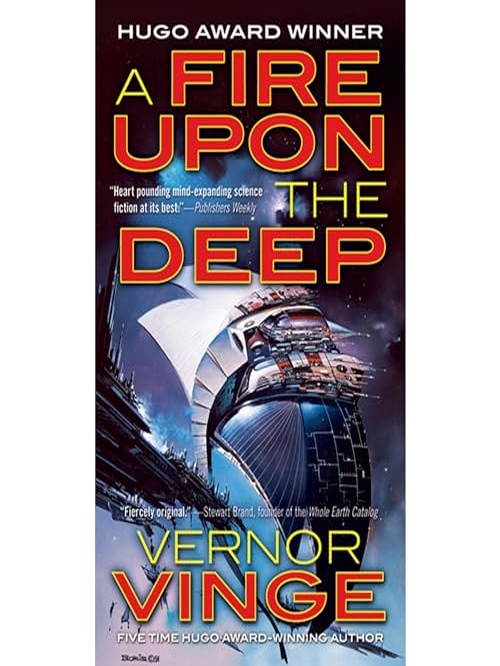
In an era saturated with fantastical escapism, what truly distinguishes a work of science fiction is its capacity to not merely transport us to another world, but to fundamentally alter our perception of our own. A Fire Upon the Deep by Vernor Vinge, the seminal inaugural volume of his Zones of Thought series, achieves precisely this, inviting us into a universe of breathtaking scale and profound intellectual ambition. It is not merely a story of galactic war and alien encounters; it is an ontological inquiry into the very nature of intelligence, the boundaries of possibility, and the arbitrary yet absolute divisions of a universe unfathomable.
The Architectonics of Thought and Space
Vinge’s genius lies in his audacious conceptualization of the “Zones of Thought,” a cosmological architecture that dictates the limits of consciousness and technology based on one’s physical location in the galaxy. From the ineffable, superintelligent entities dwelling in the “Transcend” – beings whose thoughts are so vast they can barely be perceived by lesser minds – to the “Unthinking Depths” where complexity itself collapses, this stratified reality forms the bedrock of an epic narrative. We are thrust into a universe where potential is a geographical lottery, an idea that, for me, resonates with an almost uncomfortable philosophical weight, prompting reflection on our own perceived limits and the unseen forces that might shape them. It’s a paradigm-shifting notion that elevates the common space opera into a canvas for grand philosophical speculation.
The narrative thrust of A Fire Upon the Deep ignites when the Straumli realm, driven by hubris and ambition, unleashes an ancient Transcendent artifact. What follows is not merely a military miscalculation, but a cataclysm that ripples across thousands of worlds, enslaving both natural and artificial intelligences. This central conflict is less about good versus evil and more about the chaotic consequences of meddling with forces beyond comprehension. It’s a visceral illustration of Icarus’s plight, writ across an interstellar scale, reminding us that the greatest dangers often stem not from malice, but from a profound lack of understanding.
Humanity’s Fragility and the Alien Tapestry
Amidst this cosmic maelstrom, Vinge grounds his story in the plight of a human family – scientists attempting to flee the encroaching disaster. Their capture by the Tines, an alien race of dog-like creatures with a fascinatingly complex, pack-based intelligence and a decidedly medieval culture, introduces a brilliant counterpoint to the high-concept cosmology. Here, the narrative shifts from the vastness of interstellar conflict to the intimate struggles of survival and cultural clashes. The Tines themselves are a masterclass in alien creation; their collective consciousness, their reliance on a group mind for individual sentience, is a potent exploration of alternative forms of intelligence. We witness the human children caught in a ruthless power struggle within Tine society, forced to navigate an entirely alien moral and social landscape. This juxtaposition – advanced human minds struggling to adapt to a technologically primitive yet socially intricate alien society – offers one of the novel’s most profound insights into the adaptability, and indeed the fragility, of intelligence.
A desperate rescue mission, composed of an eclectic crew that includes humans and other intriguing alien species, becomes the reader’s primary conduit through this labyrinthine universe. Their quest is twofold: to save the children and to retrieve a secret that holds the key to the survival of interstellar civilization itself. This journey is not merely an adventure; it is a meticulously crafted exploration of cooperation, sacrifice, and the enduring human (and non-human) spirit in the face of existential threats. Vinge‘s capacity for world-building here is nothing short of monumental, presenting us with cultures and biologies so distinct, yet so convincingly rendered, that they challenge our anthropocentric assumptions at every turn.
An Enduring Intellectual Legacy
Awarded the 1993 Hugo Award for Best Novel, A Fire Upon the Deep stands as a testament to Vernor Vinge‘s unparalleled vision within the Science Fiction & Fantasy genre. It is a work that transcends mere genre classification, offering both the thrill of a gripping space opera and the intellectual rigor of a philosophical treatise. His narrative arc is not linear but spiraling, constantly revealing new layers of complexity and demanding active engagement from the reader. We, as readers, are asked to grapple with concepts that push the very boundaries of our imagination, to consider intelligences so vastly different from our own that their motivations and actions are almost incomprehensible.
I find A Fire Upon the Deep to be a singularly transformative reading experience. It is a book that lingers, its ideas echoing long after the final page is turned, compelling us to re-evaluate our place in the universe and the potential, both glorious and terrifying, that lies beyond our immediate grasp. For those who seek not just stories, but universes to explore, and for minds that crave intellectual voyages as much as dramatic action, this novel is an absolute necessity. It serves as a powerful reminder that the finest science fiction is not just about what could be, but about what is within the infinite permutations of thought and existence. To truly comprehend our own limitations, we must first dare to imagine the boundless.