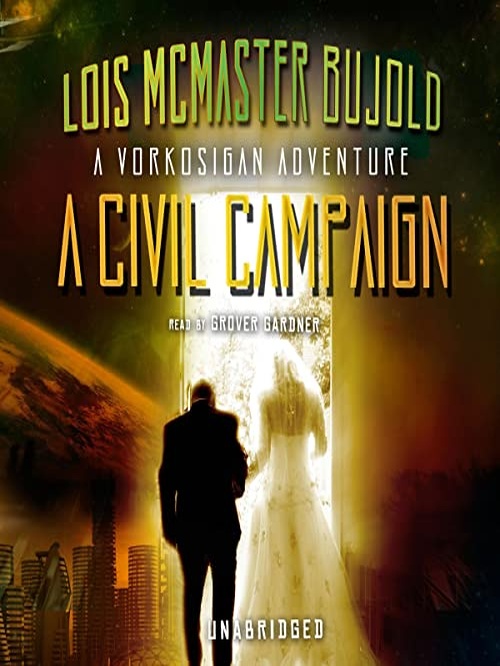
When Love Becomes the Most Dangerous Mission of All
What happens when the galaxy’s most resourceful covert operative — a man who has bluffed his way through blockades, infiltrated enemy fleets, and talked his way out of a death sentence — finds himself utterly, humiliatingly defeated by a single woman who simply doesn’t love him back? A Civil Campaign opens with precisely this predicament, and in doing so, Lois McMaster Bujold announces something extraordinary: she is done writing space opera. Or rather, she is writing something far more treacherous than that.
This ninth entry in the celebrated Vorkosigan Saga — positioned chronologically after Komarr — is, at its structural heart, a Regency comedy of manners transplanted into a feudal-militaristic interstellar society. The ghost of Jane Austen haunts nearly every chapter. The debts to Georgette Heyer are equally conspicuous. And yet A Civil Campaign is neither imitation nor pastiche. It is a genuinely original synthesis, one that manages to be simultaneously hilarious, politically sharp, and emotionally devastating in ways that its genre predecessors rarely achieved.
Miles Vorkosigan and the Limits of Tactical Genius
The novel’s central joke — and it is a joke that Bujold sustains with remarkable structural discipline — is that Miles, whose career has been defined by improvisation under impossible pressure, is catastrophically bad at romance. His “cunning plan” to court the recently widowed Ekaterin Vorsoisson without her awareness constitutes one of the most elaborately self-defeating romantic strategies in modern science fiction. He mistakes manipulation for courtship, information management for intimacy, and his own narrative control for consent.
This is not incidental. Bujold is making an argument here about the psychology of men who are accustomed to being the cleverest person in any room. Miles doesn’t simply want Ekaterin; he wants to orchestrate the conditions under which she will want him. The distinction matters enormously, and the novel’s most morally serious passages turn on whether Miles — and we, as readers who have spent eight previous books adoring him — are willing to sit with the discomfort of that distinction.
When Ekaterin discovers the full scope of his machinations, her fury is not melodrama. It is the legitimate grievance of a woman who has just escaped one controlling relationship and found herself quietly enrolled in another, however well-intentioned. That Bujold allows this confrontation to land with full force, without softening it through Miles’s characteristic wit, represents a level of authorial integrity that elevates the book well beyond its romantic-comedy framing.
A Comedy of Errors With Genuine Consequences
What distinguishes A Civil Campaign from lesser entries in the comedic-SF tradition is Bujold’s refusal to treat her farce as consequence-free. The novel braids together no fewer than four or five simultaneous crisis threads — a District inheritance dispute with genuine legal complexity, a politically explosive petition regarding gender and Barrayaran succession law, a disastrous dinner party that ranks among the great set-pieces of the saga, and a bioengineering venture involving insects that produces some of the book’s most gleefully absurd sequences.
These threads are not merely comic scaffolding. The succession crisis carries real weight because Bujold has spent nine books establishing Barrayar as a society in genuine, painful transition — a planet where feudal tradition and galactic modernity grind against each other with constant friction. When Lord Dono Vorrutyer returns from Beta Colony having undergone a sex change specifically to claim a countship, the narrative doesn’t play this as mere provocation. It becomes a lens through which Bujold examines how institutions calcify around the bodies and identities they were designed to exclude, and how those institutions crack when confronted with individuals willing to exploit their own internal contradictions.
The gender politics here are, for a novel published in 1999, remarkably sophisticated. Bujold doesn’t moralize; she dramatizes. We see the absurdity of Barrayaran gender law not through authorial editorializing but through the cascading legal and social chaos that ensues when someone takes those laws at their most literal.
The Architecture of Ensemble
One of the novel’s genuine structural achievements is its management of ensemble. A Civil Campaign is not Miles’s book alone — it belongs equally to Kareen Koudelka and Mark (navigating the collision between Betan sexual liberation and Barrayaran propriety), to Ivan Vorpatril (deployed here as both comic relief and unexpectedly poignant observer), and to Lord Dono’s champion Olivia Koudelka, who is given considerably more interior complexity than the plot strictly requires.
This generosity toward secondary characters is a Bujold signature, and it pays particular dividends here. The novel’s emotional center of gravity shifts with each chapter, so that what begins as Miles’s story gradually becomes a meditation on what it costs various people — of different genders, classes, and neurological configurations — to pursue genuine agency within a society designed to constrain them.
Ekaterin herself deserves particular attention. She enters the saga in Komarr as a woman whose interiority has been systematically suppressed by a difficult marriage, and A Civil Campaign continues her reclamation of selfhood with a care that refuses to make her merely the object of Miles’s desire. Her decision in the novel’s final act is entirely her own. Bujold earns that moment.
Verdict: A Masterwork Wearing Comic Disguise
A Civil Campaign is, I would argue, the finest entry in a saga that contains several contenders for that title. It is funnier than The Warrior’s Apprentice, more emotionally precise than Mirror Dance, and more politically ambitious than Barrayar. The comedy is real and earned; so is the heartbreak; so is the social critique. That Bujold manages all three simultaneously, without any one register overwhelming the others, is a feat of craft that rewards careful attention.
This is the ideal book for readers who came to the Vorkosigan Saga for the space battles and stayed for the politics, and who suspect, privately, that the best science fiction has always been about the societies we build and the people those societies make it hardest to be. It is also, simply, a deeply pleasurable read — the kind that produces audible laughter in public and quiet reflection at 2 a.m.
The question A Civil Campaign leaves us with is deceptively simple: how many of the systems we live inside were designed, consciously or not, to make certain lives more difficult? And what does it cost — socially, personally, legally — to insist on living otherwise?
Bujold doesn’t answer that question. She does something more useful: she makes us feel its weight, and then makes us laugh at how we all keep trying anyway.