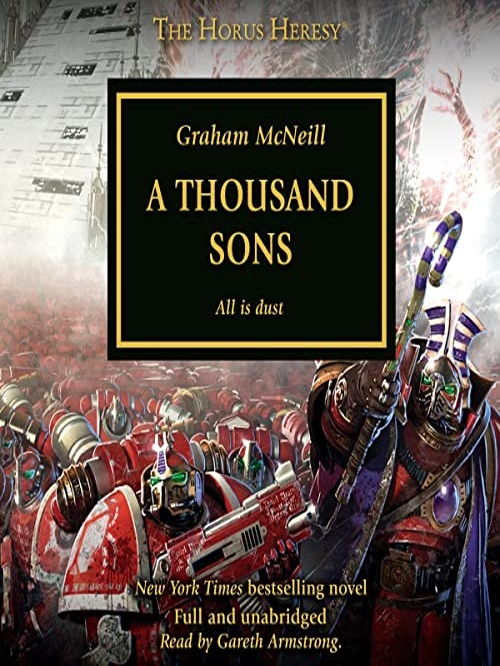
A Requiem for Knowledge: Unpacking the Tragedy of A Thousand Sons
We often find ourselves drawn to narratives that explore the perilous dance between knowledge and power, a theme as old as the myth of Prometheus. In A Thousand Sons, the acclaimed installment in The Horus Heresy series by Graham McNeill, we are presented with a truly Shakespearean tragedy, a narrative not merely of intergalactic warfare but of intellectual hubris and the catastrophic consequences of well-intentioned defiance. This isn’t just another chapter in a sprawling saga; it is a profound meditation on fate, free will, and the very nature of wisdom.
The Serpent in the Garden of Reason
From the outset, McNeill plunges us into an epistemic crisis. We witness the brilliant, if defiant, Primarch Magnus the Red and his Thousand Sons Legion, intellectuals and sorcerers in equal measure, navigating the treacherous currents of the Imperium’s burgeoning orthodoxy. Their censure at the Council of Nikaea for their “flagrant use of sorcery” serves as the inciting incident, a paradigmatic clash between empirical dogma and esoteric pursuit. McNeill masterfully crafts Magnus not as a villain, but as a Faustian figure, driven by an unquenchable thirst for understanding, convinced that forbidden knowledge is not merely a tool, but the ultimate salvation. It is this intellectual arrogance, this unwavering belief in the righteousness of their arcane arts, that sets the stage for their inevitable downfall. We are compelled to ask: when does the pursuit of knowledge become a moral failing?
A Prophecy Self-Fulfilled: The Cruelty of Foresight
One of the novel’s most arresting insights is its nuanced portrayal of prophecy. Magnus, through his forbidden arts, foresees the treachery of Warmaster Horus. His desperate, rule-breaking attempt to warn the Emperor ironically triggers the very cataclysm he seeks to avert. This narrative device forces us to confront the inherent cruelty of foresight: to glimpse a terrible future, yet be condemned to be its architect. The Emperor’s dispatch of Leman Russ and his Space Wolves to Prospero — a tragic misunderstanding born of fear and flawed communication — transforms a potential intervention into an act of annihilation. The visceral impact of this betrayal, the way a galaxy-spanning civil war can be ignited by a single, desperate act of communication, underscores the fragile nature of trust and understanding, even among demigods.
The Symphony of Despair on Prospero
McNeill’s prose shines brightest in his depiction of the burning of Prospero. It is not merely a battle; it is an elegy, a meticulously detailed account of cultural destruction. We feel the crushing weight of the Space Wolves’ brutal efficiency clashing with the Thousand Sons’ desperate, often chaotic, use of psychic power. The philosophical underpinnings of Magnus’s actions, his refusal to abandon his pursuit of knowledge even in the face of annihilation, elevate this segment beyond mere action sequences. It becomes a testament to the enduring human (or in this case, post-human) spirit’s capacity for belief, even when that belief leads to tragedy. This devastating confrontation serves as a microcosm for the larger Heresy, illustrating how ideological purity, when untempered by empathy or nuance, can lead to unspeakable atrocities.
The Enduring Echoes of a Broken Legion
Ultimately, A Thousand Sons is a powerful, melancholic exploration of choices and their irreversible consequences. Graham McNeill does not shy away from the moral complexities, presenting no easy answers or clear-cut villains. Instead, we are left with the chilling realization that heroism and damnation often share the same path. The transformation of Magnus and his Legion, destined to be forever scarred by the events on Prospero, is a testament to the profound and lasting impact of individual decisions on a cosmic scale.
This is a book for the discerning reader who appreciates Science Fiction that delves into the human condition with intellectual rigour and emotional depth. It is a must-read for anyone fascinated by the tragic interplay of fate and free will, the corrupting influence of power, and the devastating price of knowledge. We emerge from its pages not merely entertained, but profoundly challenged, left to ponder the thin, often blurred line between savior and damned.