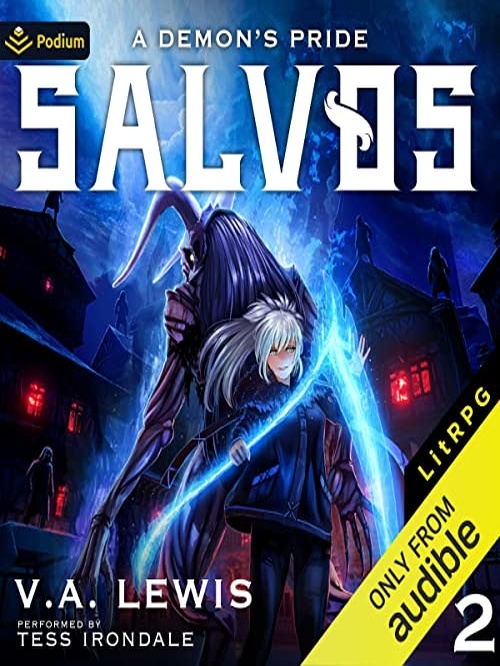
A Demon Walks Into a World That Hates Her — And Refuses to Apologize
What does it mean to be proud of what you are when the entire world has already decided you are monstrous? This is not a question borrowed from some literary fiction darling or a prestige philosophical novel. It comes, perhaps unexpectedly, from the third volume of V.A. Lewis’s Salvos series — a LitRPG web serial turned audiobook that, beneath its stat screens and level-ups, is conducting a surprisingly earnest interrogation of identity, prejudice, and the stubborn, irrational engine of selfhood.
A Demon’s Pride is not high literature. It does not pretend to be. But I find myself increasingly impatient with the assumption that genre fiction operating within progression fantasy frameworks cannot also be doing real thematic work. Lewis’s series has been building toward something, and this installment is where the scaffolding starts to reveal an actual architecture.
The Outsider Who Refuses the Mask
Salvos, our protagonist, is a Demon. Not metaphorically. Not as some edgy aesthetic choice. She is, within the world’s taxonomy, a creature from the Netherworld — alien in cognition, cheerfully sociopathic in her early appearances, and now, three books in, something far more complicated. She has earned her Gold Rank as an adventurer. She has companions she fiercely protects. And yet the world — its institutions, its people, its very System — categorizes her as an existential threat.
The tension Lewis constructs here is deceptively simple but narratively potent: Salvos cannot hide what she is forever, and she refuses to be ashamed of it. In a genre saturated with protagonists who conceal their overpowered nature for strategic advantage, Lewis flips the trope. Salvos’s concealment is not about power fantasy — it is about survival against systemic bigotry. The “pride” in the title is not vanity. It is ontological defiance.
This is where the book earns its weight. The [Cultists], the assassins, the company war she may or may not have accidentally ignited — these are competent action-adventure beats, well-paced and satisfying in the way progression fantasy demands. But they orbit a gravitational center that is genuinely interesting: what happens when a being who defines herself through growth and connection exists within a system designed to deny her both?
Progression as Philosophy, Not Just Mechanics
LitRPG lives or dies on its progression systems, and Lewis understands the contract. Numbers go up. Skills evolve. There are class advancements and satisfying power spikes. But what distinguishes A Demon’s Pride from the mechanical grind of lesser entries in the genre is that Salvos’s progression is inseparable from her psychological development. Each level gained, each new ability unlocked, is also a statement about who she is choosing to become — in a world that insists she has no right to choose at all.
I want to highlight something Lewis does quietly but effectively: Salvos’s naïveté is not static. In the first book, her ignorance of human social norms was played largely for comedy. Here, her misunderstandings carry consequences. She starts a company war through a combination of genuine confusion and an inability to process why beings would organize their economies around exploitation. It is funny. It is also, if you tilt your head slightly, a pointed observation about how normalized systems of power appear absurd when viewed by someone outside them entirely.
Tess Irondale’s narration deserves specific mention. Salvos is a character who could easily become grating — too loud, too impulsive, too relentlessly herself. Irondale threads the needle with precision, finding the vulnerability beneath the bravado, the loneliness beneath the cheerful aggression. At nearly twenty hours of audio, the performance never flags.
Where the Seams Show
I would be dishonest if I did not note the book’s limitations. Lewis’s prose, functional and clear, rarely rises to the level of memorable. The supporting cast, while likeable, tends toward archetypal rather than fully realized — they exist in relation to Salvos rather than as independent centers of narrative gravity. And the pacing in the middle third sags under the weight of sequential encounters that, while individually entertaining, blur together in retrospect.
There is also a structural tension inherent to serialized web fiction adapted into discrete volumes: A Demon’s Pride does not so much end as pause. The emotional arcs reach satisfying waypoints, but the larger story — Salvos’s search for her companion, her reckoning with the Netherworld, the world’s inevitable confrontation with what she truly is — remains deliberately, sometimes frustratingly, unresolved.
Who Should Walk This Road
This is a book for readers who have already bought into progression fantasy’s core promise — that watching a character grow stronger can be genuinely compelling narrative — and who are hungry for a series that asks why that growth matters. If you have bounced off LitRPG before, A Demon’s Pride is unlikely to convert you; it operates firmly within its genre’s conventions. But if you are already a citizen of this space, Lewis’s series represents something approaching its best self: genre fiction that takes its own premise seriously enough to find real meaning in it.
The question Salvos poses, ultimately, is one worth sitting with long after the stats fade from memory: If the world insists you are a monster, and you know you are not, how much of yourself are you willing to sacrifice to prove it? The answer this book offers — nothing, not one fragment — is, I think, more radical than it first appears.