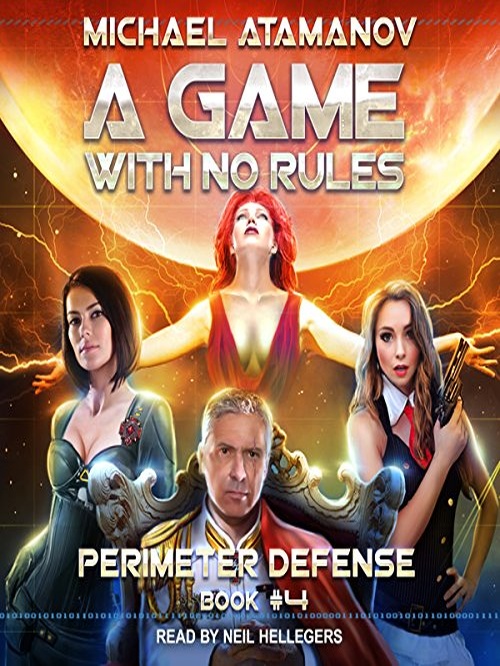
When Empires Fracture: Order, Loyalty, and the Chaos Between
There is a particular dread that comes with watching a great institution collapse—not in a single catastrophic moment, but through a slow, grinding erosion of trust, obedience, and shared purpose. Michael Atamanov‘s A Game with No Rules, the latest installment in his Perimeter Defense series, understands this dread intimately. It weaponizes it.
The Anatomy of Institutional Decay
The Empire is crumbling. Not from without—at least, not yet—but from within, as the Great Houses turn increasingly inward, their loyalties calcifying into self-interest. Atamanov constructs this collapse with a structural intelligence that elevates the book well above standard Science Fiction space opera. This is not a story about laser battles and starship maneuvers, though those elements exist. It is, at its marrow, a study in political entropy—the moment when the center can no longer hold and every peripheral power begins to sense, with animal cunning, that the apex predator has grown old.
What makes Atamanov’s framing so sharp is his refusal to assign clean moral coordinates. The Great Houses are not simply villainous. They are rational actors responding to a weakened signal. That is a far more uncomfortable truth to sit with.
Three Tensions That Define the Narrative
First, the question of coordination versus coincidence. Atamanov plants this seed early and tends it with admirable patience. Are the cascading defections a spontaneous collapse, or does an unseen hand orchestrate them? This dramatic irony—the reader suspects conspiracy while the protagonist struggles to confirm it—generates a sustained intellectual tension that rewards attentive reading. It mirrors, not incidentally, how real political crises unfold: ambiguously, maddeningly, without the clean edges that hindsight later imposes.
Second, the alien invasion as structural pressure, not mere plot device. In lesser hands, the encroaching alien threat would serve as straightforward antagonism—the external monster that forces humanity to unite. Atamanov is more sophisticated. The invasion functions as a stress test, a forcing mechanism that exposes every fracture line the Empire had papered over with ceremony and tradition. The aliens matter less as characters than as a mirror held up to human dysfunction.
Third, the traitor aristocrats—and what their betrayal reveals about belonging. The rumored alliances between influential nobles and alien forces carry genuine psychological weight. Atamanov understands that treason is rarely born of ideology alone. It emerges from accumulated grievance, wounded pride, the slow accumulation of slights from institutions that promised more than they delivered. These figures, even when condemned, feel legible.
Atamanov in the Landscape of Military Science Fiction
Situating A Game with No Rules within the broader Science Fiction tradition, one finds Atamanov occupying an interesting middle ground—neither the austere, idea-driven density of Alastair Reynolds nor the propulsive pulp of early David Weber. He writes with the pacing instincts of someone who understands serialized fiction deeply: momentum is everything, but momentum must be earned through character investment, not action inflation.
Within the Perimeter Defense series, this volume marks what feels like a genuine narrative escalation—a pivot from tactical problem-solving toward something more philosophically ambitious. The stakes are no longer merely military. They are civilizational.
Neil Hellegers’ narration, across nearly thirteen hours, serves the material well. His register carries the right blend of world-weariness and urgency, lending the political machinations a gravity that cold prose alone might struggle to sustain.
Who Should Make This Journey
A Game with No Rules rewards readers who have followed the series, though its political architecture is drawn clearly enough that a patient newcomer can find their footing. It is ideally suited for those who find their Science Fiction most satisfying when it doubles as political philosophy—when questions of governance, loyalty, and institutional legitimacy carry as much weight as the technology enabling them. Fans of Frank Herbert’s Dune, particularly its preoccupation with how power corrupts the systems designed to wield it, will recognize a kindred sensibility here.
Those seeking pure action catharsis may find the deliberate pacing occasionally frustrating. That frustration, I would argue, is the point. Atamanov wants us to feel the friction of a world that refuses to resolve cleanly.
A Final Reckoning
With a rating that places it firmly among the more distinguished entries in contemporary military Science Fiction, A Game with No Rules earns its reputation not through spectacle but through seriousness of intent. Atamanov asks a question that feels urgently contemporary: when the institutions meant to protect us reveal themselves as hollowed out, who among us is willing—and capable—of being the load-bearing wall?
The answer he offers is not comfortable. But then, the best science fiction rarely is. It holds the mirror up until we are forced to look.