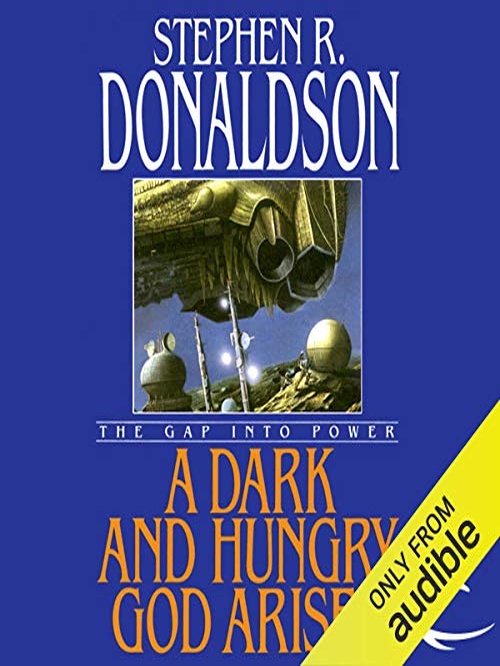
When the Abyss Stares Back: Stephen R. Donaldson’s Unflinching Descent into Power
There is a particular kind of science fiction that refuses to let you look away. It doesn’t offer you heroes to admire from a comfortable distance or villains whose darkness is neatly contained within the borders of genre convention. Instead, it grabs you by the collar and forces your face toward the mirror, demanding you reckon with the ugliness that power — political, physical, psychological — inscribes upon the human soul. A Dark and Hungry God Arises, the third volume of Stephen R. Donaldson‘s Gap Cycle, is precisely that kind of book. And I suspect that’s exactly why it remains one of the most underappreciated achievements in modern space opera.
A Cathedral Built on Moral Wreckage
By the time we arrive at this third installment, Donaldson has already laid his groundwork with brutal efficiency. The Real Story and Forbidden Knowledge established the triangulated agony between Morn Hyland, Angus Thermopyle, and Nick Succorso — victim, monster, and charming predator, respectively, though those labels shift and dissolve with every chapter. Now, in A Dark and Hungry God Arises, the stage expands dramatically. We find ourselves at Billingate, an illegal shipyard that functions as a kind of Casablanca in the void — a place where every transaction has a second meaning, every alliance conceals a betrayal, and the line between civilization and savagery has been not merely blurred but deliberately erased.
What Donaldson constructs here is nothing short of architectural. The novel operates as a kaleidoscope of competing perspectives, each chapter rotating the narrative lens to reveal how the same events look radically different depending on whose desperation we inhabit. This is not the simple trick of unreliable narration. It is something more ambitious: a systematic dismantling of the very concept of narrative authority. No single character possesses the truth. No single motive is pure. We are left to assemble meaning from the wreckage of competing agendas, much as the characters themselves must do.
The Machinery of Manipulation
One of the most striking achievements of this novel is its treatment of institutional power — specifically, the cold war between Warden Dios, director of the United Mining Companies Police, and Holt Fasner, the corporate overlord Donaldson simply and chillingly calls “the Dragon.” Their conflict operates at a remove from the visceral horrors of Billingate, conducted through bureaucratic maneuvering, coded directives, and the strategic deployment of human beings as instruments. Angus Thermopyle, once a free agent of pure predatory instinct, has been literally reprogrammed — his body and mind cyborged into a weapon whose trigger belongs to someone else.
I find this to be Donaldson’s most devastating insight in the entire series up to this point: that the difference between a criminal and an operative of the state is not moral but merely procedural. Angus was monstrous when he was free. Now he is equally monstrous, but useful. The horror is not that institutions create monsters — it is that they simply redirect existing monstrosity toward approved targets. If that doesn’t resonate with a contemporary reader navigating questions about surveillance states, corporate governance, and the weaponization of individuals by larger systems, I’m not sure what would.
Morn Hyland and the Paradox of Survival
Morn remains the gravitational center of the Gap Cycle, though Donaldson wisely refuses to grant her the narrative prominence that would allow us to sentimentalize her suffering. She is not a symbol. She is not an archetype of resilience dressed in the trappings of science fiction. She is a woman making impossible choices under impossible conditions, and what makes her compelling is precisely her refusal to be reduced to any single interpretation.
In A Dark and Hungry God Arises, her agency — such as it exists — operates in the narrow spaces between the agendas of men and institutions that regard her as a resource to be exploited. Her zone implant, that device which allows external control over her emotional and physical states, functions as one of the most disturbing metaphors in contemporary science fiction: a literalization of the ways in which autonomy can be stripped, commodified, and bargained with. That Morn continues to act within these constraints, to find leverage in the very mechanisms of her oppression, gives the novel its fragile, defiant pulse.
The Architecture of Dread
I want to speak plainly about Donaldson’s prose in this volume, because it is both the novel’s greatest asset and its most common point of contention. He writes with a density and deliberateness that some readers mistake for opacity. Sentences coil and recurve, weighted with subordinate clauses that mirror the psychological complexity of the characters they describe. This is not accidental. Donaldson is a writer who believes that form should embody content, and in a novel about the labyrinthine nature of power, conspiracy, and self-deception, the prose itself becomes a maze the reader must navigate.
Scott Brick‘s narration of the audiobook edition deserves particular mention here. At over twenty hours, this is a demanding listen, but Brick brings a gravitas and clarity to Donaldson’s intricate sentences that makes them not merely comprehensible but compelling. He differentiates the novel’s sprawling cast with precision, and his pacing — unhurried but never slack — honors the deliberate rhythm of the source material. For those who have found Donaldson’s prose daunting on the page, the audiobook may well be the ideal entry point.
The Amnion Problem
No discussion of the Gap Cycle can avoid the Amnion — the alien species whose mutagenic agenda threatens humanity with a form of extinction that is, in some ways, worse than death. The Amnion don’t want to destroy us. They want to convert us, to dissolve individual identity into their collective biology. They are, in essence, the ultimate expression of the novel’s central anxiety: that selfhood is fragile, contingent, and perpetually under siege.
What I find remarkable is that Donaldson resists the temptation to make the Amnion the primary antagonists. They are a threat, certainly — existential and implacable. But the true danger in A Dark and Hungry God Arises comes from within. It is human greed, human cruelty, human institutional corruption that creates the conditions under which the Amnion can flourish. Billingate exists because humans built it. The black market in Amnion mutagens exists because humans profit from it. The alien menace is real, but it is enabled, at every turn, by the very species it threatens. This is not a novel about humanity rallying against an external enemy. It is a novel about whether humanity deserves to survive at all.
A Reckoning with Darkness
Let me be direct: A Dark and Hungry God Arises is not a comfortable read. It is not designed to be. Donaldson has never been interested in providing the reassurances that genre fiction so often trades in — the reliable hero, the satisfying resolution, the implicit promise that good will ultimately prevail. What he offers instead is something rarer and, I would argue, more valuable: an honest confrontation with the costs of power, the fragility of moral identity, and the terrible ingenuity of human beings when it comes to finding ways to harm one another.
This third volume represents the series at its most expansive and, paradoxically, its most claustrophobic. The canvas is vast — interstellar politics, alien biology, corporate conspiracy — but the emotional register is intimate and suffocating. Every character is trapped, whether by external forces or internal compulsions, and the reader is trapped with them.
Who should read this? Those who have already committed to the Gap Cycle, obviously — this is not a standalone entry point. But more broadly, this is essential reading for anyone who believes that science fiction at its best is not escapism but confrontation. If you admire the political ruthlessness of Frank Herbert‘s Dune, the psychological extremity of Peter Watts, or the moral complexity of Iain M. Banks‘s Culture novels, Donaldson’s Gap Cycle belongs on your shelf. It is harder, darker, and less forgiving than any of them, and it is precisely that refusal to flinch that makes it unforgettable.
Here is the question I am left with, three volumes deep into this series: If every institution corrupts, and every individual is compromised, where does moral authority reside? Donaldson doesn’t answer. He simply keeps turning the screw. And somehow, impossibly, I keep reading.