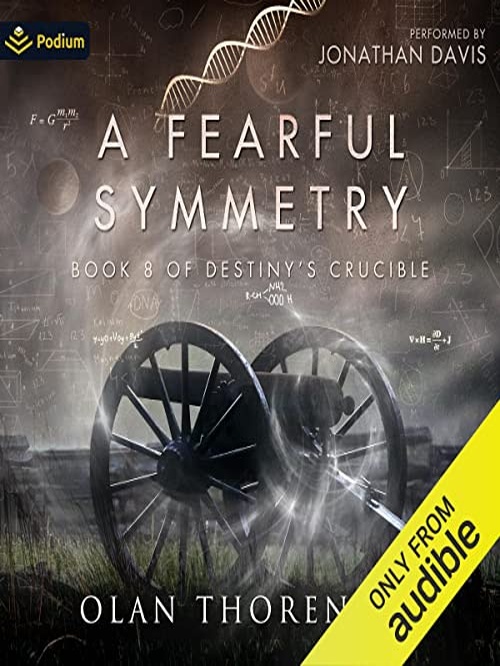
When Science Meets the Forge of Civilization: Olan Thorensen’s A Fearful Symmetry
What happens when a modern mind, armed with centuries of accumulated scientific knowledge, collides with a world still forging its way through the crucible of early industrial development? It’s a question that science fiction has toyed with before—Mark Twain’s Connecticut Yankee comes to mind—but few series have pursued the premise with the methodical, almost obsessive rigor that Olan Thorensen brings to his Destiny’s Crucible series. A Fearful Symmetry, the latest installment, doesn’t merely continue the saga; it deepens it, complicates it, and forces us to reckon with an uncomfortable truth: that progress, even when guided by the best intentions and the sharpest intellect, carries within it a terrible symmetry of creation and destruction.
The title, borrowed from Blake’s immortal meditation on the tiger—”What immortal hand or eye / Dare frame thy fearful symmetry?”—is no decorative flourish. It’s a thesis statement.
The Weight of Knowledge in a World Not Ready for It
By this point in the series, Thorensen has moved well beyond the fish-out-of-water novelty that powered the early volumes. The protagonist is no longer simply surviving; he is shaping. And that shift—from adaptation to agency—is where A Fearful Symmetry finds its most fertile thematic ground.
What strikes me most is Thorensen’s refusal to romanticize the uplift narrative. There is no triumphant montage of a grateful civilization leaping forward. Instead, we get something far more honest: the grinding, politically fraught, morally ambiguous work of introducing technologies and ideas into a society that has its own momentum, its own power structures, its own resistance. Every advancement creates winners and losers. Every innovation disrupts an equilibrium that someone, somewhere, was depending on.
This is worldbuilding not as spectacle but as argument—a sustained intellectual case for the proposition that knowledge without wisdom is not liberation but another form of tyranny.
The Architecture of Consequence
Thorensen’s engineering background shows, and I mean that as high praise. The narrative architecture of A Fearful Symmetry operates with the precision of a well-designed system: inputs lead to outputs, actions cascade into consequences, and nothing—nothing—comes free. The geopolitical maneuvering in this volume is particularly sharp. Alliances form and fracture along fault lines that feel genuinely organic to the world Thorensen has built, rather than contrived for dramatic convenience.
There’s a passage midway through the book where the protagonist confronts the realization that his interventions have accelerated not just technological capacity but military capacity—that the same chemistry that produces fertilizer produces explosives. It’s a moment of quiet devastation, handled without melodrama, and it encapsulates what elevates this series above its portal-fantasy peers: the understanding that symmetry, in Blake’s sense, is not balance but duality. The lamb and the tiger. The plow and the sword.
Jonathan Davis, narrating the Podium Audio edition, brings a measured gravitas to these moments that serves the material beautifully. His pacing mirrors the novel’s own—deliberate, unhurried, trusting the listener to engage with complexity rather than demanding constant stimulation.
Hard Science Fiction with a Humanist Pulse
One of the persistent criticisms leveled at hard science fiction is that it privileges systems over souls—that characters become mere vessels for the author’s technical enthusiasms. Thorensen is not entirely immune to this charge; there are stretches where procedural detail threatens to eclipse emotional resonance. But A Fearful Symmetry represents, I think, a maturation. The interpersonal dynamics carry more weight here. The cost of leadership—isolation, moral compromise, the slow erosion of certainty—registers with a visceral impact that earlier volumes didn’t always achieve.
The supporting cast has grown into something genuinely compelling. These are not cardboard figures arranged around a protagonist; they are people with agendas, blind spots, loyalties that shift under pressure. Thorensen understands something essential about political fiction: that the most dangerous conflicts are not between good and evil but between competing visions of good.
A Series That Rewards the Patient Reader
With a rating hovering near 4.68 across its readership, the Destiny’s Crucible series has clearly found its audience—and earned their trust. A Fearful Symmetry rewards that trust handsomely, delivering the meticulous technical detail that fans expect while pushing into darker, more philosophically demanding territory.
This is a book for readers who believe that the best science fiction doesn’t just imagine other worlds but interrogates our own. For those who find satisfaction in watching ideas collide with the stubborn complexities of human nature. For anyone who has ever wondered whether knowing how to change the world is the same as knowing whether you should.
Thorensen dares to frame the fearful symmetry. The question he leaves us with is the one Blake left us with, too: not could it be done, but who would dare?
And what, exactly, are they willing to become in the process?