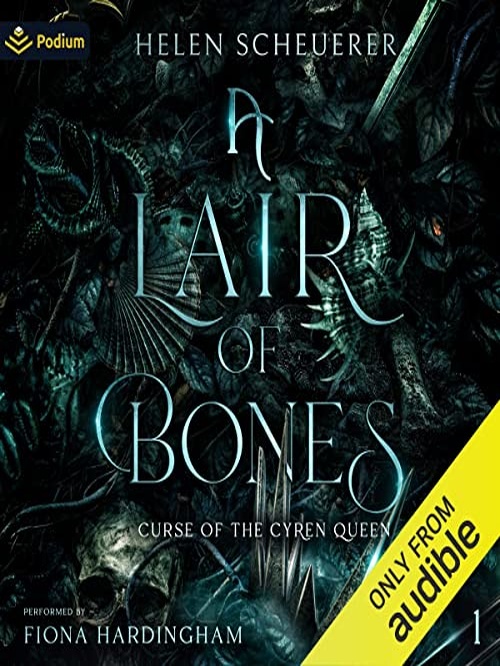
Into the Dark Below: Where Ambition Echoes Off Bone
What happens when you strip a fantasy heroine of every conceivable advantage — noble birth, political connections, even the basic respect of her own species — and then throw her into a tournament designed to kill her? Helen Scheuerer answers that question with A Lair of Bones, the opening salvo of her Curse of the Cyren Queen quartet, and the answer is more unsettling, more texturally rich, than the premise might initially suggest.
I’ll confess: I came to this book expecting a fairly standard tournament arc dressed in dark fantasy trappings. What I found instead was a claustrophobic, vertically stratified world that functions as both setting and argument — a place where geography is politics, where your altitude within a subterranean lair determines your worth, and where music carries the weight of a weapon.
The Architecture of Oppression
Saddoriel is the novel’s quiet triumph. Scheuerer constructs her cavernous fortress not as mere backdrop but as a living thesis on caste and containment. The lair operates on a vertical logic: power ascends, misery sinks. Roh, our protagonist — daughter of a criminal, bone cleaner by forced vocation — inhabits the lowest rungs of this architecture, both literally and socially. There’s something almost Dickensian in the specificity of her labor, the grime of it, the way the lair’s upper echelons remain tantalizingly abstract to someone who has only ever known the Lower Sector.
What elevates this beyond familiar chosen-one territory is Scheuerer’s refusal to make Roh’s ambition entirely sympathetic. Roh doesn’t merely want freedom or justice; she wants power. That distinction matters. It complicates every alliance she forms, every risk she takes, and it forces us to sit with a protagonist whose moral compass doesn’t always point where we’d like it to.
Cyrens, Not Sirens: The Texture of Reinvention
The cyren mythology here deserves attention. Scheuerer draws from siren lore but bends it into something less familiar — creatures bound to music and magic in ways that feel organic to the world rather than decorative. The Queen’s Tournament, the novel’s central narrative engine, leverages this mythology effectively. Each trial demands not just physical prowess but a kind of cunning that feels specific to cyren culture, rooted in deception and sonic manipulation.
Where the book occasionally falters is in its pacing through the tournament’s middle trials. There are stretches where the escalation plateaus, where the tension that Scheuerer builds so masterfully in the opening act diffuses into procedural sequences that feel more dutiful than dangerous. The labyrinthine setting — all tunnels and levels — can blur together when the narrative lingers too long without a sharp character beat to anchor us.
Yet when Scheuerer is firing on all cylinders, the prose carries a visceral, almost tactile darkness. Bones aren’t metaphorical here. They’re workplace material. They’re architecture. They’re what’s left of the losers. That materiality gives the novel a grounded brutality that separates it from more sanitized entries in Young Adult dark fantasy.
The Weight of a Name
One of the more compelling threads running through A Lair of Bones is the question of inherited identity. Roh is defined — constrained, punished, dismissed — by her mother’s crimes before she ever has the chance to commit her own. Scheuerer handles this with nuance, resisting the temptation to make Roh’s redemption arc about proving her essential goodness. Instead, the novel asks a harder question: what kind of person does systemic contempt actually produce? The answer, it turns out, is someone far more interesting than a simple underdog.
Fiona Hardingham‘s narration in the audiobook edition deserves particular mention. At over thirteen hours, the performance carries the weight of Saddoriel’s depths with a tonal range that distinguishes between the lair’s many inhabitants without ever tipping into caricature. Her Roh is sharp-edged and hungry — exactly right.
A Descent Worth Taking
A Lair of Bones is not a flawless novel. Its middle sags, some of its secondary cyrens remain more archetype than character, and the inclusion of the bonus novella A Song in the Deep — while welcome — underscores how much worldbuilding Scheuerer needs beyond the main narrative to make her mythology cohere fully.
But here’s what stays with me: this is a book that takes its own darkness seriously. It doesn’t use grim aesthetics as window dressing for a fundamentally comforting story. Roh’s world is cruel in structural, systemic ways, and her response to that cruelty is ambition untethered from moral certainty. That’s a compelling foundation for a quartet.
Perfect for readers who gravitate toward the subterranean menace of Naomi Novik‘s Scholomance series or the political ruthlessness of Sarah J. Maas‘s early work, but who crave a protagonist less interested in being liked than in surviving on her own uncompromising terms.
The question Scheuerer leaves us with isn’t whether Roh will win the tournament. It’s whether winning will leave anything worth ruling.