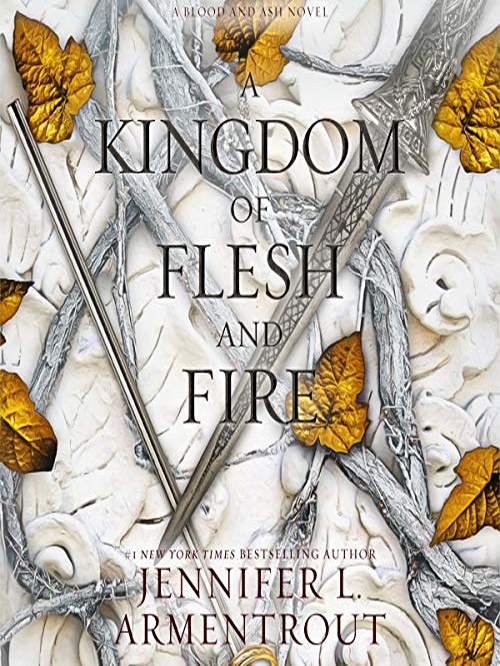
When the Veil Lifts: A Kingdom of Flesh and Fire and the Seduction of Moral Complexity
There is a particular kind of narrative tension that the best fantasy romance writers understand instinctively — the kind that does not merely ask will they or won’t they, but rather who are these people beneath the roles they’ve been forced to inhabit? Jennifer L. Armentrout, with the second installment of her Blood and Ash series, doubles down on exactly this question, and the result is a book that operates with far more psychological intelligence than its genre label might initially suggest.
The Architecture of a Necessary Betrayal
A Kingdom of Flesh and Fire opens in the wreckage of the first book’s explosive conclusion. Poppy — no longer the sheltered, ceremonially veiled Maiden — is now a captive of Casteel Da’Neer, the man she trusted and the man who deceived her. What Armentrout does with this setup is, frankly, more sophisticated than most readers might anticipate: she refuses to let either character retreat into the comfortable binaries of victim and villain.
Poppy’s interiority here is the novel’s true engine. Stripped of her religious identity, her institutional purpose, and her constructed sense of self, she must confront a question that resonates far beyond the fantasy kingdoms of Solis and Atlantia — what remains of a person when every defining narrative about them turns out to be fabricated? This is not merely a romantic dilemma. It is an existential one, and Armentrout handles it with surprising emotional precision.
Trust as a Tactical and Emotional Battlefield
The central structural gamble of this novel is its uneasy alliance between Poppy and Casteel. They must cooperate. They must not trust each other. And yet, inevitably, irrevocably, they do — in increments so carefully calibrated that the reader feels each concession as a small, private surrender.
Casteel, to his credit, is not simply a brooding love interest with good cheekbones and a dark past. Armentrout constructs him as a man fluent in manipulation who is, increasingly, unmanned by genuine feeling. His lies are seductive, yes — but it is his truths that carry genuine weight, and the novel’s most affecting passages are those quiet moments when the performative architecture of his persona cracks just slightly. The best romance, at its core, is about vulnerability. And Armentrout understands that vulnerability, in a character like Casteel, must be earned by the narrative, not simply declared.
The Political Body and the Mythological Undercurrent
What elevates A Kingdom of Flesh and Fire above its more formulaic peers in the Fantasy Romance genre is Armentrout’s sustained attention to world-building as political metaphor. The Ascended are not merely supernatural antagonists — they are an institution, a theocratic power structure built on manufactured consent and enforced ignorance. Poppy’s journey out of Solis is, at its most fundamental, a deprogramming narrative: the slow, painful dismantling of inherited ideology.
The wolven, the Descenters, the Atlantian court — each faction exerts pressure on Poppy not merely as plot mechanics, but as competing ideological claims on her identity and her body. This is a novel deeply preoccupied with the question of who gets to define a person’s worth and purpose, and it asks that question through the language of myth and monarchy with considerable thematic consistency.
Armentrout also begins, here, to unfurl the deeper mythological scaffolding of the series — the bleeding skies, the trembling earth, the slow revelation that Poppy is something other than what any kingdom has accounted for. These elements are handled with enough restraint to feel genuinely ominous rather than merely decorative.
On Pacing, Prose, and the Strategic Use of Slow Burns
No honest review of this novel should omit its structural indulgences. At over 700 pages in print form, A Kingdom of Flesh and Fire lingers — sometimes productively, sometimes not. Armentrout’s prose is not the crystalline, literary kind; it is propulsive, emotionally immediate, and occasionally repetitive in its rendering of Poppy’s internal states. Readers expecting the taut economy of, say, a Naomi Novik novel will need to recalibrate their expectations.
But within its own aesthetic logic, the pacing is largely deliberate and occasionally masterful. The slow burn here is not merely a romantic device — it is a structural argument. The novel insists that connection forged in the aftermath of betrayal must be rebuilt slowly, tested repeatedly, earned through accumulated shared experience rather than grand gesture. That is, frankly, a more mature romantic philosophy than the genre typically offers.
A Story for Readers Who Want More Than Escape
I would resist the impulse to recommend this novel to everyone, because its pleasures are specific and its demands are real. A Kingdom of Flesh and Fire rewards readers who are genuinely invested in Poppy as a psychological subject, not merely as a romantic heroine. It rewards patience with payoff. It rewards the willingness to inhabit moral ambiguity without demanding premature resolution.
This is, at its best, a novel about the terrifying freedom of an identity in collapse — and the equally terrifying possibility that the person who emerges from that collapse might choose, with full awareness, to love the man who helped destroy the old self. That is not a comfortable romantic fantasy. It is, however, a deeply human one.
For readers already immersed in the Blood and Ash world, this second volume is essential and, in many respects, superior to its predecessor in emotional complexity and narrative ambition. For those new to Armentrout’s work, begin at the beginning — the architecture of this investment requires the proper foundation.
The question worth sitting with, long after the final page: How much of who we are is the story we’ve been told about ourselves — and what does it cost to finally put that story down?