
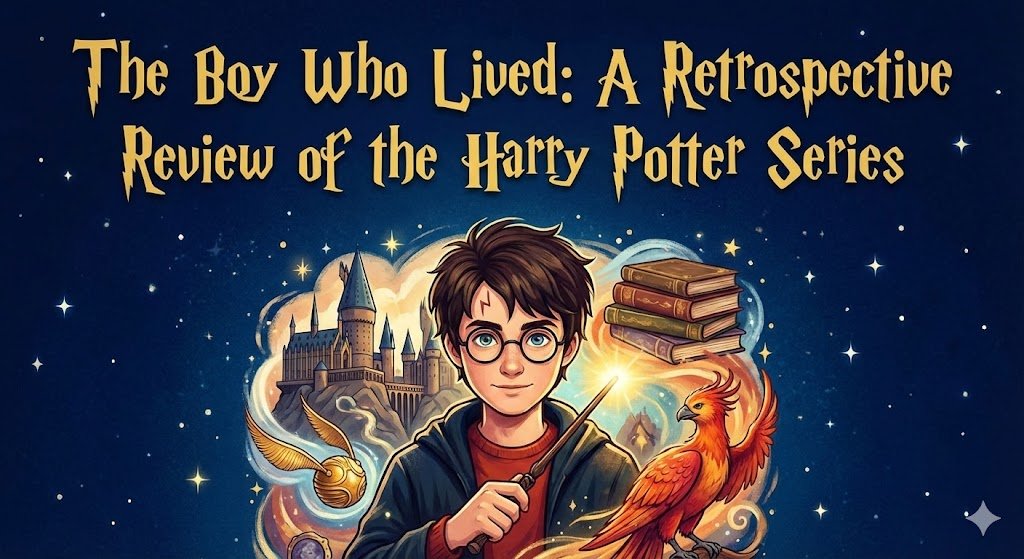
Few books have transformed the literary landscape quite like J.K. Rowling’s Harry Potter series. What began as a children’s story about a young wizard on a train to Scotland blossomed into a global phenomenon that defined a generation. But looking back, does the story of the “Boy Who Lived” stand the test of time? The answer is a resounding yes.
The Plot: A Journey from Innocence to War
The story follows Harry Potter, an eleven-year-old orphan living in a cupboard under the stairs with his abusive aunt and uncle. His life changes forever when he receives an acceptance letter to Hogwarts School of Witchcraft and Wizardry.
While the first few books (The Philosopher’s Stone, The Chamber of Secrets) serve as magical mystery adventures, the series matures alongside its protagonist. As Harry grows, the narrative shifts from whimsical boarding school hijinks to a dark, complex war against the dark wizard Lord Voldemort. It is a classic “Hero’s Journey,” but executed with such detail that it feels entirely fresh.
The “Golden Trio” and Character Depth
The heart of the series is not the magic spells, but the characters.
-
Harry Potter: He is not a perfect hero. He can be moody, angry, and impulsive, which makes him incredibly relatable.
-
Hermione Granger: Representing logic and intelligence, she proves that knowledge is just as powerful as muscle.
-
Ron Weasley: Often underrated, Ron provides the heart, humor, and loyalty that holds the group together.
Rowling also excels at writing morally grey characters. Figures like Severus Snape and Albus Dumbledore are revealed to be far more complex than they initially appear, teaching readers that the world is not simply divided into “good people and Death Eaters.”
World-Building and Themes
Rowling’s world-building is immersive. From the moving staircases of Hogwarts to the bustling streets of Diagon Alley, the Wizarding World feels tangible.
However, the true brilliance lies in the themes woven into the fantasy:
-
The Power of Love: The story consistently argues that love—friendship, parental love, and sacrifice—is the only magic Voldemort cannot understand or defeat.
-
Prejudice: The conflict between “Pure-bloods” and “Muggle-borns” serves as a poignant allegory for real-world racism and classism.
-
Accepting Death: The series deals heavily with loss, ultimately suggesting that death is but “the next great adventure.”
The Verdict
Harry Potter is more than just a children’s book; it is a modern classic. While the prose is simple in the early books, it evolves into a sophisticated narrative that explores the human condition.
Whether you are 10 years old or 50, Hogwarts offers an escape that feels like coming home. It is a story that reminds us that while we may not have magic wands, we all have the power to choose between what is right and what is easy.